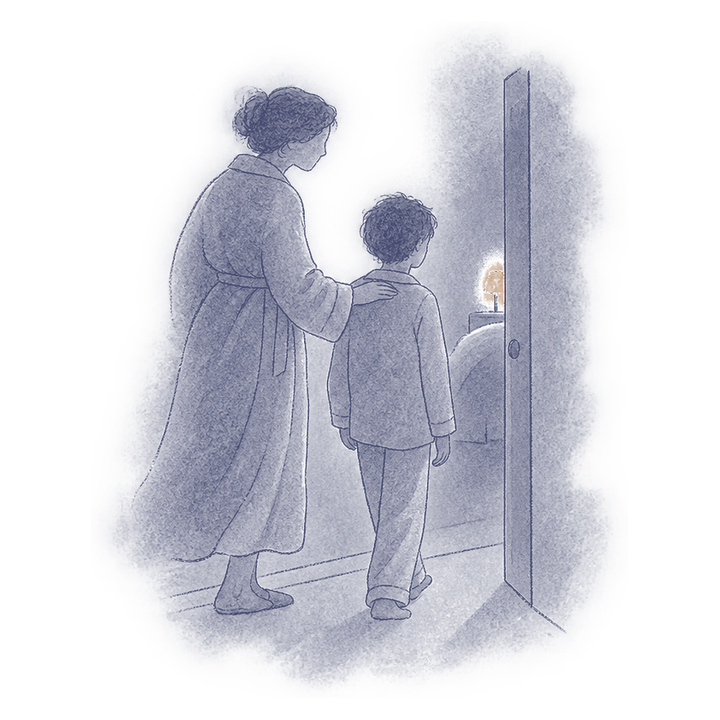
It tends to come an hour or two after bedtime, often while the adults are still up. There's a step on the landing, and there is your child, eyes open, looking straight through you. You may have asked what they were doing and got a flat, odd answer or none at all, or tried to shake them awake and met tears instead. Those open eyes are the unnerving part, because they make it look as though the person is there and choosing not to know you, when the part of them that would know you is still asleep.
That blankness is how sleepwalking usually looks. A sleepwalker usually has open eyes and a blank face and can't answer you in the ordinary way. They do routine things for a few minutes, walking about or getting dressed, and won't remember any of it24. Around five in every hundred children sleepwalk in a given year5, and most grow out of it by their teens without any treatment14. In the meantime, there's something simple you can do the next time it comes.
How can someone walk around while they're asleep?
What you met on the landing was someone walking who wasn't there. How does a body manage that while its owner sleeps? The story starts in deep sleep, the hardest sleep of the night to wake from, which is most plentiful in the first few hours. Sleepwalking begins in a partial arousal from that deep stage, typically in the first third of the night124. That's why it so often comes not long after bedtime.
So why don't they simply wake up? What I find striking is how reluctantly deep sleep lets go. Someone in light sleep comes up within seconds, but deep sleep needs a much stronger push, and even then the sleeper comes up slowly, with a strong pull back down2. That groggy, half-woken state is sometimes called sleep drunkenness, and it's close kin to sleep inertia. A sleepwalker is someone caught partway along that slow climb. The parts of the brain that drive movement have come up into something like waking, while the parts for awareness and reasoning are still in deep sleep36.
As researchers explain it, the brain's built-in programs for moving switch on while the regions for planning, judgment and memory stay switched off2. That is the whole of the strangeness you saw: a body that can walk downstairs and open the fridge, guided by nothing that could ask whether it ought to, and keeping no record of the trip. It's how car keys end up in the fridge and furniture gets rearranged2 by someone who will only learn of it the next morning, from whoever found them.
Each strand is one part of the same sleeper. Sleepwalking begins in a partial arousal from deep sleep1, and in the clearest recording, from one person during a close cousin of sleepwalking, the areas that drive movement rose to wake-like activity while the areas for awareness and reasoning stayed in deep sleep36. The wash is that gap: why someone can look awake and not know you. Back in bed, the pull of deep sleep tends to draw them down again2. Drawn from those descriptions, with no values to read off.
Drawn as an illustration of the pattern
See this as a table
| Moment | The parts that move the body | The parts that notice and remember |
|---|---|---|
| Deep sleep | Deep sleep | Deep sleep |
| Up and walking | Awake | Deep sleep |
| Back in bed | Deep sleep | Deep sleep |
Are they acting out a dream?
It can look that way, especially when someone mutters or seems to be searching for something. Most of the night's vivid, storylike dreams come later on, in REM sleep, and sleepwalking comes out of the deep sleep of the early night instead12. Doctors describe it as coming with few or no dream pictures, and as leaving part or all of the episode unremembered2.
Some adults do remember a fragment, and researchers don't fully agree on how much experience goes with an episode. In a Paris sleep clinic, researchers asked thirty-two adults with sleepwalking or sleep terrors what they recalled, both over their lives and on the morning after a night in the lab. Nine in ten could describe at least one dream-like experience they'd acted out, often an escape from some disaster, and in more than four in ten of those the scene was their own bedroom37. So the danger was close by, in the very room they were sleeping in, and they ran from it. Those scenes were simpler than REM dreams, and the sleepwalkers mostly fled, where people with REM sleep behavior disorder mostly fought back7. That's a different condition, in which vivid dreams are acted out, and it often brings people to a doctor8.
Children weren't part of the study, though, and most people, children especially, wake with nothing to remember at all2. For a parent, the useful part is this: your child came up out of deep sleep rather than the dreaming stage, so they probably aren't living out a troubled dream.
If your child screams and seems terrified rather than blank, that's likely a close cousin, the sleep terror. It begins with a sudden scream and intense fear, and it's most common in young children29. Trying to stop one tends to make it worse2.
It’s often said
You must never wake a sleepwalker, it could hurt them.
Why it can feel that way
What’s going on underneath
No clinical review or health guidance suggests that waking hurts a sleepwalker. No one has tested it in a trial, but no one has reported harm from it either. What the old rule gets right is the confusion: being pulled out of deep sleep can leave a sleepwalker more confused2, which is why the advice is to lead them back to bed, and to wake them slowly if you have to24. If they pull away or get upset, there's no need to insist or hold on, since a sleepwalker may well go back to bed on their own4.
Why is it so common in children, and will they grow out of it?
If you're wondering why your child, and why now, much of the answer is in the family and in their age. In Quebec, researchers followed nearly two thousand children from toddlerhood to age 13, and each year the mothers noted whether their child had sleepwalked. It was most common at age 109. Whether a parent had done it too made a great difference: when neither parent had ever sleepwalked, just over one in five children did at some point, and when both had, about three in five did9. A large study of Finnish twins points the same way, with genes accounting for a good share of who sleepwalks as a child310, though the particular genes haven't been found yet3.
Going by those family figures, the tendency itself is largely a matter of family and age, and it isn't caused by anything you've done as a parent, in the choices you've made or the way you run your home. A run of short or irregular nights can set off episodes in a child who is already prone to them2. Those are the nights to watch, and why some nights bring it on is worth a look. Nor is sleepwalking in a child in itself a sign of a hidden psychological problem1. Most children leave it behind on their own, and in one study it had stopped by age 13 in about three in four of them1.
-
If it's your child who sleepwalks
Most childhood sleepwalking needs nothing beyond reassurance and a safe house14, and it usually fades by the teenage years14. Since they won't remember, you might tell them about it lightly the next day, or not at all, if hearing it would only worry them. If a night in a friend's bunk is coming up, a word with the other parent about stairs and the top bunk may be all it takes.
-
If you're the one who sleepwalks
Usually you hear about it from someone else: a partner or housemate telling you the next morning what you did at an hour you can't recall. About 3.6% of US adults have sleepwalked in the past year11, and most did it as children too10. Before a night in a shared room, a hotel or anywhere new, you could lock the door and window and clear the floor4. A sleep diary24 of bedtimes, tiredness and episodes can show what sets yours off, and it's worth bringing to a doctor. Frequent sleepwalking is more common alongside depression, OCD, sleep apnea or insomnia1112, though it isn't clear which way the link runs, and the walking itself isn't a sign of a hidden psychological problem1.
Why do some nights bring it on?
Families who live with it often notice that the bad nights come when someone is overtired, which is what researchers saw when they played sounds during deep sleep to ten adults who sleepwalk and ten who don't. On a normal night, three of the ten sleepwalkers got up into an episode; after being kept awake for twenty-five hours, all ten did, while none of the people who don't sleepwalk had one213. Missing sleep makes deep sleep pull harder, so when something disturbs it, the sleeper is more likely to come up only halfway. That only happens in someone already prone to sleepwalking.
You may have noticed your own pattern: the late night, the child coming down with something, the strange bed, the noisy house. Researchers sort what sets episodes off into two kinds. Noise, pain or pauses in breathing can break deep sleep up2. Sleep loss or a body clock out of step can deepen its pull2. Either kind makes an episode more likely in someone prone to it2. Fever, stress and alcohol are often named as well, though the evidence for those comes mostly from what people report412. This is the part you can do something about. Regular bedtimes and nights long enough leave fewer of the overtired nights when episodes come213. In a large sleep-clinic series, mostly of adults, regular, sufficient sleep on its own brought partial or full relief to nearly one in five people who sleepwalked1.
How can I make the house safer on nights it might happen?
A sleepwalker moves with open eyes and no judgment, so the aim is a house where that does no harm. On nights it might happen, you could:
- keep doors and windows closed or locked24
- put a gate at the top of the stairs, if it's a child who walks24
- clear the landing and the floor of things to trip on24
- lock away knives and tools24
- keep a child who sleepwalks out of the top bunk24
If they might leave the house, a door alarm is worth fitting4, ideally one that won't blare, since a sudden noise can itself set off an episode2. None of this will stop an episode from starting, and it isn't meant to1. Its work is to make sure a walk in the night ends back in bed, with nobody hurt.
Does waking a child before it usually happens help?
If your child tends to walk at much the same time each night, you may hear of scheduled awakenings: waking the child briefly fifteen to thirty minutes before the usual time, each night for a few weeks12. A handful of small reports found that children who tried it improved, though none of them followed other children who didn't, to see what would have happened anyway. Only one trial has set it beside something else in children, and it was small, with twenty children. One group was woken on a schedule and also kept to regular sleep and meal times, while in the other the parents were given explanation and reassurance alone. Both groups improved, and the trial found no clear difference between them, though twenty children are too few to rule one out1, and the trial's author wondered whether the reassurance itself had been doing some of the work1. If you're wondering whether to set an alarm, it's low-risk, though it's been studied only in children and only in small numbers. The families given reassurance alone improved too, and if the author's hunch is right, the steady explaining you're already doing may be doing some of the work.
A closer look How do researchers know part of the brain is awake?
The clearest view so far came by chance, from one young man. A 20-year-old man with epilepsy had electrodes placed inside his brain to plan surgery, and while he was being recorded he had a confusional arousal, a close cousin of sleepwalking. His motor and cingulate areas, which drive movement, showed wake-like activity, while the frontoparietal areas that support awareness and reasoning stayed in deep sleep6.
Years earlier, a brain scan taken during a 16-year-old's sleepwalking episode had shown movement pathways active while other arousal systems were still switched off, which the authors called a dissociation between body sleep and mind sleep214. Each is one person, and a recent review notes that several kinds of evidence now point the same way3: a brain partly up and partly down, at the same moment.
For tonight, if you're still lying there listening, the timing is on your side. Sleepwalking belongs mostly to the first third of the night, when deep sleep is most plentiful12, and the same strong pull that made them so hard to reach tends to draw a sleeper back down2. The person you led back is most likely asleep again by now, remembering little or nothing of the landing or the kitchen24, and you can stop listening for footsteps and get some sleep yourself.
Sleep and rest, sleep and rest, Father will come to thee soon; Rest, rest, on mother’s breast, Father will come to thee soon;