You may have looked at it over the first coffee, before the day had properly begun. A small bar with “lower than usual” beside it has a way of following you through the morning, until a night you felt fine about starts to seem like one you somehow got wrong. And the figure jumps about: high after a night that felt poor, low after one that felt good, for no reason you can find.
The watch or ring on your hand can't see deep sleep at all. It reads your heartbeat and how you move23. It has no window on the brain waves that make sleep deep, so its number is a guess.
And your body takes deep sleep first and repays what it misses. All the hours you spent awake yesterday were building toward it1, so it comes in the opening hours after you drift off. When a night runs short of it, the body tends to make it up soon after1. That's what this morning's bar is guessing at.
What is deep sleep?
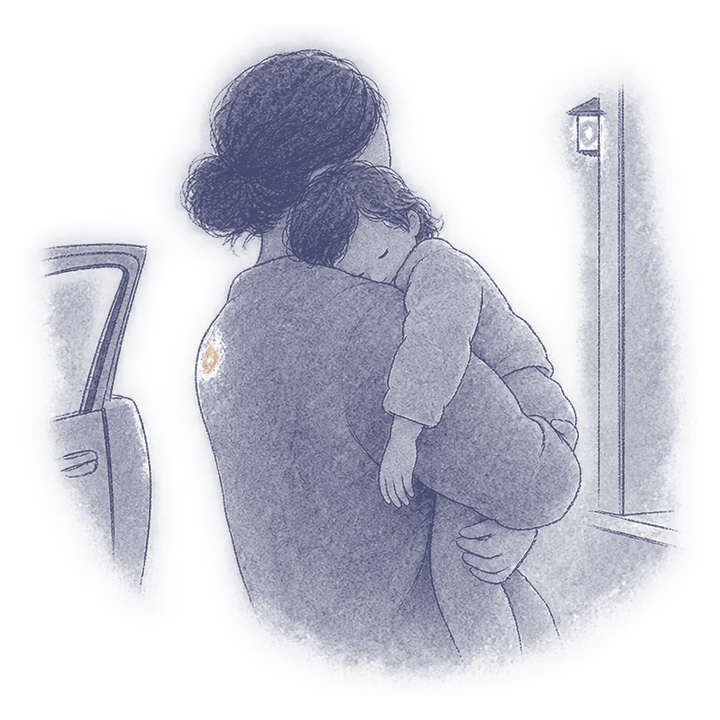
You'll know deep sleep from the outside before you ever meet it on a chart. A child lifted from the car after a long drive who hangs heavy over your shoulder all the way up the stairs is deep in it. Children get more of it than they ever will again: deep sleep is at its fullest before puberty14. And if a phone has ever woken you near midnight and left you for a few long seconds not knowing where you were, that thick, slow climb back to waking is sleep inertia. It's usually worse when you're pulled out of deep sleep than out of lighter sleep5.
What's going on in a brain that's so deeply asleep? You can see it in the brain waves. Deep sleep is the deepest stage of non-REM sleep, and researchers also call it slow-wave sleep1, because the brain's activity gathers into slow, large waves that roll like a swell. It's the hardest stage to wake from. Its depth rises smoothly as slow waves build, and the more of them there are, the stronger a sound it takes to wake you6. There's no sudden step where deep sleep begins: scorers draw that line for convenience. The full tour of a night, light and deep and REM, is in What happens while we sleep?.
A closer look How does a sleep laboratory decide a stretch is deep sleep?
Scorers read the night's brain-wave recording thirty seconds at a time. They count a stretch as deep sleep, which they call N3, when at least a fifth of it is filled with slow waves of half a cycle to two cycles a second, at least seventy-five microvolts high16. That fixed height matters later in life, because brain waves grow smaller with age.
Researchers have measured the grogginess, too. In one study they tested people on a task before a nap, then woke them from it and tested them again. Those woken from slow-wave sleep did forty-one percent worse than before they slept5. Those woken from lighter stage 2 sleep did about as well as people who had stayed awake5. Not every study has found so clear a difference. Still, when a call near midnight leaves you slow and thick-headed, being pulled from deep sleep is the usual reason.
Why does deep sleep come early in the night?
From the moment you wake, a pressure for sleep starts to build, and slow-wave activity rises steadily with it through the waking day1. Once you're asleep, your body spends that pressure as deep sleep. The first non-REM cycle of the night has the most slow-wave activity, and each cycle after it has less17. By early morning there's little left to spend.
But is it really the hours awake, or the time of night? Researchers tested that with an odd month. Eight people lived for more than a month without clocks or daylight, on a twenty-eight-hour day. Their sleep drifted round the clock until it had fallen at every hour of the twenty-four in turn. Whatever the clock said, slow-wave activity was high at the start of every sleep and fell across it1. Their deep sleep kept count of how long they'd been up and took almost no notice of the hour.
A nap fits the same arithmetic. One in the late afternoon or early evening spends some of the pressure, so there's less deep sleep early that night1.
What happens to deep sleep after a short or broken night?
Say last night ran short, or broke in the middle and you lay awake for an hour. Is the deep sleep you missed simply gone?
The experiments say it comes back. In one, nine people stayed awake for thirty-six hours. When they finally slept, their slow-wave activity started well above its usual level and came back down to normal only in the second half of a sleep that could run past twelve hours1.
A whole lost night is far beyond an ordinary poor one, so researchers also tried something smaller. They played sounds through the night to keep small groups of young adults out of deep sleep. The body made it up later that night, or on the next night if the sounds had gone on all night1. How much deep sleep these people got depended more on how much they'd had recently than on how long they slept1. What the body missed, it took back in the next sleep it got.
These were laboratory nights, some lost entirely and some deliberately broken, and they aren't the same as the ordinary uneven nights a tracker records. Still, the experiments all point one way. After one of your own nights with less deep sleep, more of it is likely to follow, whether or not you go to bed early.
From breakfast on through all the day At home among my friends I stay; But every night I go abroad Afar into the land of Nod.
What does deep sleep do for me?
While you're deep asleep, your body releases growth hormone at its fastest rate, and your nervous system shifts toward its resting side1. Your brain is busy too. During slow-wave sleep it replays what you learned recently, which is thought to help move it into long-term memory8.
One experiment caught that replay with the help of roses. Young adults learned where pairs of cards lay while the scent of roses hung in the room. That night, while they were in slow-wave sleep, the researchers brought the scent back. The next day they remembered more card locations, without knowing the roses had been there at all8. A smell they didn't notice seems to have sent the sleeping brain back over the cards.
Those were memory tasks in a laboratory, in young adults. And taking deep sleep away has told researchers less than you might think. When they suppress only deep sleep and leave the rest of sleep alone, the effects on the next day have been unclear, and the effects they found have often been put down to broken sleep in general1. Most of those studies were small. Deep sleep does real work, and the evidence doesn't single it out as the one stage that restores you while the rest of the night, REM sleep included, is something to spare.
It’s often said
Deep sleep is when the brain washes itself clean, so too little of it does harm
Why it can feel that way
It's a vivid picture, and it came from a real study. In 2013, in live mice, the spaces between brain cells widened by about sixty percent during sleep, fluid moved through them faster, and β-amyloid, a protein linked to Alzheimer's, was cleared faster9. The finding was widely reported, and once you've read it, a short deep-sleep bar is easy to see through it.
What’s going on underneath
The picture comes from mice, and so does the strongest challenge to it. A 2024 study measured clearance directly. It found clearance was markedly lower during sleep and anesthesia, and the pathways and mechanism are still disputed10. Neither study can tell us what deep sleep does in a human brain.
The nearest human evidence comes from the Framingham study. People over 60 slept in a laboratory twice, about five years apart, and researchers then followed them for seventeen years. Those whose deep sleep fell faster over those years were more likely to develop dementia11. That's an association: the researchers watched people's sleep without changing it. And deep sleep also fell faster in people with a genetic risk for Alzheimer's, so the role of deep sleep in dementia remains uncertain11. None of this work speaks to one night's reading on a ring.
How much deep sleep is normal?
Forty minutes is inside what's usual: near the lower edge for people in their twenties, and inside the usual range for many people older than that. In young adults, deep sleep usually makes up between ten and twenty-five percent of the night's sleep1. Over seven or eight hours, that comes to very roughly forty minutes to two hours. Later in life the share runs lower, because deep sleep lessens with age14.
One sleep laboratory gives a closer view of young sleepers. Thirty-four healthy adults in their late twenties spent eight hours in bed on each of three nights. They averaged somewhere between about sixty-three and eighty-two minutes of deep sleep a night2, and their nights varied widely around that, from one night to the next and from one person to another2. Those minutes describe young people in a laboratory. They aren't a target for you, and there's no fixed number of minutes everyone needs.
Why would two healthy people the same age differ so much? Part of it seems to be who they are. People of the same age and sex differ a good deal in how much deep sleep they have, and the difference stays steady over time, like a trait, partly written in their genes1. Your own level may simply run lower than a friend's, and stay there. What you take at night can play a part as well: common sleeping pills, zolpidem among them, reduce deep sleep1.
Why is my deep sleep lower than my partner's?
If your partner is younger than you, age is probably much of the answer. Deep sleep is at its peak before puberty and declines from then on, and age has one of the largest effects on it of anything that shapes sleep, even in healthy people with no sleep problems14. The thinner deep sleep of later life doesn't seem to make people sleepier by day, either: older people fall asleep less readily in the day than young people do1.
How steep is the fall? One study shows it in men. Researchers gathered the sleep recordings of 149 healthy men from four laboratories, the youngest in their teens and the oldest in their eighties, none with sleep complaints. Slow-wave sleep fell from about nineteen percent of the night in the youngest men to about three percent in men aged 36 to 50, with little further fall in the decades after12. Scorers read those nights by eye, with a rule that can miss smaller waves6, so that three percent may undercount; the closer look below explains why.
Your body still makes up a short night as you get older. It does so less strongly: older adults show a weaker rebound after lost sleep than younger ones7.
And the years don't treat everyone alike. Take the Framingham sleepers from earlier: between their two laboratory nights, how far their deep sleep fell varied a lot from person to person: it fell further in some than in others, and in some it changed little or not at all11. So the lower bar beside your partner's is partly the years between you and partly who you are. There's more on the wider changes in Why does my sleep change as I get older?.
A closer look Is some of the fall with age in how it's scored?
It may be, and it's one of the more interesting open questions in sleep research. Over the years slow waves grow smaller and fewer, most of all over the front of the brain and in the first one or two cycles of the night7. Scorers count a wave as slow only when it reaches a fixed height of seventy-five microvolts. Where did that number come from? The mark was set mostly from recordings of young men, and the manuals never explained why it was chosen6. Some of an older sleeper's slow waves miss it and get scored as lighter stage 2 sleep6.
When researchers scored nearly three thousand recordings again by other methods, the fall with age in men was still there6. The gap between men and women looked different. Scored the usual way, men over 70 had less than a third of the deep sleep of women their age7. When the researchers counted slow waves by their speed instead, women's deep sleep came down with age to a level comparable with men's6.
Researchers still disagree about what this means. As the evidence stands, the fall with age looks real, since it survived the rescoring. Its size in scored minutes may be overstated, and the rule itself may account for much of the gap between older men and women.
What is my tracker measuring?
What you wear is a small light that reads your pulse through the skin and a sensor that feels you move. From these it estimates your sleep stages, using your heartbeat, including the small variations between beats, and your movement23. The brain waves that define deep sleep are recorded only in a sleep laboratory23. What reaches you in the morning is a guess built from your pulse and your stillness.
How good a guess? When researchers set trackers beside a sleep laboratory's brain-wave recording, most of them missed between thirty and fifty percent of the deep sleep that was there2, and they usually called it light sleep2. Even the best one matched the laboratory only on average. On a single night it could be about an hour too high or too low2.
Those were models from 2018 and 2019, and newer ones may do better. In a 2023 study at Korean sleep clinics, the Pixel Watch and Fitbit Sense 2 did best at spotting deep sleep, and the Oura Ring 3 improved on earlier versions3. Even so, the best devices agreed with the laboratory less well on deep sleep than on REM3. That's a single study, and its authors have ties to a company that makes a sleep app.
After an evening of drinking, your bar may come up tall even on a morning you woke feeling rough. Alcohol tends to add deep sleep in the first half of the night and disrupt sleep in the second13, so the bar can look good after a night that wasn't. Does alcohol help you sleep? goes into it.
Each ring is the deep sleep a sleep laboratory counted from brain waves, averaged over the nights a device was worn. The dot is that device's own average for the same nights, and the line runs from its lowest to its highest likely reading of a single such night2. Along the lit line, the same night could show up as a few minutes or as more than two hours.
Worked out from the figures in the studies cited
See this as a table
| Device | Counted from brain waves, on average | The device's average reading | Where one night's reading could fall |
|---|---|---|---|
| Fitbit Alta HR, 49 nights | 81 minutes | 75 minutes (6 lower) | 7 to 143 minutes (74 too low to 62 too high) |
| Garmin Fenix 5S, 29 nights | 63 minutes | 69 minutes (6 higher) | 10 to 128 minutes (53 too low to 65 too high) |
A closer look How was the tracker test done?
The independent test came from a sleep laboratory where thirty-four healthy adults, about 28 years old on average, slept three nights each2. They wore a Fitbit Alta HR and two Garmin watches, with three more devices beside the bed, all from around 2018 and 2019. The researchers deliberately disrupted one of the three nights, so the trackers met broken sleep as well as ordinary sleep. They recorded every night's brain waves too, and used those as the true count. The devices tended to do worse on the broken night, mostly at telling sleep from waking, and for deep sleep their errors were large on every night2.
The Fitbit came closest on deep sleep. Across forty-nine nights its average was only about six minutes below the laboratory's, yet on any one night its reading could fall anywhere from about seventy-four minutes too low to about sixty-two too high2. The other devices' single-night ranges were of similar width, from the Garmin Fenix 5S's somewhat narrower one to much wider2. They didn't all err the same way: three of the six that reported stages counted too much deep sleep2. Everyone in the test was young, and nobody yet knows how the devices fare with older sleepers.
Can I get more deep sleep?
An earlier bedtime or a longer stretch in bed would be expected to add little. The sound experiments showed why: deep sleep tracks what you've had lately more than the hours you spend asleep1. The things that do shape it are already part of your day. The hours awake build it. A late-afternoon or evening nap spends some of it1. And a single bout of exercise adds a small amount of slow-wave sleep that night14.
Maybe you've tried a cooler room, magnesium or an app of pink noise to lift the figure. If it didn't budge, or jumped about regardless, that's about what you'd expect from a guess that, on any one night, scatters widely around the true count2.
Headbands and apps sold to raise deep sleep by playing sounds into it have thin evidence behind them. In the laboratory systems they borrow from, the memory benefit shrank as more studies came in, and about a third of people could hear the sounds15. And the headbands and apps sold for home use weren't part of the studies15.
-
If you feel fine and it's only the number that bothers you
-
If you're tired most days and wonder if this is why
The deep-sleep figure is a poor guide here, partly because of how trackers measure it and partly because taking away deep sleep alone has had unclear effects on the following day1. For tiredness that lasts, a better place to start is how much sleep you're getting, which How much sleep do I really need? covers, and the causes in Why am I still tired after a full night's sleep?.
What the research says
- Deep sleep is defined by slow, large brain waves that only a brain-wave recording can see. Well established
- How much deep sleep you get is set mainly by how long you've been awake, so it gathers in the first cycles of the night. Well established
- After lost sleep, deep sleep comes back stronger the next time you sleep. Well established
- Deep sleep lessens from childhood on, and the fall is seen in healthy people. Well established
- Deep sleep helps move recent learning into long-term memory, at least for laboratory tasks. Good evidence
- In tests of 2018–19 models in healthy young adults, consumer trackers often missed a third to a half of deep sleep, and a single night's figure could be about an hour out. Good evidence
- People differ widely in how much deep sleep they have at any age, and the differences are partly genetic. Good evidence
- Studies disagree about whether sleep speeds the clearing of waste from the brain, and the work so far is in mice. Still debated
Most of the laboratory work is in healthy young adults, and how large the fall with age is in scored minutes, like much of the gap between men and women, is still debated because of how slow waves are measured.
Questions people ask
Is forty minutes of deep sleep too little?
Probably not, taken on its own. In young adults, deep sleep usually makes up ten to twenty-five percent of the night1, which puts forty minutes near the lower edge. It declines with age14, so for many older people forty minutes is inside the usual range. And people of the same age differ a good deal in how much they have1.
Does an afternoon nap cost me deep sleep?
It can, if it's late in the afternoon or early evening. A nap then spends some of the day's sleep pressure, leaving less deep sleep early that night1. There's more in Are naps good for you?.
Does exercise give me more deep sleep?
A little, it seems. A review of sixty-six studies found a single bout of exercise brought a small increase in slow-wave sleep that night14, mostly in healthy adults.
So when the bar comes up again tomorrow over coffee, you'll know what it's guessing at. Your deepest sleep came first, in the hours just after you fell asleep. Tonight, after a full day awake, those first hours are likely to be the deepest of the night again, whatever this morning's number said.