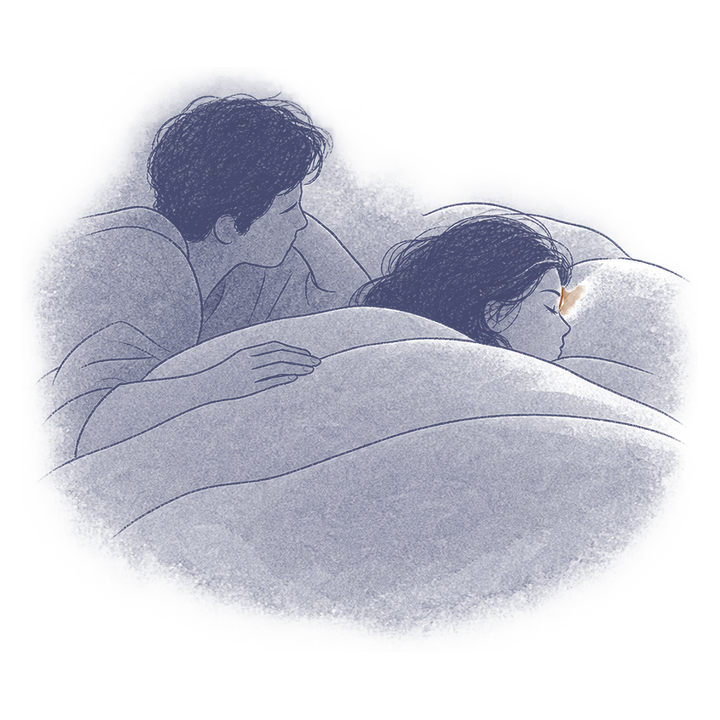
All through those hours you were on the move. You went down into sleep and came back up, several times over, without ever quite knowing it.
Each trip begins in lighter sleep. From there you sink into deep sleep, where the brain's waves grow slow and large. After a while you rise into REM sleep, when the eyes dart under the lids and the most vivid dreams come. Then you drift up almost to waking before setting off down once more. Each of these rounds is a sleep cycle, and a night usually has four to six of them12.
The rounds aren't copies of one another. The first ones go deepest and stay down longest, and as the hours pass the deep stretches shrink and REM takes over3. By early morning you're in a lighter, dream-filled sleep, quite unlike the sleep you fell into at midnight. Between the rounds you come up close to waking, at the seams where one round ends and the next begins. Inside the rounds the brain stirs too, for a few seconds at a time and far more often4.
What are the stages of sleep?
You probably know light sleep from the inside. It's the drifting doze a small sound can lift you out of, and the night spends more time there than anywhere else. Sleep labs split it into two stages, the N1 and N2 you may see on a sleep report, and count deep sleep as a third, N3; together they make up non-REM sleep1. N2 alone fills almost half of an adult's night3. It's the ground you cross on the way down to deep sleep and back again.
If you've lain beside someone in the first hours of the night, you'll have heard what comes next: slow, even breathing that hardly changes. All through non-REM sleep the nervous system's resting side is in charge. Breathing slows and steadies, and blood pressure falls about a tenth below its waking level5. In deep sleep the brain's waves turn slow and large3, but the work isn't only in the head. Deep sleep is when the body releases the most growth hormone6.
REM is the strangest of the stages. Inside the brain it looks much like being awake, with quick, small brain waves and bursts of rapid eye movements3. Out in the body, the muscles are largely paralyzed, and breathing and blood pressure turn irregular5. It comes back several times a night.
Of the three states, REM stands apart twice over, with brain waves that look the most like waking and a body that is the stillest of all. The traces are sketched on one scale from descriptions of sleep-lab recordings3 rather than from anyone's own night, and the body beneath follows a review of how breathing and blood pressure change in sleep5.
Drawn as an illustration of the pattern
See this as a table
| Stage | Brain waves | Muscles | Breathing |
|---|---|---|---|
| Light sleep N1 and N2 | Small, with brief flickers of activity | Tone lowered | Slower and steady |
| Deep sleep N3 | Slow and large | Tone lowered | Slower and steady |
| REM sleep Rapid eye movement | Fast and small, much like waking | Largely paralyzed | Irregular |
Why does deep sleep come early in the night and dreaming late?
Two different rhythms shape the night, and they keep different hours. Deep sleep answers mostly to how long you've been awake6, so after a full day there's plenty of it waiting. In the first cycle it builds fast and runs deep, then eases off shortly before REM. Each time you go back down, it builds a little more slowly and peaks a little lower. Cycle by cycle, the sleeping body is working off the need the day built up.
REM keeps the body clock's time instead. It follows the same inner rhythm that sets your body temperature, and it peaks an hour or two after your temperature reaches its lowest point, close to the time you usually wake6. So the two cross over in the dark. Deep sleep thins as its need is met, while REM's stretches grow longer and more intense3 as morning nears. The last hours of a night are a different kind of sleep from the first.
The ninety minutes is an average. When researchers pooled the sleep-lab recordings of 205 healthy adults, a typical cycle fell within about twenty-five minutes either side of ninety, and some ran further out still2. With that much spread, ninety-minute blocks are too loose a measure to count on when setting an alarm.
Is it normal to wake up between cycles?
It is. Now and then you may catch yourself half-awake, shifting the pillow and going under again before you've properly woken. Far more often it happens without your knowing. Many times an hour the sleeping brain tips toward waking, a shift in its waves that mostly lasts a few seconds4 before it slips back. In one sleep lab, healthy adults aged 18 to 30 had about eleven of these arousals in each hour of sleep4, and the number climbs as the years go by. If you've come here from Why do I keep waking up at 3am?, this is the same night seen from further back, across the whole of it.
Fuller wakings come in the night too, and many of them seem to be gone by morning. Where do they go? One small sleep-lab study offers a reason. The researchers played word pairs to people as they drifted off. Those allowed ten minutes of sleep could barely recall the pairs played three minutes before they dozed off7. Those woken after only thirty seconds of sleep showed little or no such loss. The study looked at falling asleep at bedtime, so applying it to wakings in the night is a guess, though a reasonable one. Each time you slip back under, sleep probably takes the last few minutes with it, and the waking goes unrecorded.
Does the brain switch off when we're asleep?
It’s often said
Sleep is the brain switching off for the night.
Why it can feel that way
From the inside, a night is a blank. You remember lying down and you remember the morning, and nothing in between seems to have happened at all.
Some people sleep through a thunderstorm and still stir at a small sound: their own name, a familiar voice in the next room, a stranger's voice they weren't expecting. One small study shows what the brain is doing underneath. Seventeen healthy sleepers spent the night in a sleep lab while the researchers played them names, spoken in voices they knew and voices they didn't. Their brain responses still told the voices apart in every stage, deep sleep and REM included8, and the unfamiliar voices drew the larger response. The sleepers slept on through all of it. Only the recordings of their brain waves showed them listening.
Perhaps you've spent a first night in a hotel or a friend's spare room and slept worse than you do at home. Why would a strange room keep part of you up? A small set of lab experiments with thirty-five young adults suggests an answer. On their first night in the lab, the left half of the brain slept less deeply than the right9. When an unexpected sound played, the left half answered more strongly, and the sleepers came awake faster. By the second session, about a week later, the two halves slept alike again. The researchers read this as a night watch: one half of the brain kept on duty in a place it doesn't know yet, standing down once the place grows familiar.
A closer look How did researchers find one half of the brain keeping watch?
The study ran three experiments with thirty-five young healthy adults in all9, around a dozen in each, who slept in the lab for two sessions about a week apart. The researchers measured the depth of slow-wave sleep in each half of the brain separately. In some experiments they also played occasional odd tones among regular ones, to see which half reacted and how quickly the sleeper woke. Of the arousals those tones set off on the first night, more than eight in ten came through the left half.
The researchers measured only the first sleep cycle of each night, so the findings describe the start of a first night in a new place.
What's happening when someone's eyes move under their lids?
If you've lain awake near morning beside someone, or looked in on a sleeping child, you may have watched their eyes flicker and dart under closed lids. That's REM sleep seen from the outside, and the hours before dawn, when REM runs longest, are when you're most likely to catch it. Their body stays still while it happens, its muscles largely paralyzed5, even as the brain inside runs fast.
Are they dreaming? The first researchers to study REM wanted to know the same thing, so they woke sleepers in the lab and asked. Seventy-four percent of the people woken from REM reported a dream, against seventeen percent of those woken at other times10. Later researchers asked a looser question, what had been going through their minds, and people woken from non-REM sleep often had something to describe10. In the early morning hours, those non-REM dreams can be impossible to tell apart from REM ones.
If you've ever been shaken awake from deep sleep, you know the thick, stumbling confusion of it. Coming out of a vivid dream at dawn feels quite different. That groggy spell, sleep inertia, is worse when you're woken from deep sleep, and coming up out of REM leaves the body readier to move11. So the stagger at midnight and the clearer waking at dawn are two kinds of waking, from two kinds of sleep.
What is each stage of sleep for?
The firmest answer is about what you learned during the day. Sleep helps you keep it, and the evidence for that is solid. How the brain manages it is a livelier question. The leading account has the sleeping brain replaying memories in deep sleep and moving them into long-term storage, with REM perhaps helping to steady them3. It's a striking picture, the day run back through while you lie there knowing nothing of it. Researchers still argue over how the work divides between the stages.
You may have read that sleep washes waste out of the brain. Researchers don't agree about that yet. In 2013 one team found that mice cleared waste faster during sleep12. In 2024 another team found clearance in mice was markedly reduced13. Both studies were in mice, so neither can say what happens in a sleeping person, and for now the question is open.
What the research says
- A night runs in cycles, usually four to six of them, averaging about ninety minutes each, though the length varies from cycle to cycle and person to person. Well established
- Deep sleep gathers in the first half of the night and REM sleep in the second. Well established
- Brief arousals happen many times an hour through healthy sleep, and grow more frequent with age. Good evidence
- Sleep helps us keep what we've learned, though how the work divides between deep sleep and REM is still argued. Good evidence
- Small lab studies suggest the sleeping brain still tells familiar voices from unfamiliar ones, and keeps half a watch on a first night somewhere new. Early evidence
- Whether deep sleep and REM take up less of the night with age: two large reviews disagree. Still debated
- Whether sleep washes waste from the brain isn't settled yet, as two studies in mice found opposite results. Still debated
- Consumer trackers tell sleep from waking well and miss much of deep and REM sleep. Good evidence
Most of what's known about the stages comes from healthy adults sleeping in laboratories, and nights differ from person to person, with genes accounting for about half of that difference3.
Does the pattern change as we get older?
If you're older, you may have noticed your nights are more broken than they used to be, with more wakings in them. That's the part researchers agree on. Across many sleep-lab studies of healthy adults, each decade added about two brief arousals an hour and about ten minutes awake14 after first falling asleep.
Whether deep sleep and REM take up less of the night with age is less clear. Two large reviews have come to different answers. One found that both shrank15, and the other found no real change14. Part of the gap may come from how carefully each screened its people for health problems, and how it scored their sleep. Why does my sleep change as I get older? follows all of this further.
Whichever review turns out closer to the mark, a night broken by more brief wakings is the usual kind of night in later life.
What can my sleep tracker tell me about my stages?
In the morning your phone lays out the night as a row of bars, light and deep and REM. How far can you trust them? Trackers are good at telling when you're asleep and when you're awake. They're much less sure about which stage you're in. When researchers tested seven consumer devices from 2019 and 2020 against full sleep-lab recordings in healthy sleepers, most missed thirty to fifty percent of deep and REM sleep, usually labeling it light sleep16. Every one of them counted too much or too little light sleep. Newer models weren't part of the test.
The lab's own chart is a human drawing of the night as well. Brain activity shifts smoothly from one state to the next rather than stepping between stages, and trained experts scoring the same recording agree only about eighty percent of the time26. So the colored bars on your phone are best read as a rough sketch of your night's shape, deep stretches early and REM late. A morning chart that shows little deep sleep may come from a night with deep sleep the device didn't see.
I swear they are averaged now—one is no better than the other, The night and sleep have liken’d them and restored them. I swear they are all beautiful, Every one that sleeps is beautiful, every thing in the dim light is beautiful, The wildest and bloodiest is over, and all is peace.
So the night you can't remember had a shape all along. It began with a few long dives into slow, heavy sleep, while your body worked off the day behind you. Then came lighter rounds that rose nearer to waking, each ending at a seam where you almost woke and let it go. Toward morning came the long stretches of REM, the eyes moving and the dreams running on. When you wake from a vivid dream at dawn, you're coming up from the part of the night that belongs to morning, the same part everyone still asleep around you is in now.