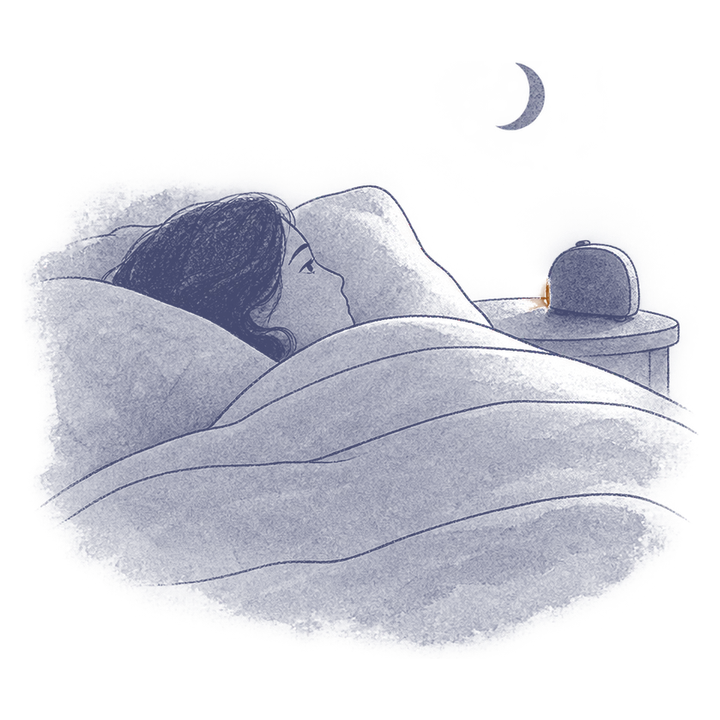
You come to, and before you've decided anything your eyes have found the clock, or your hand the phone. Then the sum begins, how many hours are left and how the morning will feel, and within a minute or two you're properly awake. If that's where you are now, there's one small thing you could try first, and the why of it can wait until you want it.
The point is to give the minute after waking something to do, because that minute is the part of the night you can change. With the time unknown, there's no sum of hours left to work out. It can't make sleep come on cue, and if your mind wanders off the path, you can pick it up again wherever you left it.
If a long while passes and you feel restless or cross rather than drowsy, it often helps more to get up for a little while, and getting up when you can’t sleep explains when and how.
Is it normal to wake up in the middle of the night?
A night's sleep runs through a cycle of lighter sleep, deep sleep and REM sleep, the sleep where most dreaming happens. That cycle comes round four to six times, each one lasting about ninety minutes4 on average. At the seams between cycles we tend to wake briefly, and healthy adults generally don't remember all2 of these wakings by morning.
Researchers in one sleep laboratory recorded a night's sleep in healthy adults with no sleep apnea. They counted every brief waking, even the ones far too short for the sleeper to notice, and found about twenty-two a night in people aged 18 to 30, rising to about forty-two in people aged 51 to 705.
The wakings people remember tend to be the longer ones. In one small study, people needed to be awake for about four minutes2 on average before they remembered a waking the next morning, and that varied a lot, from thirty seconds for some people to ten minutes for others. The study didn't record what filled those minutes, so what follows is a likely reading rather than a result: a waking spent on clocks and sums and plans probably runs long enough to be remembered, and one with nothing much to think about is more likely to slip away. That's why the minute after you wake, and the few after that, seem to matter so much.
Why does it happen in the early hours and not just after I fall asleep?
By 3am your body has already spent most of its deep sleep. Why spend it first? Deep sleep tracks how long you've been awake. After a full day your need for it is greatest as you drop off, and the first cycles of the night use up most of it1. Each cycle after that takes longer to reach deep sleep and doesn't go as deep. Meanwhile your body clock times REM sleep, which grows more plentiful toward morning16. By the small hours you're sleeping lightly and dreaming more, and a waking you'd have slept through at midnight may wake you properly.
Age adds to this. In the same laboratory that counted those wakings, deep sleep made up nineteen percent of the night in the youngest group and three percent in the oldest5. People with less deep sleep tend to wake more often1, and that may be part of why these early-morning wakings grow more familiar with the years.
Follow the line from left to right: the dips into deep sleep grow shallower, the stretches of REM sleep grow longer, and the seams between cycles climb higher until one breaks through in the small hours. The shape is an illustration drawn from four to six cycles of about ninety minutes4, deep sleep spent early1 and REM sleep most plentiful toward morning16. Real nights are less tidy, and differ from person to person.
Drawn as an illustration of the pattern
See this as a table
| Cycle | About | Deep sleep | REM sleep | Where it ends |
|---|---|---|---|---|
| First | 11pm to 12:30am | The most | Short | Sleep carries on |
| Second | 12:30am to 2am | Less | Short | Rises near the surface |
| Third | 2am to 3:30am | A little | Longer | A brief waking |
| Fourth | 3:30am to 5am | Hardly any | Longer | A brief waking |
| Fifth | 5am to 6:30am | Hardly any | Longest | A brief waking |
| At | What |
|---|---|
| About 3:30am | A waking you might catch |
Why is it the same time every night?
Two rhythms keep good time here. Your sleep cycles run at much the same pace from one night to the next, and so does the body clock that times REM sleep1. So if your bedtime is steady, the lighter stretches of the night tend to come round at the same hour too.
Noticing adds to it. People who sleep badly often check the clock through the night7, and a time you've seen on three nights running is easy to recognize on the fourth. Nobody has tested this directly. Still, the likeliest explanation for the punctuality is the regular shape of your own nights, made visible because you happened to look.
It’s often said
Waking at 3am is a cortisol spike, or the liver's hour, or a sign of something
Why it can feel that way
You wake and check: 3:07 again, the same minute as last night and the night before. Punctuality like that is uncanny. An explanation with a reason attached, a hormone or an organ or a meaning, makes the hour feel less random.
What’s going on underneath
Cortisol, the hormone most linked with stress, peaks shortly after you wake in the morning8, well after 3am. The idea of a nighttime spike gives a puzzling experience a reason, and so do the organ-clock and spiritual accounts. No study turned up that tests them as a cause. What is known is that the late cycles of the night are light and dream-rich, and the small hours are when mood is at its lowest3. A waking at that hour meets light sleep and low mood together, and that's likely part of why it can feel so full of meaning.
Why does everything feel so much worse at 3am?
A worry that arrives at 3am can feel enormous and unsolvable, and part of that is the hour itself. Mood follows a daily rhythm. Positive feelings are at their lowest3 somewhere between about 1am and 4am, and negative feelings are at their strongest. How can anyone tell the hour apart from plain tiredness? In one laboratory study, twenty-four young adults lived for weeks on days twenty-eight or thirty hours long, with no clocks to go by, so their body clocks slipped out of step with their hours awake. Their moods followed the body clock9. How long they'd been up made a difference only in combination with where that clock had reached, never on its own.
So the worry is real, and it reaches you through a mind at the bottom of its daily rhythm, in a dark house where it can seem that everyone else in the world is asleep. The same thought often looks smaller by mid-morning, and it's okay to let it wait until then. If worry is often what greets you at this hour, What can I do when worry keeps me awake? has more for those nights.
Why can't I get back to sleep?
Those first minutes awake have a way of filling up. When researchers listened to people with insomnia, many described the same habit: they check the clock to see how long they've been awake and then work out how much sleep is left7. The checking seemed to leave them judging their nights as worse than they were. Researchers who study insomnia have traced how this turns into a loop. Worry about sleep and about tomorrow stirs the body up10, and a stirred-up mind watches harder for signs of a bad night. What it finds feeds the worry again.
Watching the clock seems to draw that loop tighter. In small experiments, people asked to keep an eye on a clock11 as they tried to sleep worried more and took longer to drop off. Trying hard does something similar. Sleep isn't fully under our control12, and when the mind is busy, as it usually is at 3am, effort tends to make sleep slower to come13.
What seems to loosen the loop is something specific to picture. In a small study of people with insomnia, some were taught at bedtime to fill their minds with an imagined scene, specific and absorbing, while others were given no instructions. Those who kept the scene in mind14 fell asleep sooner and had fewer unwelcome thoughts. A vague plan to distract themselves didn't help in the same way. These studies were all done at bedtime, and nobody has yet tested them after a waking at 3am, though the same loop is at work there.
A flock of sheep that leisurely pass by, One after one; the sound of rain, and bees Murmuring; the fall of rivers, winds and seas, Smooth fields, white sheets of water, and pure sky; I’ve thought of all by turns; and still I lie Sleepless;
Wordsworth tried sheep and rain and bees by turns, and lay there anyway. Put the clock, effort and imagery studies side by side and they point one way. The people who did better were the ones left with less to manage: no clock to watch, no order to fall asleep fast, and one specific scene to picture. It seems reasonable to carry the same approach over to a 3am waking, untested as that is.
Could stress or a drink in the evening be waking me?
-
If you're going through a stressful stretch
Stress makes it harder to fall and stay asleep15. People differ a great deal, though. Some people's sleep suffers quickly under pressure, and others sleep on much as before. What seems to leave a sleeper most exposed is the habit of turning worries over. If that's how your days are going at the moment, those same worries may be waiting when you wake in the night, ready to start up again. How do I stop my mind racing at night? has ways to stop going over them for a while.
-
If you had a drink or two in the evening
At every dose studied, an evening drink helps you fall asleep faster and sleep more solidly in the first half of the night, then disrupts the second half16. The disruption begins as your body finishes clearing the alcohol6. In studies at higher doses, that took about four to five hours from falling asleep. So if you'd drunk that much and were asleep by 11pm, you'd reach that point at around 3 or 4am. After a single drink the second half is still disrupted, but the hour may be different. You could notice whether your early wakings follow evenings with a drink. If you drink most evenings, Does alcohol help you sleep? covers that more fully.
-
If this has crept in over the years
Across adulthood, time spent awake after first falling asleep grows with age17. In a laboratory study, older adults' sleep broke up faster as the night went on18 than young men's did, especially in the early-morning hours, and the researchers linked this to a weaker body-clock signal for sleep at that time. Both studies looked at healthy people. What they measured is how sleep itself changes as we get older, with no disorder behind it.
A closer look How do researchers know how long it takes to remember a waking?
In a small study, thirty-nine healthy adults slept at home wearing a movement sensor on the wrist, and each morning they reported the wakings they remembered. Comparing the two, the researchers found that people had to be awake for about four minutes2 on average before they remembered a waking, with a range from thirty seconds to ten minutes. A wrist sensor isn't as precise as a full sleep recording, and the authors call the result preliminary.
It fits an older finding about the moment of falling asleep. In a laboratory study, people heard words in the minutes before they dropped off. Those who then slept for ten minutes had trouble recalling the words19, and those who slept only thirty seconds didn't. It's a strange thought: sleep seems to reach back and wipe out the last few minutes before it. That study looked at the start of the night, but the same thing may be why so many short wakings have vanished by morning.
What the research says
- Sleep runs in cycles of about ninety minutes, four to six times a night. Well established
- Deep sleep is concentrated early in the night, and the later cycles are lighter and richer in REM sleep. Well established
- Brief wakings are an ordinary part of sleep, and many are gone by morning. Good evidence
- A waking usually has to last a few minutes before you remember it. Early evidence
- Mood is at its lowest in the small hours, roughly 1am to 4am. Good evidence
- Evening alcohol disrupts sleep in the second half of the night. Well established
- In small bedtime experiments, watching the clock and trying hard to sleep made sleep slower to come. Early evidence
- No study found tests whether a cortisol spike, an organ clock or a spiritual meaning causes 3am waking. Not well studied yet
The studies of clock-watching, effort and imagery were done at bedtime, so using them for a waking at 3am rests on inference.
If you wake again tonight, a little after three, you'll know where you are in the night: between two light cycles, with most of your deep sleep already behind you. And if sleep comes back, it may take those last few minutes with it, so that by morning there's nothing of this waking left to remember.