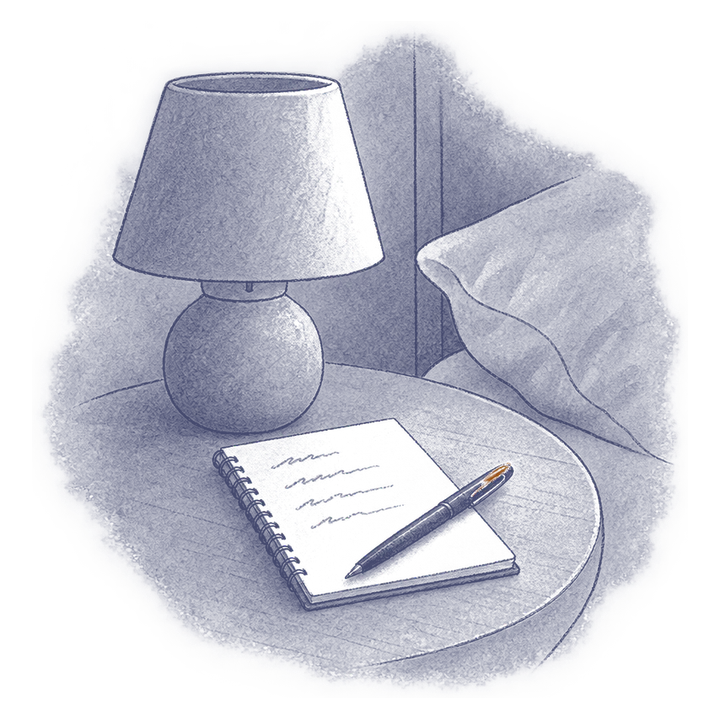

The house has gone still, the light is off, and for the first time since morning nothing is asking anything of you. That’s often just when the mind turns to everything the day left unfinished. Plenty of it is barely worry at all, more a hum of small things that keep coming back. A busy mind tends to ease off sooner when it has a small job to do than when you try to make it stop.
A ruffled mind makes a restless pillow;
Why does my mind start up the moment I lie down?
All day there was something in front of you: the work, the people, the next small job, the screen. Now the body is still in the dark and all of that has gone. What’s left are the things that didn’t get finished. Researchers who study memory have long noticed that unfinished tasks tend to stay active in the mind and keep coming to mind unbidden1, and worry about tomorrow’s work is one of the things that keeps people from dropping off.
So what does falling asleep look like from the inside? When researchers collect what people report thinking as they drift off, the answer is a strange one: thought loosens into sensory images and the planning, reasoning kind of thinking switches off3. Ideas turn into pictures. For people with insomnia, the thoughts as they try to sleep more often stay with planning and problem-solving. That makes the part of you still running through tomorrow the part that could use a different job. Something loose and picture-like would be closer to what sleep already does to your thinking.
Why does telling myself to stop only keep the thoughts coming?
When the thoughts won’t stop, you probably tell them to. That tends to bring them back. Psychologists have tested this many times in a simple way. They ask people to keep one particular thought out of their mind for a while, and then to stop. Once they stopped trying, the thought came back2.
It’s hard not to see something similar in sleep. It’s an involuntary process that can’t be put under full control4, and sleep researchers think straining to make it happen may make sleeplessness worse.
Then another kind of thought turns up: thoughts about sleep itself. How long have you been lying here? How many hours are left if you dropped off now, and how will tomorrow go on so few? Thoughts like these are among the ones most closely tied to a slow drift off5. A clock in view makes them worse. When researchers asked people to watch one while trying to sleep, they worried more and took longer to fall asleep6. If you like, you could turn yours to face the wall.
A closer look What do the studies on pushing thoughts away show?
Psychologists run these studies the same way each time. They ask volunteers to keep one particular thought, usually a neutral one, out of their mind, and then to stop trying. When researchers pooled thirty-one of these lab studies2, the thought rebounded afterward. It even came up more during the attempt when people were busy with something else as well. None of the studies took place in bed at night, so applying the finding to bedtime is a reasonable guess that nobody has measured.
One old experiment did test effort and a busy mind at bedtime. Researchers asked normal sleepers to fall asleep as fast as they could while Sousa marches played to keep their minds busy, and those sleepers took longer to drop off than people told to sleep whenever they liked7. With new-age music playing instead, the pattern turned around. Why would the music matter? It suggests effort and a busy mind make each other worse, though a single experiment can’t turn that into a rule.
For the thoughts about sleep, researchers gave people a voice-activated recorder to keep by their own beds at home for three nights, and the sleepers spoke their thoughts aloud as they lay there. Thinking about sleep and what a bad night would cost, along with working through problems5, went most closely with taking longer to fall asleep. That loop is central to the leading account of insomnia8. In it, worry about sleep revs the body up, the person starts watching for signs they aren’t sleeping, and trying to control the thoughts makes things worse.
What can I give my mind to hold instead?
If pushing thoughts away only brings them back, the other way is to give the mind something to do. A small study in the UK tried this with forty-one adults with insomnia, over one night at home. The researchers taught some of them to fill their minds with an engaging imagined scene before sleep. They told others simply to distract themselves, and gave the rest no instructions at all. The people with a scene to picture fell asleep sooner and had fewer, less distressing unwanted thoughts9 than those with no instructions. The vaguer advice to distract themselves didn’t make the same difference. The researchers think the scene worked because it took up enough room to stop people drifting back to their worries, and because it gave them something to do in place of a thought to avoid9.
You may have tried counting sheep and found you could count and go on worrying at the same time. A fresh picture every few seconds asks a little more of you. Going by the imagery study’s reasoning, that seems likely to leave less room for the thoughts. That’s one way to see why cognitive shuffling, a method some researchers have proposed, might help. You take a word with no worry in it and, for each of its letters in turn, picture one unconnected thing after another. A string of random pictures takes the place of one scene. Each is random and gone in a few seconds, a little like the loose images of ordinary drifting off. If it doesn’t suit you, another slow, visual task can do the same work, such as walking room by room through a house you once lived in.
We couldn’t find a published trial of shuffling itself, and the imagery study tested a single scene, but it’s a harmless thing to try. If tonight’s thoughts are frightening ones more than busy ones, it may help less. In one study, distraction went with worse-rated sleep when the bedtime thoughts were anxious ones10, so a task like this may suit a busy mind better than a frightened one.
You may be tempted to reach for the phone to drown the thoughts out. The picture task needs no screen and no light. It works with your eyes closed, there in the dark.
A closer look Where does cognitive shuffling come from?
Beaudoin and colleagues proposed cognitive shuffling, which researchers call serial diverse imagining. One way to see why it might help is through the sleep-lab picture of drifting off, where thought loosens into images as the planning mind switches off3. Shuffling asks a busy, planning mind to picture one unrelated thing after another. The pictures are too random to build a story or a problem from, so thinking may loosen in the same way.
The nearest evidence is the imagery study in forty-one people with insomnia, where a specific scene to picture helped and a vague instruction to distract didn’t make the same difference9. That study used a single engaging scene, while shuffling moves through many. When researchers reviewed ways to change bedtime thinking, they found that of the strategies tried so far, some helped, some made no difference and some made things worse3. Beaudoin is one of that review’s authors, and he directs companies selling products based on his research3. That’s worth knowing when you read about the method elsewhere.
For the point about frightening thoughts, researchers in the Czech Republic worked with 129 healthy adults10. They showed the volunteers pictures before bed to stir them up, and after that one night the volunteers rated their own sleep on waking.
What can I set up earlier in the evening?
As you brush your teeth and set the alarm, you’re often still running through tomorrow’s jobs. One small lab study tried giving them somewhere else to go. Fifty-seven healthy young adults spent a night in a sleep lab. Before lights out at 10:30pm, each of them spent five minutes writing. Half wrote a to-do list for the days ahead, and half wrote about what they’d already done. The to-do list group fell asleep faster1.
The researchers think what mattered was getting the tasks down on paper instead of turning them over in the mind1. It was one night in a lab, with young people who fell asleep fairly quickly anyway. Whether a nightly list helps at home, over many nights or for people with insomnia hasn’t been tested1. A few evenings with a notepad are a way of finding out what it does for you.
Worries are a little different from tasks. It may help to give them their own time and place, on paper and away from bed, at the kitchen table perhaps. Then bedtime doesn’t have to be where they get sorted. In one early trial, thirty-three students who had insomnia sat down on each of five nights and wrote out possible solutions to their worries11. By their own account, their minds were less busy at bedtime than those of students who wrote the worries down without solutions. Whether writing about worries before bed helps sleep itself is still debated, and What can I do when worry keeps me awake? goes further into it.
A closer look How were the writing studies done?
The researchers at Baylor University recruited fifty-seven students and others aged 18 to 30 and screened them for sleep and psychiatric disorders. They then put each volunteer by chance into one of the two writing groups. It was the volunteers’ first night in the lab, which the researchers used as a stand-in for an occasional night of bedtime stress. People who didn’t know who had written what scored the brain recordings1 that showed how quickly each volunteer fell asleep. Since both groups wrote, the pen and paper alone can’t explain the difference.
People who listed more items tended to fall asleep faster1. Among those who wrote fewer than ten, the gap between the groups was smaller. That was a side analysis in about twenty-eight people per group, and the authors say that’s too few to tell much about differences between individuals.
Writing about worries, rather than tasks, has gone differently in different groups. In poor sleepers it shortened how long they felt it took to fall asleep, while in people with insomnia it eased the busy mind on one measure without shortening the time to fall asleep1213. The two studies had forty-two and twenty-eight people, each writing over three nights, so the question is still open.
What the research says
- Trying to push a thought out of your mind tends to bring it back. Good evidence
- Sleep can’t be fully willed, and researchers think straining for it may make sleeplessness worse. Good evidence
- In one small lab study, five minutes writing a to-do list helped healthy young adults fall asleep faster; it hasn’t yet been tested at home or in insomnia. Early evidence
- Picturing an engaging scene helped people with insomnia fall asleep sooner in one small study. Early evidence
- We couldn’t find a published trial of cognitive shuffling itself. Not well studied yet
- Whether writing about worries before bed helps isn’t clear yet: findings differ between poor sleepers and people with insomnia. Still debated
- Occasional worry about everyday things is a normal part of life. Well established
People differ, so it’s worth keeping whichever of these works for you.
What if it’s still racing after a long while?
Some nights the pictures and the list won’t be enough. If your mind is still going after a good while, it’s okay to stop lying there trying harder, given what effort does to sleep. Getting out of bed for a while is one of the standard steps in treating insomnia14, part of what’s called stimulus control. Should I get up if I can’t sleep? goes into when and how. If the same thoughts come back in the small hours, Why do I keep waking up at 3am? is about that waking.
Worrying now and then about everyday things is an ordinary part of life15. If what keeps you up is less a busy hum and more a worry that’s hard to control on most days, lasting six months or more and coming with restlessness, tiredness, irritability, tense muscles or poor sleep15, it’s worth talking to a doctor or other health care provider. The same goes for nights of low mood or panic. If the sleeplessness itself has gone on for many weeks, CBT for insomnia is the treatment made for it.
On ordinary nights, the racing is the day still talking, and it eases once it has somewhere to go: the list written and set down on the bedside table, and a mind moving from one small picture to the next until the pictures begin to drift on their own.