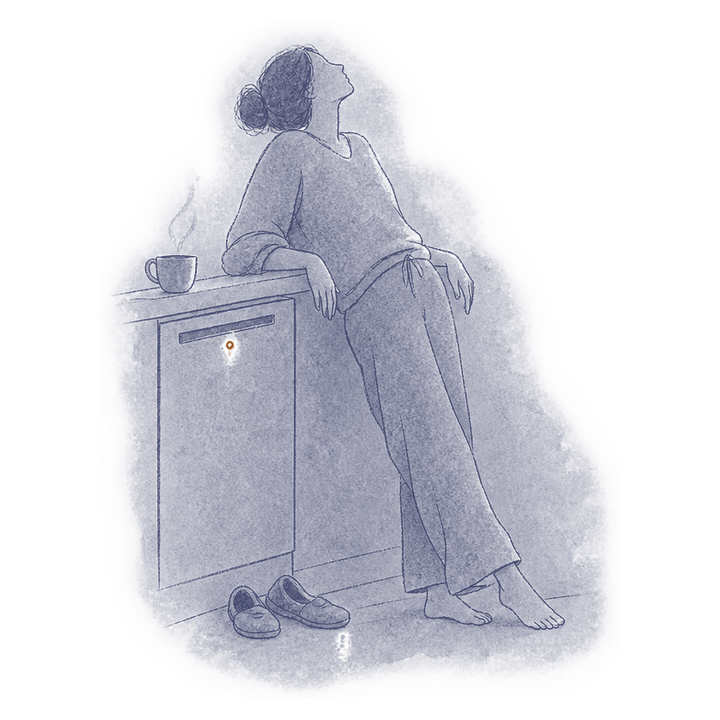
Perhaps you’ve been handed the routine before: the bath, the herbal tea, the rule about no screens after nine. Some evenings you don’t keep it up. On others you do all of it and still lie there switched on, and somehow that’s worse. Your phone may be in your hand because this is the first time all day that nobody needs anything from you, and you can know it isn’t helping and keep scrolling anyway. The buzz is what’s left of the day, still moving through your body after the work of it has stopped. Trying harder at the routine gives you one more thing to think about, so tonight you can let the steps go.
Why can I be exhausted and wide awake at once?
Two things are pulling you in opposite directions. One is sleep pressure, the need for sleep that builds through every hour you’re awake. By late evening yours is high, and that’s the heaviness in your eyes. The other comes from your body clock. In laboratory studies it adds a spell of alertness in the few hours before melatonin starts to rise, when it is harder to fall asleep, even after a long time awake1.
How strong is that push? Strong enough that in early sleep-lab work, people who’d been kept up the night before still struggled to sleep in that stretch, which the researchers called a “forbidden zone”2. There’s more on the clock in why you can be wide awake at bedtime.
The rest of the hum is the day itself. When you go back over its worries and problems in your head, your body’s stress response keeps going after the stress has ended3. A harder day gives you more to go back over4, and that’s one way it reaches the night.
Why doesn’t it switch off when I finally stop?
What does it look like when a body comes down from a bad day? Two small lab experiments with students give a rough picture. The researchers set each student a task: mental arithmetic while someone harassed them, exercise or a hand held in icy water. Then they watched the students’ blood pressure fall. After the exercise and the cold it came down sooner5. After the upsetting task it took longer. And later, when the students went back over the task in their heads, it rose again5. In the second experiment, the students given something else to occupy them straight afterwards recovered better than those who sat with nothing to do5.
These were small lab studies, and they can’t say how long an ordinary evening takes to come down. The shape they do show fits the evening you’re having. After a hard day your body is slow to come down, and each time you go back over the day, you nudge it up again.
Once the last dish is in the rack, what does the nudging is mostly the day’s leftovers: one more email, a hard conversation, a task half finished. If you work, the research on working adults is worth knowing. Those who manage to switch off from work in their own time tend to report better sleep and less fatigue6, and doing work things after work goes with switching off less6. It can be taught, too: programs that teach it helped working adults switch off, on average7.
Why does trying to relax keep me awake?
Can you try too hard to fall asleep? In the mid-1990s, researchers put that to a small group of good sleepers in a lab. They told some to fall asleep as fast as they could, and others to drift off whenever they liked. Then they added music. Some of the sleepers lay listening to new-age music, and the others had John Philip Sousa marches playing. With the new-age music, trying hard helped. With the marches in their ears, it backfired: the people trying hardest took longer to fall asleep than those the researchers had left to it8.
That small study tested effort to sleep. Sleep researchers think trying directly to make sleep happen can make sleeplessness worse9, though they’ve studied it mainly in people with insomnia. Effort to relax goes a step past what either of them tested, though it seems a reasonable step to take. On a wired evening, the day still on your mind can play the part the marches played. Then a routine done as a task becomes one more thing to get right.
Is it my phone keeping me up?
Researchers don’t agree yet on how much screens before bed matter, and the argument starts with one study. Twelve young adults moved into a lab. On five evenings they read for about four hours before bed on a light-emitting tablet, and on five others from a printed book10. The room was very dim. After the tablet evenings, they felt less sleepy and took nearly ten minutes longer to fall asleep10.
That’s a real effect. It came from four hours of glowing screen in near darkness, evening after evening, which is a long way from most nights on the sofa. In everyday life the link looks far smaller. Among UK teenagers keeping time-use diaries, a screen in the thirty minutes before bed went with about one minute less sleep11. A survey like that can’t show which causes which. Still, for those teenagers the screen looks like a small part of the night.
What may count more is how you use it. Nobody has tested this yet, but a screen that keeps asking things of you, like messages to answer in bed, may add to the buzz more than a show half watched on the sofa. Rather than banning the phone, you could notice which kind of evening it’s giving you.
A closer look What did the tablet study find, and why is it argued over?
The twelve young adults in the study10 lived in the lab for its whole length, ten evenings in all at the dose described above. The researchers fixed their sleep at eight hours, so how long they slept couldn’t differ. After the tablet, they were sleepier the next morning.
The design was strong and carefully controlled. The argument is over that dose, which is unlike most evenings, and over size, since only twelve people were tested. Published comments asked how far the result reaches into ordinary phone use.
The surveys don’t decide it either, because they don’t all point the same way. On one side, a review of studies in 16- to 25-year-olds linked poorer sleep with phones, computers, the internet and social media, but not with television12. In a survey of Belgian adults, messages and calls after lights out went with taking longer to fall asleep13. On the other side are the UK diaries11, where the link shrank to that single minute. None of these surveys can show cause. The nearest thing to a test is one small pilot trial, in which people who put their phone away thirty minutes before bed fell asleep faster and felt less keyed up14.
So what does it all add up to? The links turn up across ages, nobody has shown the screen is the cause, and a modest step has a little evidence behind it. That’s a reason to try putting the phone down a while before bed, if you’d like to, and not much of a reason to ban it.
Why is it so hard to give the evening up?
What makes bed so hard to go to, when you’re this tired? The researchers who named bedtime procrastination, going to bed later than you meant, have a suggestion. They think it has less to do with not wanting to sleep than with not wanting to stop what you’re doing15. When the evening is the only stretch of the day that’s yours, stopping means handing it back. Bedtime also comes at the end of a long day, so they expected the fixes most likely to help to be ones that don’t rely on willpower15. There’s more on that pull in why you stay up late when you’re tired, and on evenings that feel closer to dread of going to bed.
You don’t have to give the hour up. You can keep it and move it to the dim end of the evening, once the day’s business is closed. Spent on something familiar and low-key, it can become the part of the night where you wind down.
-
If your evening only starts once the children are asleep
“Wind down for an hour first” can mean having no evening at all, and it’s fair to want the time. No research looks at parents’ evenings in particular, but the same things seem to apply. Once the lunchboxes and the last messages are done, the hour can go on something you enjoy in lower light and still be the one that winds you down. A short evening can be spent that way too.
-
If work follows you into the evening
Working in your own time goes with switching off less, and switching off goes with better sleep6, so it may be worth trying a clear end to the working day: a moment when the laptop shuts and stays shut, even on days when the work isn’t finished.
-
If you’ve been lying awake most nights for months
That’s a different thing from an evening when you can’t switch off, and it has treatments of its own that sleep specialists recommend16. Do I have insomnia? is a good place to start, and CBT for insomnia explains the treatment they recommend.
What helps on an ordinary evening?
None of this is a routine, and you could take any one piece and leave the rest. The aim is to stop adding to the day and let what’s already there come down. For most evenings that starts with an end to the day’s tasks you can feel, a point where you know they’re done. The lights can come down after that. Then there’s the part worth looking forward to, something you enjoy that keeps your attention without demanding much of it, like a novel you’ve read before, a puzzle or a show you half know.
That last idea comes from the students in the lab. Those given something to occupy them straight after an upsetting task came down better than those left with nothing5. Perhaps it kept them from going back over it, and that’s the job those easy things can do for you.
When it comes to bed, sleep specialists advise people with insomnia to go only when sleepy, and to get up again if sleep won’t come rather than lying there trying16. That advice was made for insomnia, but both halves seem to fit ordinary evenings too. As far as I can see, both are there to spare you long stretches in bed trying to sleep, and a wired evening can bring those as well.
A drink can seem the quickest way down. Alcohol does help you fall asleep faster, but it disrupts the second half of the night at every dose studied17, as Does alcohol help you sleep? explains.
What the research says
- Going over the day’s problems in your head keeps the body’s stress response up after the stress has ended. Well established
- The body clock tends to make the few hours before your usual bedtime a harder time to fall asleep, even when you’re tired. Good evidence
- People who switch off from work in their own time tend to sleep better. Good evidence
- In one small lab study, trying hard to fall asleep backfired when marching music was playing. Early evidence
- Researchers don’t agree yet on how much screens before bed matter: four hours of tablet reading had clear effects in a lab, while in teenagers’ daily lives a screen before bed went with about a minute less sleep. Still debated
- For people with insomnia, going to bed only when sleepy is standard advice. Well established
Most of what is known about coming down after a hard day comes from labs and surveys, and people differ in how fast their evening comes down and how late their clock runs.
And the night shall be filled with music, And the cares, that infest the day, Shall fold their tents, like the Arabs, And as silently steal away.
You can keep your hour tonight, on the sofa or on the bottom stair, with nothing new coming in. Bed can wait until your eyes start closing on their own.