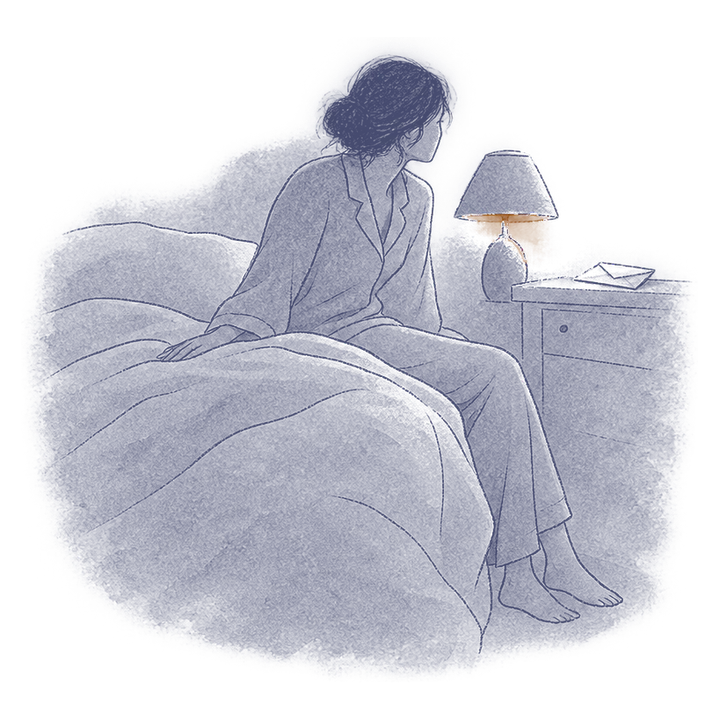

Perhaps it's the hour when everyone else in the house is asleep, and you're the one still lying there, listening to it tick and creak. Or perhaps it's the morning after, and you're counting how many nights it has been now, and trying to remember the last time you slept straight through. Often whatever started it, a loss, a move, an illness, a hard stretch at work, has eased by now, and still the nights haven't come back with it.
What makes poor sleep insomnia?
Clinicians look for three things together before they call it insomnia. There's the night itself: trouble falling asleep, staying asleep or waking too early2, the long stretches awake, perhaps finding you can't nap even though you're worn out3. There's the day, too, since the definition counts tiredness, a low or short-tempered mood, a mind that can't concentrate2. Often it's the days that finally send people looking for help. And there's the chance to sleep: all of this happens despite enough time in bed and a reasonable place to sleep2.
Clinicians describe chronic insomnia as happening at least three nights a week for at least three months2. Anything shorter they call short-term, or acute, insomnia34, and it's worth taking seriously even though it often passes. Those numbers describe a pattern, agreed on so that clinicians can talk about the same thing. They aren't a test you pass or fail by counting your nights. There's no scan or overnight test that finds insomnia in the body. A doctor recognizes it from what you tell them about your nights and days25.
-
If you go to bed in good time and sleep still won't come, or won't stay
If this sounds like you, it may help to know that how it started and what keeps it going now are often two different things, and the second is the part you can work on.
-
If there simply aren't enough hours, because of shifts, caring, a baby or a packed life
Your tiredness is real, but it isn't insomnia as clinicians define it: insomnia means poor sleep despite enough time to sleep2. Advice about spending less time in bed is meant for people who lie awake, so it isn't for you. You might find more help in how much sleep you need and getting through the day after a short night.
Will this rough patch pass on its own?
For many people it does. One US study watched it happen: 1,248 people aged 35 and over who slept well kept a sleep diary every day for a year6. Along the way a little over a quarter of them went through a spell of bad nights, and most of them found their way back to good sleep6. Out of the whole group, fewer than two people in a hundred ended the year with chronic insomnia6. The researchers who followed those diaries suggest that a short run of sleeplessness may simply be part of how a body answers stress or threat6. If your own bad nights are only a few weeks old, that may be what's happening: a body still answering a hard stretch, which often eases as the stretch does.
Follow the band from the left: it's everyone in the diary study who had a bad spell, and each branch is as wide as the number of people who took that path. Most of it turns back toward good sleep, and the branch that became chronic insomnia is very narrow. The people were good sleepers aged 35 and over in the US, two-thirds of them women, who kept a sleep diary every day for a year6. The chronic branch is worked out from the study's counts, and a few people weren't placed in any of these.
Worked out from the figures in the studies cited
See this as a table
| Where they ended up | People | Share of the group |
|---|---|---|
| Went back to sleeping well | 244 | 72% |
| Kept sleeping poorly now and then | 65 | 19% |
| Went on to chronic insomnia | 23 | 7% |
| Not placed in any of these | 5 | 1% |
| The whole group | 337 | 100% |
If your bad nights have gone on for months now, insomnia that has lasted that long tends to stay until something changes. In a Canadian study that checked on people with insomnia a year later, about three in four still had it7. The long kind also responds well to treatment89, even when it has lasted for years.
And even when it's been around a long time, it usually isn't every night. Poor nights tend to come in runs of a few, with better ones between10, which may be why a good night can arrive out of nowhere and then refuse to repeat.
Why is it still here when the reason has gone?
Most people can point to the week it began. In one small UK trial, most of the people with new insomnia traced it to something ordinary, such as trouble at home, money worries or a change at work4. Once that has eased, it can feel faintly foolish to be awake at 2am when so much else has come right again. But what started the trouble and what keeps it going can be two different things211. Insomnia often becomes a problem in its own right211, whatever set it off.
Clinicians often explain this with a three-part model from the 1980s: what makes someone prone, what sets it off and what keeps it going412. It's a widely used framework rather than a proven account of every case2, but it fits what many people describe.
The stressful weeks set it off. Then you start protecting your sleep: you go to bed earlier to give sleep more chance, you sleep in on the mornings you can, you stay in bed trying. You check the clock and work out that if you fall asleep now, you'll still get four hours. These are the very things, worry about sleep, irregular hours and too much time in bed2, that the guideline review finds keep chronic insomnia going. The extra hours in bed spread the same sleep pressure more thinly across them. And night after night of lying awake in the same bed can teach your body to be alert there2.
Clinicians think that learning is why you can be drooping on the sofa at 10pm and wide awake the moment your head meets the pillow, as the bedroom and the routine of going to bed come to set off alertness by themselves4. Trying harder may add to it, since sleep can't be made to happen, and striving for it may keep insomnia going13. One model suggests that watching the clock feeds a loop in which worry raises arousal, you look for signs the night is going badly and you come to feel you slept even less than you did14.
Every one of those habits began as a way of looking after yourself. They aren't the whole story, either, since some of it, such as genes, other illness or a body that runs more alert around the clock2, is nothing anyone chooses. But the habits are the part within your reach, so the early nights, the lie-ins and the hours awake in bed are where your own nights can begin to change.
It’s often said
If I go to bed earlier, or sleep in at the weekend, I'll catch up
Why it can feel that way
After weeks of short nights it seems only fair to give sleep more room, and on some mornings sleeping in does bring an extra hour.
What’s going on underneath
When sleep is the trouble, more time in bed tends to mean more time awake in it. The guideline review counts too much time in bed and irregular hours among the things that keep insomnia going2, and the NHS advises against sleeping in after a bad night3. A steady getting-up time, and going to bed when sleepy, usually serve sleep better.
A closer look Why does my sleep seem to break more easily than other people's?
If a hard week seems to cost you nights that other people sleep straight through, there may be a reason for it. Some people's sleep reacts more strongly to stress, which researchers call sleep reactivity, and it runs partly in families11.
One US study followed adults who had no insomnia, and some of them developed it within the year. Most of those whose sleep had once been hard to disturb had become highly reactive by the time their insomnia began, especially after a major life stress, and that sensitivity stayed higher after the insomnia lifted11. It comes from a single group of people, so it's early evidence.
Still, it's something worth knowing about yourself. If your sleep has broken once under strain, it may shake more easily the next time stress comes, and knowing that ahead of time can make those nights less of a surprise.
A flock of sheep that leisurely pass by, One after one; the sound of rain, and bees Murmuring; the fall of rivers, winds and seas, Smooth fields, white sheets of water, and pure sky; I’ve thought of all by turns; and still I lie Sleepless;
What helps, if it doesn't pass?
If you've worked through the lists, cutting coffee, darkening the room, trying lavender, and you're still awake, that isn't because you did them wrong. US sleep specialists advise against using sleep hygiene on its own to treat chronic insomnia15. The likeliest reason the tips fall short is that they don't reach the part that keeps insomnia going.
What does reach it is CBT for insomnia, the treatment US and European guidelines recommend first for adults with chronic insomnia, in person or online, including for people with other health conditions5815. Over a few weeks it works on the habits and the worry themselves. In trials, people got to sleep faster and spent less of the night awake, while their total sleep barely moved16, so what it gives back is mostly the hours of lying there.
In one Canadian trial, the 160 adults who took part had lived with insomnia for sixteen years on average9. They met in groups once a week for six weeks, and some went on to extra treatment after that. By the end, about half were in remission, and six months later the gains were still there9. A long history doesn't put it out of reach, and a fully online program has helped too17.
If your bad nights are only a few weeks old, there's much less to go on. In one small UK trial, a single hour-long session of CBT-I helped far more people into remission within a month than waiting did4. There's more on what the treatment involves in what CBT for insomnia would ask of you.
Perhaps you're wondering whether a pill would be simpler. Pills and CBT-I seem to help about as much at first, but only CBT-I has shown benefits that last once treatment stops918. That's the reason sleeping medicines come after CBT-I in the guidelines, usually short-term, when CBT-I alone hasn't been enough58. As for the pharmacy sleep aids, fast-release melatonin and herbal remedies, the European guideline advises against them for insomnia5, and whether sleeping pills are safe to take looks at each one. So CBT-I comes first, and it's the one worth asking for.
If you've been taking a benzodiazepine, a kind of sedative sleeping pill, most nights, please don't stop it suddenly: the FDA advises cutting down gradually, with a plan made with your prescriber, to avoid withdrawal19. If a drink has become part of how you get to sleep, there's more on what it does to the night in how alcohol affects sleep.
What the research says
- Insomnia means trouble sleeping despite enough time to sleep, with effects on the day. Well established
- In one US diary study of good sleepers aged 35 and over, most short spells of poor sleep settled within a year without becoming chronic. Good evidence
- Worry, irregular hours and too much time in bed help keep chronic insomnia going. Good evidence
- The three-part model is widely used by clinicians as a framework for how insomnia starts and lingers, which is different from proof of what causes it. Good evidence
- CBT for insomnia is the first treatment guidelines recommend for chronic insomnia in adults. Well established
- In one small trial with a one-month follow-up, a single session of CBT-I led to remission for six in ten people with short-term insomnia, against fewer than two in ten who waited. Early evidence
- Sleep hygiene on its own isn't advised as a treatment for chronic insomnia. Good evidence
Most CBT-I trials were in adults with chronic insomnia, and the strongest figures come from people without other sleep or mental-health conditions, so less is known about short-term insomnia and about insomnia alongside other illnesses.
When is it worth seeing a doctor, and what would I say?
If you've been wondering whether your sleep is enough of a reason to book an appointment, the NHS suggests going if changing your habits hasn't helped, if it has gone on for months, or if it's making the days hard to cope with3. What you'd say fits in a few lines: how long it's been, how many nights a week are bad, what it does to your days, what you think set it off and what you've tried.
If you'd like, you could keep a rough note each morning for a week or two. It's only notes for the doctor, with nothing to grade, and it can say much of this for you: doctors find a sleep diary useful5. From there, they'll look for anything behind it, may offer CBT face to face or online, and may refer you to a sleep clinic if another sleep problem seems likely3. And if getting an appointment is hard, a fully online CBT-I program is another way in, and in one US trial, more than half of the adults followed up after signing up for one themselves were in remission a year later17.
Does it matter whether I call it insomnia?
Some people dread the word, as though it were a sentence handed down, and others half want it, so that the struggle at last has a name. Either way, it describes a pattern of nights and days, recognized from what you tell someone25, and it says nothing fixed about who you are. People in the first weeks tend to speak of having a sleep problem, and a sense of being an insomniac can build over time4. So the more useful question may be what's keeping this going now: the early nights, the lie-ins, the clock, the long hours of trying. That's the part that can be unlearned. About half the people in that Canadian trial reached remission, after sixteen years9 of bad nights on average.