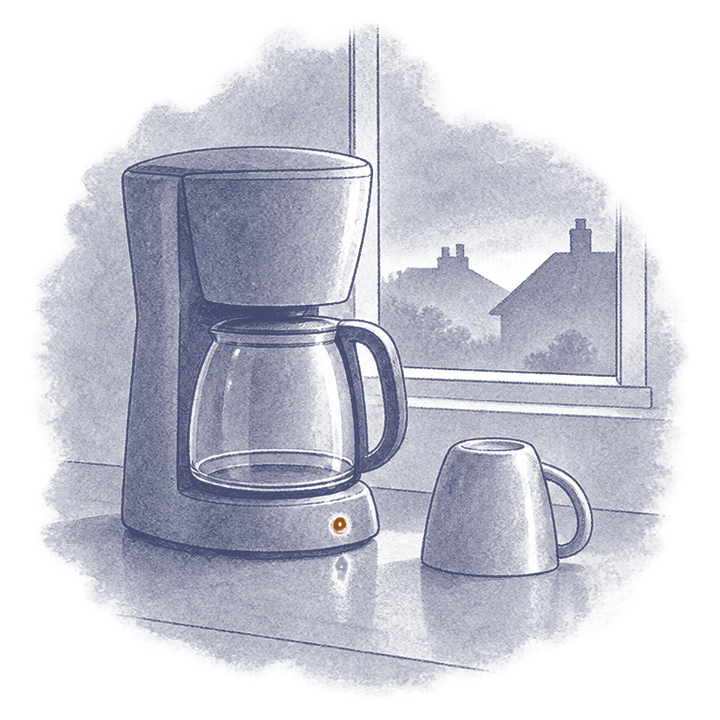
It's the hour when the window turns from black to gray, and you can tell this waking is for good. It isn't like a waking at 3am. In the middle of the night there's a chance of drifting off again. At five, the night has finished: the body is done with sleep even though you still feel tired, and the day has started without you.
If you're reading this before the alarm, there's nothing you have to do about it yet. Lying still is a fine way to spend it for as long as it feels like rest. If it turns into straining or watching the clock, you can get up. Either way, you could keep the light low: curtains closed, and a dim lamp in place of the overhead one.
When it keeps happening, the mornings start to look alike. The same hour, the same sum of how long until the alarm, and the same answer that it isn't enough. When researchers ask older adults, more than a third in most studies1 say they wake early or struggle to stay asleep several times a week.
Why does my night end so early?
In the last stretch of your night, the light sleep of the hour or two before the alarm, most of the pressure for sleep that built up through the day before has already drained away. What keeps you asleep is your body clock, whose strongest pull toward sleep comes in the early morning hours, just before your usual waking time1.
As the years pass, that clock tends to run earlier. Its daily rhythms, such as the rise and fall of body temperature and melatonin, run earlier in middle-aged and older adults than in people in their twenties1, and the change begins even in middle age. So it wakes you earlier too. If your alarm is still set for the old morning, the gap between the two is the hour you lie awake. In older adults that last stretch also seems to be the part of the night most easily broken, as if the clock's early-morning push toward sleep weakens with age1.
Why the clock moves like this is still largely unknown1. There's more on how it keeps time in what the body clock is, and how it decides when you're sleepy.
Is it because I'm getting older?
Age is part of it. Across a lifetime, the timing people prefer gets later through the teenage years, peaks around 20, then drifts steadily back toward earlier hours2, until by the eighth decade it's close to where it was in childhood. Mornings that have crept earlier over the years are following a curve that turned somewhere around twenty.
Much of what looks like sleep wearing out with the years turns out to depend on health. When researchers pooled studies of healthy people, the changes that come with age shrank or vanished in those carefully screened3 for illness, mood disorders, medicines and sleep disorders. One thing still went on falling after 60: the share of time in bed spent asleep. So an early waking that arrives with something else, a new medicine, pain, a low stretch or a bladder that wakes you, is worth looking at for its own sake.
It’s often said
Older people just need less sleep
Why it can feel that way
If you wake at five feeling more or less fine, and the people around you in their seventies sleep less than they did at thirty, it looks as if the body asks for less.
What’s going on underneath
In one laboratory study, researchers gave healthy people aged 60 to 76 sixteen hours a day in bed for several days. The older volunteers ended up sleeping about 7.4 hours, against 8.9 hours for people aged 18 to 324. The researchers read this as fitting a lower need for sleep, though they couldn't rule out a lower ability to sleep. The older volunteers had also come in a little short of sleep from home. Since neither of those could be ruled out, this one small study leaves the question open.
Why doesn't going to bed earlier make up for it?
You lost an hour this morning, so tonight you go up an hour sooner, and on paper the sum works. The same study helps explain why it so often doesn't. At home, its older volunteers spent about 8.1 hours in bed but slept only about 6.5 of them4. Given sixteen hours a day in bed, their sleep leveled off at about 7.4 hours. The researchers' own reading is that time in bed beyond what you can sleep can itself show up as waking too early4.
A longer stretch in bed doesn't add sleep, then. It spreads the same sleep thinner, and the extra wakefulness has to go somewhere. When you go to bed earlier, it seems likely that much of it comes at the far end, so the next morning comes earlier still. This is reasoning from the study, and it hasn't been tested as a result in its own right. It does run the same way as a well-tested treatment for long-running insomnia. Sleep restriction keeps time in bed close to the time slept, so that sleep comes in one more solid stretch5, and it only widens the window as sleep fills it. You can read more about that in what CBT for insomnia asks of you.
Can light help me sleep later?
Light moves your clock, and what it does depends on when it reaches you. Light in the late evening and early night shifts the clock later, light in the late night and early morning shifts it earlier, and light in the middle of the day does little16. The turning point is the low in body temperature, a few hours before your usual waking time.
So much sleep advice says to get bright light first thing. That suits people whose clocks run late and need moving earlier. Your clock already runs early, though. Bright light at dawn comes after the turning point, so it moves the clock earlier still. Follow that through, and tomorrow's waking would tend to come sooner. For you, the most familiar advice about light pushes the wrong way. The useful light for you comes at the other end of the day, in the evening.
One early clock, drawn; the hours are an example. Sleep ends well before the alarm, and the wait falls at the end of the night rather than in its middle. Light before the turning point moves the clock later and light after it moves it earlier16, so the evening before sleep falls on the side that moves the clock later, and the hour after waking on the side that moves it earlier.
Drawn as an illustration of the pattern
See this as a table
| What | From | To |
|---|---|---|
| An early clock: Asleep | 9:30pm | 4:45am |
| Awake, waiting for the alarm | 4:45am | 6:30am |
| Light here moves the clock later | 8pm, and before | 2am |
| Light here moves it earlier | 2am | 8am, and after |
| Moment | At |
|---|---|
| Body at its coolest | 2am |
| Alarm | 6:30am |
The evening is when most houses begin to dim, and it's the stretch the studies of light have tried to use. The studies are small, and they don't all agree. In one, researchers worked with twenty-four adults who had been waking too early and whose clocks ran early. Some sat through two evenings of bright light, and a comparison group sat in dim red light instead. Those two evenings moved the bright-light group's body clocks about two hours later7. Over the next four weeks, those people spent less time awake in the night, slept more in total and had fewer days feeling low. They also tended to wake later, though only as a trend.
A second trial went less well. Older adults used light boxes at home, and little changed8. When the American Academy of Sleep Medicine looked at the trials, it suggested evening light only weakly, and only for people diagnosed with a clock running two or more hours early9, because the evidence is very low in quality. Put together, evening light looks like a hopeful thing to try for yourself: the way light moves the clock is well understood, and the proof that it fixes early mornings is still thin.
A closer look What did the other trials of evening light find?
In another small trial, thirty-one people aged 55 or over with milder early waking used bright light at home for three weeks, 30 to 60 minutes before bed, and it changed little beyond how long they lay in bed after their last waking8. The researchers still saw light as worth trying, and wondered whether the timing and the dose had been right.
The guideline's best result came from older patients diagnosed with an early clock. They sat with two hours of bright light between 8pm and 11pm for twelve days9, and their clocks moved about 2.4 hours later, with about 51 minutes more sleep.
What can I do with the early hour itself?
If you wake at five and feel you might doze, keeping the room dark and lying still is a reasonable choice. Dawn light pushes an early clock the wrong way, so keeping it out may stop it moving the clock. No one has tested this as a treatment, and the guideline found no evidence either way9, so heavier curtains, or leaving the blind down until your alarm, are small ways to try it.
If you know from long experience that sleep is over for the night, you can stop fighting for it and get up. Insomnia treatment suggests much the same, getting up when sleep won't come and rising at the same time every morning5, so that the bed stays tied to sleep rather than to long stretches awake. There's more on that in whether to get up if you can't sleep. Some people find the early hour becomes their own, with a dim lamp, a warm drink and a book or the window, saved for themselves before anyone else is awake.
Morning is when I am awake and there is a dawn in me.
How do I know which of these fits me?
-
If you're sleepy early in the evening and your mornings have crept earlier over the years
This sounds like a clock that has moved, often with age, and when the pattern is strong and steady, doctors have a name for it. Evening light and a steady bedtime are the things most worth trying here.
-
If you spend much longer in bed than you sleep
If you go up early, lie awake at the start or the end, and add up far fewer hours asleep than in bed, the window may be longer than your sleep. The older volunteers in one study slept about 6.5 of their 8.1 hours in bed4. Bringing bedtime later, so the window fits the sleep you make, is a reasonable idea drawn from that study and from how insomnia treatment works5, though it hasn't been tested for early waking.
-
If the early mornings came with a flat, low stretch, and the first thought is dread
This is a different picture, and here the mood is the place to begin, with what to do when you wake early dreading the day.
What if I wake early dreading the day?
People who have had both kinds of early morning say they feel different. One simply comes early. The other comes early with dread, when the first thought is of the day ahead and how to face it.
That second kind has been noticed for a very long time. Physicians in ancient Greece described melancholic people who woke too early10, long before anyone had a word for depression. Today waking too early is one of the listed symptoms of depression11. In middle age, it can be one of the ways depression shows. Early waking on its own doesn't mean depression, though, so what matters is whether the early mornings come with other signs.
The signs to notice are low mood, or a loss of interest and pleasure in things you used to enjoy, lasting most of the day, nearly every day, for two weeks or more11. If that sounds like you, it's well worth talking to a doctor, and whatever care you can reach, a family doctor or a local clinic, is a good place to start. Depression is treatable, and sleep often improves as treatment works, though for some people it stays poor1011.
If the sleep trouble lingers after the low mood has lifted, that's worth raising too, because insomnia that persists is linked to a new episode of depression12. It can also be treated in its own right. CBT for insomnia is the first treatment guidelines name for insomnia that has gone on a long time, and the evidence that it helps alongside depression is promising10.
What else can wake me early?
A few ordinary things can bring the morning forward.
If you had a drink in the evening, it may be part of the story. Alcohol helps you drop off and sleep soundly in the first half of the night, but disrupts the second half, at every dose studied14, so an evening drink can show up as a five o'clock waking. There's more in whether alcohol helps you sleep.
If you wake needing the bathroom, that grows common with the years, and waking to pass urine affects about half of people in their 60s15. As sleep grows lighter toward morning, a filling bladder is more likely to wake you. Sometimes it runs the other way round, and you wake for another reason and then go.
If you're going through the menopause, the early hours may come with night sweats. Trouble staying asleep rises through the menopause, with hot flashes and night sweats a large part of it16, and treating the flashes can help sleep, which is the subject of why sleep can be so hard during menopause.
And if you share a room with someone who rises before you, an eye mask can keep the dawn out where the blind isn't yours to leave down.
You may have read about melatonin for this. The guideline found no evidence to recommend it for an early clock, and the older advice rested on expert opinion alone9; with melatonin, timing matters a great deal, and the melatonin page explains why.
A closer look Is an early clock a sleep disorder?
A strongly early clock from youth is rare. In one Utah sleep clinic, researchers looked back over about ten years of new patients, 2,422 people, most sent to be checked for sleep apnea, and found that about one in three hundred had a clock that put them to sleep before 8:30pm and woke them before 5:30am all year, starting before age 302. Most of these young-onset cases ran in families, and many of the people didn't see it as a problem at all.
So which are you? That young-onset pattern is different from the earlier mornings that arrive in midlife and later, and how common the age-related kind is isn't known2. What sorts the rest is how you sleep when you're allowed to keep your early hours. If you sleep well that way, and the whole night runs steadily two or more hours early, doctors call it advanced sleep–wake phase disorder9. Early waking only counts as insomnia disorder when it comes with daytime problems at least three times a week for three months10, which is the subject of whether you have insomnia.
No study gives a date to expect change, so there's no need to count every night. You'll know whether anything is helping by whether your mornings feel different over a stretch. If nothing shifts, CBT for insomnia or a doctor can take it further.
This evening, you could leave the main lights on through the dishes and the news. And when the early tiredness comes, you could read one more chapter before you go up.