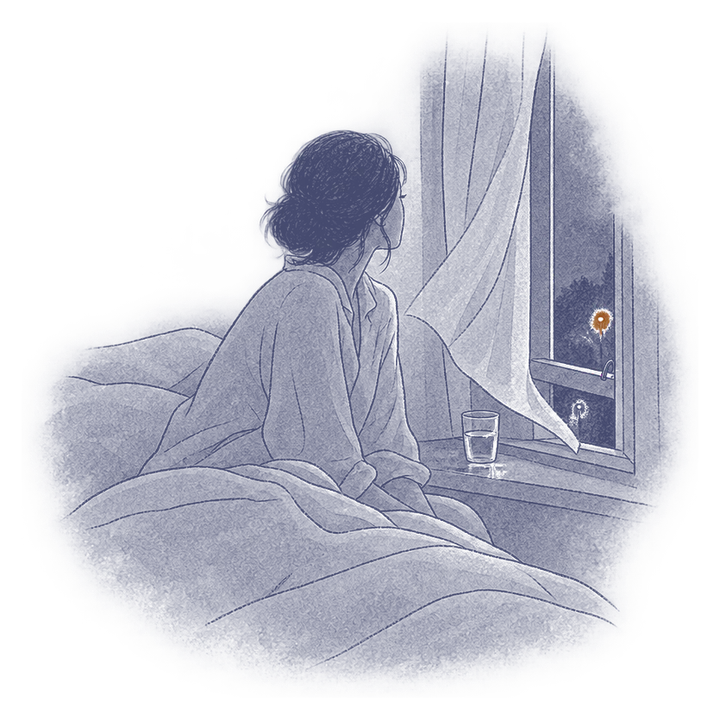
If you're still hot, it helps to let the heat go first: the duvet off, a sip of water, a dry t-shirt if yours is damp, and the light kept low. A spare kept by the bed saves hunting for one. A flash is the body shedding heat: blood vessels near the skin open and sweat starts across the upper body5. It usually lasts one to five minutes5, so most of what you're feeling is already on its way out.
I heard the trailing garments of the Night Sweep through her marble halls! I saw her sable skirts all fringed with light From the celestial walls!
Why do I sometimes wake just before the heat comes?
Some nights you may wake with your heart already going, and only then feel the heat climb from your chest. Researchers in the San Francisco Bay area saw the same thing when they brought thirty-four women in perimenopause into a sleep lab for sixty-three nights5 and caught each flash by the moisture on their skin. The heart rate shifted up to two minutes before the skin began to sweat5. Their idea, which is still a theory, is that the flash and the waking are both set off by the same alarm-like burst in the nervous system5, so on some nights you wake first and the heat follows after.
The flashes came most often in the fifth hour after the lights went out5. For someone who turns the light off around eleven, that is the hour between three and four in the morning.
Researchers don't fully agree on the order yet, and one lab study found that early in the night most flashes came before the waking, while later in the night the order reversed7. All of this comes from small groups of healthy volunteers in sleep labs, so it is a sketch of what may be happening in your own bed.
Why do I lie awake for an hour after the flash has gone?
Most flashes woke the women in that lab, though the waking around them made up, on average, only about a quarter of the time they spent awake after first falling asleep5. Most of their wakefulness came from somewhere other than the heat. Their sense of how long they'd been awake followed the waking around flashes, and not the rest5, which may be why the heat feels like the whole story of a bad night when it is often only how the night began.
One account of how the longer waking gets started is that falling hormone levels may make women more reactive to stress, raising arousal and worried thoughts about sleep8. Those thoughts can make flashes worse in turn8, a loop that may help insomnia start and stay. That's still an idea, and no trial has tested it. The pattern itself is better known. Studies that followed women over years have found that flashes and insomnia tend to come together, and that the more severe the flashes, the more likely insomnia is to start and to last89.
So a bad night is often two things, what wakes you and what keeps you awake. A flash or a hormonal shift can be the spark. The long, wakeful stretch afterward can turn into an insomnia with a pattern of its own, which is why it can be there on cool nights too, and why it may stay as the flashes ease. That second part has its own treatment, CBT for insomnia. In two trials of women in these years it eased the insomnia, and in the one that counted flashes, it did so while they came as often as before.
The top band divides every flash the researchers caught; the band beneath divides the time the same women spent awake after first falling asleep, so the two are the same nights seen from two sides. Thirty-four healthy women in perimenopause, over sixty-three nights in a sleep lab5. The lit part is the waking that came at other times, away from any flash.
Worked out from the figures in the studies cited
See this as a table
| Whole | Note |
|---|---|
| The 222 flashes measured | 34 women in perimenopause, 63 lab nights |
| Their time awake after first falling asleep | An average night; from none to 89% between nights |
| Part | Of | Share |
|---|---|---|
| Woke her | The 222 flashes measured | 69% |
| Passed while she slept | The 222 flashes measured | 20% |
| Came when she was already awake | The 222 flashes measured | 11% |
| Around a flash | Their time awake after first falling asleep | 27% |
| At other times | Their time awake after first falling asleep | 73% |
Is it really menopause, or is it my age?
Perhaps you've been told it's just your age, or wondered it yourself at 4am. Waking in the night is the most common complaint of these years9. A large American study called SWAN asked the same women about their sleep year after year, and found that the odds of trouble staying asleep rose across the transition, even after allowing for other health and life factors9. Falling hormone levels were linked to more trouble falling and staying asleep9, which points to the menopause itself.
When some of the same women slept in a lab, the recordings found no differences by menopausal stage9, and researchers don't agree yet on what to make of that. The same recordings did find that women in late perimenopause and after had more fast brain activity during sleep, the sign of a brain staying more alert, partly explained by hot flashes9. That more alert sleeping brain is a real finding, and it suggests something a count of minutes asleep can miss.
Will it ever get better?
The flashes often take years to end10. The waking that lingers is another matter, because it responds to treatment now1. When SWAN followed women with frequent flashes, half of them had flashes for 7.4 years or more10. If yours began late, after your periods had stopped, the end may be nearer: those women had them for the shortest time10.
That figure is about the flashes alone, since SWAN didn't measure how long the insomnia lasts on its own. That part of your nights doesn't have to be waited out. In a trial of CBT for insomnia by phone, it eased even while the flashes kept coming1.
It’s often said
It's your age, it's hormones, and it will pass.
Why it can feel that way
You may have heard it at the doctor's, and there's something true in it: the flashes do end in time.
A closer look How long did the flashes last in SWAN?
SWAN followed 3,302 women at seven US sites from 1996 to 201310, asking about their flashes at a median of thirteen visits. Among the 1,449 who had frequent flashes, on at least six days in the previous two weeks, the median total length was 7.4 years10. For the 881 whose final period could be dated, the flashes carried on for a median of 4.5 years after it10.
When the flashes began made the largest difference. Women whose flashes started while their periods were still regular, or early in perimenopause, had them for a median of more than 11.8 years, and those whose flashes started after their periods had stopped for a median of 3.4 years10. African American women reported the longest of all, a median of 10.1 years10. All of it is the women's own account, visit by visit.
What helps with the waking that lingers?
In western Washington State, 106 women aged 40 to 65 who had insomnia and at least two hot flashes a day joined a trial1. Some had six phone sessions of CBT for insomnia over eight weeks, and the others had six phone sessions about menopause in general. By twenty-four weeks, eighty-four percent of the CBT-I group were in the range of no insomnia, against forty-three percent1. Their flashes came just as often as before, though the women found them less disruptive1, so the heat kept coming and the long nights mostly stopped.
A trial in Detroit found much the same in 150 postmenopausal women, average age 56, whose chronic insomnia had begun with menopause11, some of them years past their last period. Six months on, the CBT-I group slept forty to forty-three minutes more a night than the other groups11, which is the better part of an hour given back to nights like the one you may be having. Sleep restriction on its own, which limits the time spent in bed, helped nearly as much as the full course, and sleep hygiene advice did little11.
Much of what helped these women, then, was spending less time lying awake in bed. After a bad night, you could keep your usual bedtime and getting-up time, because sleeping in or going to bed early to catch up stretches the time in bed out again. That's reasoning from this one trial, which didn't test it directly.
The MsFLASH researchers then pooled four trials in 546 women with insomnia and hot flashes, and CBT-I eased insomnia the most12, by more than twice as much as anything else they tested. Exercise and yoga helped less, as did several medicines, and omega-3 supplements did nothing for insomnia12. The order is a rough one, because they compared each treatment with its own trial's control group rather than with the others.
CBT-I is the recommended first treatment for insomnia disorder, and it comes by phone, online, through apps and in person8. It can feel worse before it feels better, since in the first weeks sleeping less can bring daytime sleepiness, poorer concentration and low mood8. That is worth knowing if you drive a lot, or if your work needs a sharp mind in those weeks. What is CBT for insomnia, and what would it ask of me? describes what it involves and how to find it.
What about hormone therapy?
For the flashes and night sweats themselves, hormone therapy is the most effective treatment there is2. Sleep is a separate question, and the evidence there is thinner. In pooled trials, hormone therapy improved sleep quality moderately in women who had flashes, with no clear benefit in women without them, and for some women it left sleep still troubled813. Those trials were at moderate to high risk of bias13. So the two treatments reach different parts of the night: hormone therapy the flashes that wake you, and CBT-I the waking that lingers afterward.
Whether hormone therapy suits you depends mostly on your age, how long it has been since your last period and your health, and its risks depend on the type, the dose, how long it's taken, how it's taken, when it's started and whether a progestogen is included2.
-
If you're under 60, or it's been less than ten years since your last period
For women in this group with no medical reason against it, hormone therapy is the most effective treatment for the flashes, and the benefits outweigh the risks for treating bothersome ones2. In the large WHI trials, among women aged 50 to 59, combined estrogen and progestin led to about twelve extra serious health events per 10,000 women each year14, and estrogen alone, taken by women without a womb, led to about nineteen fewer per 10,000 women each year at the same ages14, an estimate from the trial rather than a proven benefit. Combined therapy raised the risk of breast cancer, and estrogen alone did not14.
-
If you're over 60, or your last period was more than ten years ago
The risks are higher for women who start hormone therapy after 60 or more than ten years after menopause, mainly heart disease, stroke, blood clots and dementia2. In the WHI trials, combined therapy led to about thirty-eight extra serious events per 10,000 women a year among those aged 70 to 7914. Non-hormonal treatments for the flashes, such as some antidepressants, gabapentin or fezolinetant15, and CBT-I for the waking, are the places to start the conversation.
-
If you've had breast cancer, or you have heart disease
Hormone therapy isn't suitable for women who have had an estrogen-sensitive cancer such as many breast cancers, or whose symptoms began during breast cancer treatment, or who have cardiovascular disease, and for them non-hormonal treatments and CBT are the options815. The trials of CBT-I in women with flashes and after menopause didn't study women after breast cancer on their own, so the team who know your treatment are the people to talk it through with.
If hormones aren't for you, or you'd rather not, there are other treatments for the flashes, and you can name any of them to your doctor. The menopause society recommends CBT, clinical hypnosis, some antidepressants (SSRIs and SNRIs), gabapentin and fezolinetant, each with good evidence, and oxybutynin as well15. A newer drug, elinzanetant, which came after that statement, cut moderate to severe flashes by about three a day more than placebo in trials, and improved sleep disturbance16. Those trials were funded by its maker, measured sleep by the women's own reports and included no women still in perimenopause16. If your periods haven't yet stopped, the evidence doesn't reach you yet. It isn't taken alongside certain medicines, including some antifungals and antibiotics, or with severe liver problems17. Whichever of these treatments you're considering, your doctor or pharmacist can check it against the medicines you already take, with extra care after breast cancer treatment.
The same society doesn't recommend supplements, herbal remedies, soy, cannabinoids, acupuncture, paced breathing or cooling techniques as treatments for the flashes15, which is a separate matter from pushing the duvet off to get back to sleep. Nor does it count exercise, yoga, mindfulness or relaxation as a flash treatment15, though exercise and yoga did bring small gains for sleep in the pooled trials12. If you've tried melatonin or an evening glass of wine, Is it okay to take melatonin every night? and Does alcohol help you sleep? each look at one of them.
A closer look What did the elinzanetant trials find?
Elinzanetant was tested in two trials of 796 postmenopausal women aged 40 to 6516, at sites across the US, Canada, Europe and Israel. The women began with roughly thirteen to sixteen moderate to severe flashes a day, and by twelve weeks those taking it had about three fewer a day than those on placebo, with less sleep disturbance16. Headache and tiredness were more common than on placebo, mostly mild16.
It was first approved in the UK in July 2025, and then in Australia, Canada, Switzerland and the US17.
A closer look Where do the hormone therapy risk numbers come from?
The figures for women in their fifties and seventies come from the Women's Health Initiative, which enrolled 27,347 postmenopausal women aged 50 to 79 at forty US centers14 and gave them either hormones or a placebo, for a median of 5.6 years on combined therapy and 7.2 years on estrogen alone. The women were taking it to prevent disease, rather than to relieve symptoms14, and the hormones were an older oral form, so the trials tell us nothing about patches or newer progestogens.
The "serious health events" are a combined count of heart disease, breast cancer, stroke, clots in the lungs, bowel and womb cancer, hip fracture and death14, which is why the number can fall for one group while rising for another. Those figures are given for each age group, a year at a time.
The breast cancer counts are for all ages together, from 50 to 79. Over the median 5.6 years on combined therapy, invasive breast cancer was found in 206 of about 8,500 women taking it, against 155 of about 8,100 on placebo, while estrogen alone, among about 5,300 women against 5,400, did not raise it14.
Could something other than menopause be waking me?
Sometimes it can, and one thing to ask your doctor about is sleep apnea, which becomes more likely after menopause. In one large Wisconsin study, women past menopause had between two and a half and three and a half times the odds of it, compared with women before menopause, even after allowing for age, weight and smoking3.
You might barely snore, with no one beside you hearing your breathing stop, and still feel worn out, low or unable to stay asleep. That picture fits apnea in women more often than in men: they're more likely to have insomnia and mood problems, and less likely to have the snoring or pauses in breathing that someone else notices4. It gets missed more often, because the screening questions were largely built around men's symptoms4. Early menopause, including surgery to remove both ovaries, raises the risk further4.
In one lab study of 102 women aged 44 to 56 who volunteered because their sleep was already disturbed, just over half had sleep apnea, restless legs or both18. They came forward because they slept badly, so that's no guide to women in general. It does show how often something else can be behind the bad nights, and when it is, easing the flashes may not mend the nights.
If you're past menopause and often tired or sleepy in the day, wake unrefreshed or snore, you could ask to be checked3. The same goes for insomnia with low mood that won't shift4, snoring or not, since apnea brings insomnia and low mood more often in women than it does in men. Do I have sleep apnea? explains what a test involves.
If the waking doesn't ease with CBT-I, that's another reason to ask about apnea. The trial in women with flashes left out those with a diagnosed sleep disorder and didn't test the others for one1, so it can't say how CBT-I fares in women who also have apnea.
Is my mood making my sleep worse, or the other way round?
You may have noticed it runs both ways: after a run of bad nights your mood dips, and on low days the nights get harder. The risk of depression is higher in these years too. The SWAN researchers kept asking the same women how they were at visit after visit. They found that the women were two to four times more likely to develop major depression during the transition and early postmenopause than before it9. The women who started out sleeping poorly fared worse: they were more likely to have depression that lasted or came back9.
If you've been low before, that matters too. Most women who have a major depression in perimenopause have had one before, and sleep trouble is part of how it shows19, so a change in your nights can signal that it's coming back. A long run of bad nights is something to tell your doctor about, for your mood as much as your sleep.
Depression is more than a few bad days. Its core signs are low mood or loss of interest most of the day, nearly every day, for at least two weeks20, usually with other symptoms alongside, and in middle age it can show up as waking in the night or too early in the morning20. A doctor or therapist can treat it with the proven depression treatments, antidepressants and talking therapy19. There's some evidence that estrogen lifts mood in perimenopausal women, especially those who also have flashes19, though it isn't approved for depression. If low mood ever comes with thoughts of suicide, please tell someone tonight. In the US, the 988 Suicide & Crisis Lifeline is free and answers by call or text at any hour of the night21, so you don't have to be alone with it until morning:
- US and Canada 988 Suicide & Crisis Lifeline: call or text 988 (any time)
- UK and Ireland Samaritans: call 116 123 (free, any time)
- Australia Lifeline: call 13 11 14 (any time)
- Anywhere else Find A Helpline: visit findahelpline.com (lists free helplines by country)
What the research says
- CBT for insomnia is the recommended first treatment for insomnia disorder. Well established
- In two trials of women in and after menopause, CBT for insomnia eased insomnia, and in the one that counted flashes, it did so while they came as often as before. Good evidence
- Hormone therapy is the most effective treatment for hot flashes and night sweats. Well established
- Hormone therapy improves sleep moderately in women who have flashes, with no clear benefit in women without them, in trials at some risk of bias. Good evidence
- In SWAN, frequent flashes lasted a median of 7.4 years, from about 3.4 to over 11.8 years depending on when they began. Good evidence
- Sleep apnea becomes more likely after menopause, and in women it shows more as insomnia and low mood. Good evidence
- In one small sleep-lab study, most flashes woke the women, though they accounted for only about a quarter of their time awake. Early evidence
- Researchers don't agree yet on whether the flash or the waking comes first, and small lab studies have found it both ways. Still debated
- A cool bedroom cut early-night flashes a little in one small lab study. Early evidence
Most sleep-lab work here comes from a few dozen healthy volunteers, and the CBT-I trials didn't study women after breast cancer or surgical menopause on their own.
Questions people ask
Does a cooler bedroom help?
It may help a little, early in the night. In a small sleep lab study, sleeping at 18°C (about 64°F) rather than warmer cut flashes in the first half of the night from about 2.2 to 1.5, though not in the second half7, and the menopause society doesn't count cooling as a treatment for the flashes themselves15. Cooling off after a flash hasn't been tested as a way back to sleep, so a cool room and the duvet pushed aside are there for comfort, and there's no reason to give them up if they help.
Should I go to bed earlier to make up for it?
Keeping your usual bedtime and getting-up time may help more, even after a poor night. What helps with the waking that lingers? explains why. How do I get through the day after a bad night? has ideas for the day itself.
What could I ask my doctor about?
You could ask about CBT for insomnia8 for the waking, about hormone therapy2 or the non-hormonal treatments15 for the flashes, and, if you're tired in the day or wake unrefreshed, snoring or not, about a check for sleep apnea34. Saying how many nights a week you wake, and for how long, can help them see what you see.
If the heat comes again tonight, you'll know it for what it is: a few minutes of the body letting go of warmth. The duvet can lie where you pushed it, the water can wait within reach and the clock can stay face down. And if you're still awake an hour later, that hour belongs to something else, something that answers to treatment while the flashes run their course.