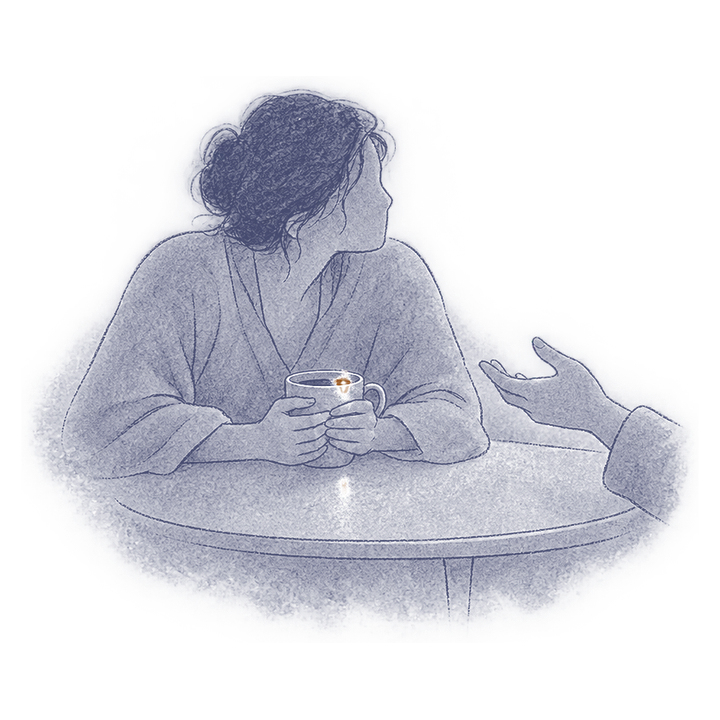
The alarm goes, and you wake thick-headed again, with a dry mouth and perhaps a dull headache that hangs about until the middle of the morning. You were in bed in good time, and as far as you know you slept straight through, yet you start the day groggy all the same. Perhaps you've tried more sleep, more coffee or a new mattress, and decided that this is simply what getting older feels like. And if someone has started mentioning the noises you make in the night, it's strange, and a little alarming, to hear about a night you have no memory of.
Most people with sleep apnea have yet to be diagnosed16, and much of what happens to them happens out of sight. As you fall asleep, the muscles of your throat relax, and in obstructive sleep apnea the airway narrows or closes, over and over7. Each time, your breathing stops or turns shallow and your oxygen dips. Each pause usually ends when your brain wakes just enough for the throat muscles to reopen the airway, often with a big gasping breath78. Then you drift off again, and it all begins again. If being told you stop breathing frightened you, that gasp is your own body ending the pause.
For most people, finding out takes one night in their own bed, with a test done at home34, and apnea is very treatable2, in more than one way. If you're the one lying awake beside the snoring tonight, listening for the next breath, there's a question near the end of the page for you: I'm worried about my partner. What can I do?
Why wouldn't I know if I stopped breathing?
When someone tells you that you stopped breathing, it can sound like an exaggeration, because you were there all night and you remember none of it. A small study of thirty-nine healthy adults sleeping at home helps explain why. In them, a waking in the night had to last about four minutes on average, anywhere from thirty seconds to ten minutes, before they remembered it the next morning5. The rousings that end each pause are brief, so it would follow that most of them are over long before memory has a chance to keep them.
No one has yet measured directly how many of those rousings people with apnea recall. The pattern does fit what health services tell their patients, that you may not know you have it until someone else tells you49.
The night you remember may feel like one long, unbroken sleep, while the night itself was broken many times over. Its only witnesses are the person lying beside you and the way your days feel.
Each upright line is one pause or shallow breath, the events a sleep test counts, drawn at the fewest each band allows34. They're spread evenly over seven hours, though real ones bunch together. Each pause usually ends in a brief rousing7, and brief wakings usually go unremembered5, so the night you recall is the plain band on top.
Worked out from the figures in the studies cited
See this as a table
| What is drawn | Pauses and shallow breaths an hour | Over seven hours |
|---|---|---|
| The night you remember | Unbroken, with none of them recalled | |
| Mild | 5 to 14 | 35 to 98 |
| Moderate | 15 to 30 | 105 to 210 |
| Severe | More than 30 | More than 210 |
| Where | What |
|---|---|
| One of the 105 in the moderate strip; the remembered strip has nothing there | A pause, then a gasp |
The distance between the night lived and the night remembered shows in how rarely apnea is found. In the 1990s researchers studied nearly five thousand employed adults in Wisconsin, people with ready access to doctors, and estimated that ninety-three percent of women and eighty-two percent of men with moderate-to-severe sleep apnea had gone undiagnosed6. Diagnosis has probably become more common since. The study is still the standard measure of how easily apnea goes unseen, and of how much more easily it's missed in women.
What are the signs?
The signs fall into two groups, the ones that happen at night, which you can't see, and the ones that come by day, which you can. The nighttime signs are mostly ones someone else notices479: loud snoring, breathing that stops and starts, and a gasp, snort or choking sound when it starts again. A partner may have heard the snoring build and then stop dead, and lain there counting through the silence until the snort that ends it.
The signs you notice yourself come by day479, and they can add up to a day you know well: sleep that doesn't refresh you however long it lasts, a dry mouth or a dull headache on waking, a sleepiness the extra coffee doesn't shift, trouble concentrating, changes in mood and eyes closing on the sofa by nine. Getting up in the night to pass urine belongs here too, though it's easy to blame on the evening's drink. So does low libido. Tiredness has many causes and none of these signs on its own means apnea, though together they're a good reason to ask about a test.
The one place this sleepiness becomes dangerous is behind the wheel, since untreated apnea makes crashes more likely, with pooled studies putting the crash rate at roughly 1.2 to 4.9 times that of comparable drivers without it10. If you find yourself fighting to keep your eyes open while driving, please pull over somewhere safe and stop. Rules about driving after a diagnosis differ from country to country: in the UK, if apnea with excessive sleepiness is confirmed, you must not drive until the sleepiness is under control4, and your doctor can tell you what applies where you live.
How can I tell snoring from apnea?
Snoring on its own isn't apnea. The US sleep guideline on mouth devices recognizes it as a separate condition, primary snoring11. Doctors have a rule for deciding who most needs a test. In the guideline they use3, what raises the odds of moderate-to-severe apnea is daytime sleepiness together with at least two of these: loud snoring most nights, pauses, gasping or choking that someone has seen, and high blood pressure. It's a way of sorting who to test, and it can't tell you whether you have apnea. If that combination sounds like your nights and days, though, it's a fair reason to ask. And if the snoring is the whole story and it's mostly your partner's sleep that suffers, there's a page about a partner's snoring written from their side of the bed.
Perhaps you lie awake for long stretches as well, and still wake unrefreshed after the hours you do get. The two can happen together. In thirty-seven studies pooled together, about thirty-eight percent of people with apnea also had insomnia, and about a third of people with insomnia had at least mild apnea when tested12. People with both tend to struggle more by day than people with either312, so you could tell your doctor about both.
Some insomnia treatments, such as sleep restriction, shorten your time in bed on purpose, and when apnea is already making you very sleepy they need a doctor's care. Do I have insomnia? and What is CBT for insomnia, and what would it ask of me? cover that side of it.
Could I have it if I'm not an older, heavier man?
You could, and if you're slim, or a woman, or nowhere near retirement, it's easy to decide the picture doesn't fit and talk yourself out of a test. Doctors do look for certain things: being male, overweight or older, a thick neck, relatives with apnea, drinking alcohol, smoking and sleeping on your back all raise the risk47. They raise the odds, and slim people get it too. Some people with apnea have an airway that looks quite normal, and Brazil and several Asian countries have as much apnea as richer countries despite less obesity, partly because the shape of the face and jaw plays a part7.
In the US, an estimated fourteen percent of men and five percent of women aged 30 to 70 have at least mild apnea along with daytime sleepiness13, and it's in women that it's missed most often. Early research finds that women with apnea more often have insomnia, tiredness, headaches and changes in mood, and less often the loud snoring or witnessed pauses that screening was built around14, and US health guidance gives the same picture9. So a woman who describes exhaustion and broken nights may be offered other explanations first. If the rest of this sounds familiar, you could name apnea yourself. Risk also rises after menopause, over and above the effect of age or weight, and more so when menopause comes early714. If your sleep changed around then, that's one more reason to raise it (Why is my sleep so bad during menopause?).
What happens when I tell a doctor?
If you've mentioned tiredness to a doctor before and been told to get more sleep, it can help to walk in this time with specifics: what anyone has seen and heard in the night, how long you sleep and how you feel after it, the morning headaches, the nights you get up, the times you've nodded off. Sleep apps, smartwatches and snoring recorders can't diagnose apnea15, but you could bring a recording of the snoring and the silences as part of that picture. There's no routine screening for people who feel fine13, and that advice doesn't cover anyone who has symptoms.
The doctor may then ask you some questions. Some use a short questionnaire about snoring, tiredness and blood pressure, or a sleepiness scale such as the Epworth, eight questions about how likely you are to doze in everyday situations3. These help decide who needs a test, but the US sleep guideline advises against diagnosing apnea from them. In the studies the guideline reviewed, which checked these questionnaires against sleep tests, the Epworth missed between about a quarter and three-quarters of people who had apnea3. So a low score on a quiz, at the doctor's or online, is no reason to set the other signs aside.
You could mention, too, if you have heart or lung disease, a condition that weakens the muscles, a past stroke or severe insomnia, or if you take opioids long term, because for people in those situations the guideline recommends a full lab study rather than a home test3. Heart or lung disease, a past stroke and long-term opioids also make a different condition more likely. In central sleep apnea the airway stays open, and the brain's signal to breathe pauses instead316. It needs an assessment of its own, and the signs, tests and treatments described here are for the obstructive kind.
What is a sleep test like?
For most people the test happens at home, in their own bed, and the kit is small347. You'd usually wear a thin tube resting under your nose, elastic bands round your chest and belly to follow your breathing, and a clip on one finger for your oxygen. You put it on at bedtime and sleep as best you can, and a little imperfect sleep is fine, since it needs at least four hours of usable recording3. A full lab study, called polysomnography37, adds sensors on the scalp, face and chin that track sleep itself, with a technician watching through the night.
The result comes back as a number347: the average count of pauses and shallow breaths in each hour of sleep, which places you somewhere from mild to severe. Spread over a seven-hour night, a moderate result means roughly 105 to 210 pauses and shallow breaths.
A home test is less sensitive than a lab study and can undercount, partly because it can't tell when you're asleep3. So if yours comes back negative or unclear and the signs are still there, the guideline's next step is a lab study, and it's reasonable to ask for one.
A closer look What do the numbers on a sleep test mean?
The result is given as the AHI, the apnea-hypopnea index347: the average number of pauses and shallow-breathing episodes in each hour of sleep. Five to fourteen an hour is mild, fifteen to thirty is moderate and more than thirty is severe.
Apnea is diagnosed at five or more an hour with the typical symptoms, such as daytime sleepiness, or at fifteen or more even without them. The figure higher up the page draws those bands as a night: each upright line one pause or shallow breath, at the fewest each band allows.
What would treatment be like?
For many people who put off a test, the dread is the mask more than the diagnosis, and what wearing one at night might seem to say about them. So what is it like? CPAP is the main treatment24. A small bedside machine blows a steady stream of air through a mask over your nose, or your nose and mouth, and the air holds your airway open through the night. Across thirty-eight randomized trials, the people who used it were clearly less sleepy by day2. Many now start at home, on a machine that adjusts its own pressure, with someone to fit the mask and show them how it works2.
The first weeks take some adjusting, and they count, because how much you use CPAP in the first days to weeks predicts whether you'll keep going2. The first nights are about falling asleep with a mask on and air flowing. After that, the things that tend to bother people are a dry nose or mouth, a sore throat, a blocked nose and a mask that leaks24. Several of those have fixes. If you wake dry or stuffed up, the clinic can add heated humidification, which eases the dryness and congestion2. If the mask leaks or rubs, you can try another, since no single type has been shown to suit everyone7. And the clinic itself is part of the treatment: their help in those early weeks improves how much people use the machine2.
Not everyone gets on with it, and in long-term studies about a third of people weren't using it enough17. Even so, most keep it up over the years about as well as people keep up asthma inhalers7, and support with the habit of using it added about an hour a night on average17.
If CPAP doesn't suit you, or you'd rather not use it, the option most people hear about first is a mouth device. It's made for you by a dentist, a custom mouthguard-like device that holds your lower jaw a little forward1118. Getting it right takes a while: it takes several dental visits to fit, and then a follow-up sleep test to check it's working711.
The other options each fit particular people. If your apnea is mild or moderate and comes mainly when you're on your back, keeping off your back is an option4718, with a small vibrating device, a tennis ball taped to the back of a sleep top or a wedge pillow. If you're overweight, losing weight can reduce apnea, sometimes enough to end it when it's mild718, and newer weight-loss medicines are being used for it too8. For some people who can't use CPAP or a mouth device, there are operations4718, among them an implant that stimulates the nerve to the tongue and the removal of large tonsils.
CPAP has the firmest evidence behind it. For mild or moderate apnea the mouth device comes close, though the trials comparing them were small, and which suits you will depend on what your test shows and what you can keep up.
A closer look How well do the other treatments work?
In head-to-head trials of the mouth device, CPAP brought the count of pauses down further, but people felt about as sleepy and rated their lives about the same with either, and there was some evidence they used the mouth device more and preferred it18. Those trials were small and of very low certainty, and the European guideline favors CPAP more strongly as apnea gets more severe18. On early evidence, the same guideline counts positional devices a reasonable alternative to CPAP when apnea comes mainly on the back and is mild or moderate18.
In one trial in which people lost ten kilograms, about twenty-two pounds, apnea went away in sixty-three percent of those who began with mild apnea and in thirteen percent of those who began with severe7. In two year-long trials of tirzepatide in adults with obesity and moderate-to-severe apnea, who started at an average of about fifty pauses an hour, the count roughly halved on the drug, against a small fall on placebo8. Stomach and gut troubles were the main side effects, and halving from about fifty would still have left many people in the moderate range.
The nerve-stimulating implant is suggested in Europe only for people with symptoms who can't be treated otherwise and whose AHI and weight fall within set limits18. Surgery to the soft palate helps fewer than half of people a lot, and removing large tonsils can help those who have them47.
Does a drink or a sleeping pill make it worse?
Perhaps there's a glass of wine or a beer most evenings, and you've blamed it for the trips to the bathroom in the night. It may be affecting your breathing as well. When researchers pooled fourteen controlled studies, drinking before sleep added about seven pauses and shallow breaths an hour in people with apnea, and about two across everyone studied19. It made the pauses longer too, with lower oxygen19.
-
If you have a drink now and then
You could see what a few evenings without a drink before bed do to the snoring and to your mornings, and mention how much you usually drink when you see the doctor, since alcohol is one of the things that raises the risk4.
-
If you drink most days, or more than you'd like
Please talk to a doctor before cutting down sharply on your own, because stopping suddenly after heavy drinking can bring on withdrawal, which needs medical care. The same appointment can cover the apnea and the drinking together, and Does alcohol help you sleep? goes further into what alcohol does to the pauses19 and to sleep.
If your nights feel broken and you drag yourself through the days, a sleeping pill can look like the obvious fix. Here the guidance and the trials point in different directions. Health services advise against sleeping pills unless a doctor recommends them, because they can make apnea worse4, and a review of the medical evidence advises doctors to use sedatives cautiously in apnea7. The trials behind that advice are few, though. In small trials that mostly lasted one to three nights, the pills tested didn't clearly raise the number of pauses, though some lowered oxygen overnight16. Their authors note that trials like these may not reflect the doses or the severity of apnea seen in everyday use16. So nobody knows yet how risky an ordinary dose is.
Whichever way that comes out, it helps to tell whoever prescribes for you about the apnea, or your suspicion of it, before adding a sleeping pill, an opioid or another sedative for the tiredness. Are sleeping pills safe to take? covers the pills themselves.
Does treating it protect my heart?
Treatment clearly helps how you feel, and it lowers blood pressure a little. Whether it also protects your heart, by preventing heart attacks and strokes, researchers haven't yet worked out. With CPAP, people are less sleepy, snore less and feel better in mood and in sleep-related quality of life27. Their blood pressure comes down too, by about 2 to 3 mm Hg on average27. That's less than blood-pressure medicines achieve.
You may have read that apnea is bad for your heart, or worse. Most of what's known comes from studies that followed people over time, and they found that untreated apnea goes along with high blood pressure, heart disease, stroke, type 2 diabetes, accidents and poorer quality of life, and severe apnea with a higher risk of death3713. Studies like those show which conditions turn up together. They leave open how much apnea itself causes, because it shares risks such as weight with all of those conditions. The clearest causal link is with blood pressure7.
One large randomized trial, called SAVE, followed people who already had heart disease or had had a stroke, and who weren't very sleepy. They used CPAP for a few hours a night on average, and it eased their sleepiness, snoring and mood, but it didn't reduce heart attacks or strokes20. A later pooled analysis found fewer events among people who used CPAP at least four hours a night21. That comparison wasn't randomized, and people who keep up any treatment tend to differ in other healthy ways.
Both studied people with heart disease who weren't very sleepy, so they can't answer the question for someone who is sleepy and otherwise well. If that's you, the firm evidence is about your days: less sleepiness, and better mood.
A closer look What did the heart trials find?
In the SAVE trial, 2,717 people aged 45 to 75 with moderate-to-severe apnea and existing heart disease or a past stroke used CPAP for about 3.3 hours a night on average20. Over the trial it didn't reduce heart attacks or strokes, though it did ease their sleepiness, snoring and mood, and most of the people in it were men with little sleepiness.
The later analysis pooled three trials, and across everyone in them there was no difference in heart attacks or strokes. Fewer events turned up only when people who used CPAP at least four hours a night were compared with those who used it less21. Because people chose how much to use it, rather than being assigned, that comparison can't show that the extra hours made the difference.
What the research says
- In obstructive sleep apnea the relaxed throat narrows or closes during sleep, and each pause usually ends with a brief rousing before sleep resumes. Well established
- A small study suggests brief wakings usually go unremembered, which may explain why people with apnea feel they slept through; no one has tested this in apnea directly. Early evidence
- Questionnaires such as the Epworth miss too many people with apnea to diagnose from. Well established
- If a home test is negative or unclear and the signs persist, the next step is a lab study. Well established
- CPAP clearly reduces daytime sleepiness in people with apnea who are sleepy. Well established
- Drinking alcohol before sleep raises the number of pauses and makes them longer. Good evidence
- Whether sleeping pills make the pauses worse isn't clear yet: guidance advises caution, while small short trials found no clear rise in pauses, though some lowered oxygen. Still debated
- Whether CPAP prevents heart attacks and strokes isn't clear yet: randomized trials found no reduction, while a non-randomized comparison found fewer events with longer nightly use. Still debated
The big heart trials studied people who already had heart disease and little sleepiness, so their results may not apply to someone sleepy and otherwise well. Apnea in children looks different and none of these findings apply to them.
Questions people ask
I'm worried about my partner. What can I do?
What you've seen matters, because they may not know until someone tells them4. You could note roughly what you hear over a night or two, the snoring, the pauses and the gasps, with no need to time or count them, and offer to go to the appointment with them. There's more on how to bring it up in the page about a partner's snoring.
Is it something I'll have for life?
Where do I start?
The night is the one part of your life you can't sit up and watch. Apnea lives entirely inside it, so the case for a test is built from outside you: from the person who hears the silence and then the gasp, and from mornings you wake up groggy however early you went to bed. If you've recognized yourself here, the first step is a small one. Tonight you could ask someone to listen, or, if you sleep alone, start a few notes on how your days are going. This week you could book the appointment and take all of it with you. For most people the test is one night in their own bed, and whatever it shows, you'll know at last what your nights have been doing while you slept through them.
Morning is when I am awake and there is a dawn in me.