You may have tried the nudge already, and the murmured “roll over”, and had a few minutes’ peace before it started up again. Now there are the sums in the dark on how many hours are left. And in the morning, when they’ve slept fine and you haven’t, you may wonder whether to say anything at all.
If the snoring beside you is steady, rising and falling all night without a break, it’s most likely nothing more than noise. While we’re awake, small muscles hold the throat open. Once sleep begins they slacken, so the tongue, throat and soft tissue of the nose narrow and shiver as the air goes past15. A steady snore is that sound kept up through the night. However hard it rattles the headboard, it’s mostly a problem for your sleep rather than theirs.
What’s worth listening for is the gaps. In sleep apnea the airway closes for a while, and the sound takes a different shape: the snoring builds and then stops, a stretch of silence follows, and it breaks off with a snort, a gasp or a choke2. Lying beside them, you’re the only witness.
What am I listening for?
A steady snore keeps its rhythm, rising and falling, while the breathing underneath it goes on through the night. When sleep doctors judge how likely apnea is, the things they ask about include pauses or gasping that someone has seen, alongside sleepiness in the day6. Loud snoring on its own isn’t enough for them.
In the apnea pattern the rhythm breaks. You hear the breathing labor, then nothing, sometimes for long enough that you start counting, and then the snort that ends it. When the airway closes, the brain rouses the sleeper for a moment and they breathe hard to make up for it5. The gasp that frightens you is the body restarting its own breathing. It does that without any help from you. They roll over and sleep on, and you’re the one left wide awake.
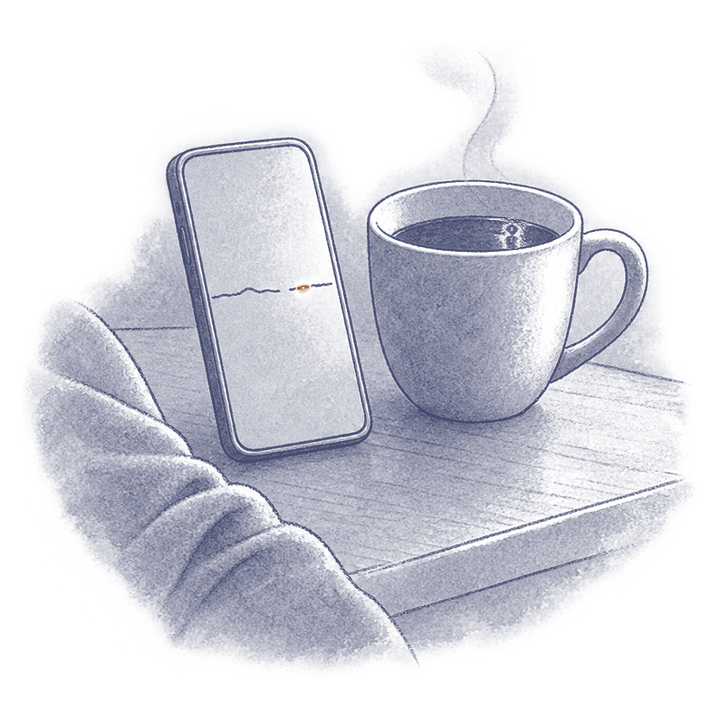
Both strips are drawn at the same height, the same volume: what sets the second apart is the gap. Ordinary snoring is relaxed tissue in the throat and nose vibrating as air passes1, breath after breath. In sleep apnea breathing stops and starts, with gasping, snorting or choking noises2, as the brain briefly rouses the sleeper and they breathe hard5. These are drawn shapes rather than a recording; real nights are less tidy.
Drawn as an illustration of the pattern
See this as a table
| Breathing | What you hear | Its shape in the drawing |
|---|---|---|
| Ordinary snoring | Rattling at times, but the rhythm keeps going | Snore after snore in an even rhythm, with no gaps |
| The pattern worth mentioning | The snoring builds, stops, then a snort or gasp | Snores building over a few breaths, then nothing, then one sharp breath before breathing goes on |
| Part | What |
|---|---|
| Before the pause | Snoring builds |
| The pause | Silence |
| What ends it | A snort or gasp |
The daytime half of the picture matters as much as the night. Across the breakfast table, you might notice that they seem exhausted however long they’ve slept, struggle to concentrate, swing in mood and wake with headaches25. And the snoring itself can be fairly ordinary. Loud snoring is more typical in men with apnea, while in women it more often shows up as tiredness, headaches and trouble sleeping3. So lighter snoring doesn’t rule it out, least of all in a woman who’s worn out every day.
Why do they say they don’t snore?
When you mention it over breakfast, they may tell you they slept fine and don’t snore at all. From their side, that’s honest. They were asleep the whole time, so they didn’t hear any of it, and people with apnea often don’t know about the nighttime signs until someone tells them3. That’s why, if apnea seems possible, the usual advice is for someone to watch them while they sleep2.
Left unsaid, it can go on for years. That may be part of what researchers saw in one older US study. They tested more than a thousand working adults overnight, people with no obvious trouble getting to a doctor, and found that most of those with moderate to severe apnea hadn’t been diagnosed7.
In Dallas, researchers held long interviews with twenty-four people who had apnea, and with their partners. Again and again it was the partner who first saw the problem and pushed for care8. The people with apnea came to understand their own illness through what their partner had seen8, more than through anything they’d noticed in themselves. Knowing someone’s breathing better than they do is an odd sort of intimacy. It also makes you the one who can tell them, and a doctor, what happens at night.
How do I bring it up without it sounding like a complaint?
It may help to start with what you heard rather than how your nights have been. “You stopped breathing for a bit last night and then gasped, a few times” is easy to hear and nothing to feel ashamed of, while “I haven’t slept in weeks” asks them to defend themselves before breakfast. Your tiredness is real and deserves its own conversation, but the pauses are the part they can’t see for themselves.
If they’re willing, you could record a minute or two on your phone one night, to play them in the morning or to take to a doctor. It won’t diagnose anything, since checklists and the like can’t stand in for a sleep test6. But it lets them hear what you hear, and from there you could suggest finding out together. Among couples where one partner was using treatment for apnea, working on it together went with better use of it, while pressure didn’t and criticism or nagging may backfire4. Those studies were about keeping treatment going, though the same spirit seems to fit the first conversation. The NHS also suggests bringing the partner who has seen it to the appointment2 to describe what the snoring is like.
What happens if they see a doctor?
For most couples it starts with an ordinary appointment with a GP or family doctor, and you don’t need to be sure it’s apnea to book one. The NHS suggests going if breathing stops and starts, there are gasping or choking noises, the snorer is very tired every day, or snoring is having a big effect on either of your lives12. That last reason means your own lost sleep counts too.
If the doctor thinks apnea is likely, your partner will need a night with their breathing recorded, and they can usually do it at home2, in their own bed. If it does turn out to be apnea, there’s more than one way to treat it. Some people improve with weight loss, stopping smoking and drinking less2. Many sleep with a CPAP machine, which pumps air through a mask at night2, and others wear a device in the mouth2. That leaves your partner room to find what suits them.
Treatment tends to help you as well: across many studies, treating apnea went with better sleep for the partner4. In focus groups, partners talked about what it was like once the snoring stopped. They said the first few nights without snoring were unnerving, then they fell asleep faster, had more energy, felt happier and, in time, moved back into the shared bed4.
Can anything ease ordinary snoring?
At the end of an evening, a couple might wonder what they could change together. None of what follows is a cure, and none of it rules apnea out. A few things do change breathing in sleep, though. Alcohol is the clearest of them. In sleep-lab studies, alcohol made snoring worse in people prone to it910, and in people with apnea the pauses and shallow breaths rose by about seven an hour after drinking9. Leaving out the drink near bedtime for a few evenings is one of the simpler things you could try together.
Weight works more slowly, over the years: in one long study people who put on weight had more pauses in their breathing four years later, and people who lost weight had fewer11. A nose that’s blocked most nights goes with a good deal more snoring12, so it’s one to mention to a doctor, though whether clearing it eases the snoring hasn’t been well tested. Sleeping pills can make snoring and apnea worse12, so they aren’t an answer for the snorer.
It’s often said
If they snore less on their side, it can’t be anything serious.
Why it can feel that way
Rolling them over often does bring a stretch of peace, and it seems to follow that whatever was wrong has been fixed.
What’s going on underneath
Rolling over often does ease the sound for people who simply snore, and it changes much less for people with apnea. In one small sleep study, snorers without apnea snored far less on their sides than on their backs, while people with apnea snored nearly as much either way13. So a better night on the side doesn’t rule apnea out, and the pauses and daytime tiredness are still the things to go by.
And what about my own sleep?
By now it may be your own sleep you most want back, and it’s fair to wonder how much of it the snoring takes. A small Mayo Clinic study gives a sense of that. Ten wives slept in the lab beside husbands who were put on CPAP halfway through the night. In the first half, up to a third of the wives’ brief wakings came within one to three seconds of a snore14. Once the machine went on, the wives slept about an extra hour14, all in the same night. It was one night and ten couples, and still the only study of its kind, but it shows how closely one person’s breathing can steer another’s sleep.
Whether your nights look like theirs may come down to how heavy the snoring is and how easily you wake. Among partners of people referred to sleep clinics with suspected apnea, more than half said snoring disturbed their sleep every or almost every night4. Yet when 110 couples from the community, mostly with milder breathing problems, were tested at home, partners slept no differently whether or not the person beside them snored or had breathing problems15. Researchers don’t agree yet on why, and lighter snoring may be part of it. If the snoring beside you is heavy and you wake easily, the clinic partners are likely the closer picture of your nights.
-
If the snoring is steady and it’s your sleep that suffers
Earplugs are the NHS’s own suggestion for a snorer’s partner1. Many partners take turns going to bed, which for some couples leads to separate rooms4. Some go to sleep before the snorer, so they’re asleep before the noise starts. Others like a steady background sound. The evidence for that is mixed and low quality16, and it’s best kept at a modest volume. None of these has been properly tested for partners of snorers, so it comes down to what suits you. Another room, or the sofa, is a sensible choice too. The Mayo wives got back about an hour of sleep in a single night14 once the snoring stopped.
-
If you’ve heard pauses and lie awake keeping watch
Many partners describe feeling they must watch the sleeper’s breathing through the night, and some keep sharing the bed despite poor sleep to be sure4. Once you’ve raised it, you don’t need to wake them or keep count until morning. Each pause ends in that gasp without you, and the earplugs can go in.
A first night apart may not feel like much of a change. When sixteen women bothered by their partners’ snoring slept alone for one night, their wakings and light sleep fell only a little17. One night is a short time to judge by, and a new arrangement can feel strange at first. If you take the spare room tonight and lie there half-listening for them through the wall, that’s one night. The next few will tell you more.
I swear they are averaged now—one is no better than the other, The night and sleep have liken’d them and restored them. I swear they are all beautiful, Every one that sleeps is beautiful, every thing in the dim light is beautiful, The wildest and bloodiest is over, and all is peace.
What the research says
- Most snoring isn’t a sign of anything serious. Well established
- Breathing that stops and starts with a gasp, plus daytime tiredness, are the signs of sleep apnea that call for a doctor’s visit. Well established
- In one older US study of working adults, most people with moderate to severe apnea hadn’t been diagnosed, and people with apnea often miss their own nighttime signs. Good evidence
- Testing can usually be done at home for adults with likely apnea. Well established
- In one small study, side-sleeping eased ordinary snoring much more than the snoring of people with apnea. Early evidence
- Alcohol and weight gain make breathing in sleep worse. Good evidence
- Treating apnea tends to improve the partner’s sleep. Good evidence
- Studies differ on whether partners sleep worse: partners of people referred to sleep clinics often say so, while a community study of mostly milder breathing problems found no difference, perhaps because the snoring was lighter. Still debated
- Earplugs, white noise and separate rooms haven’t been properly tested for partners of snorers. Not well studied yet
Most partner studies were of women sleeping beside men, so less is known about male partners and same-sex couples.
A closer look Who was studied, and what did they find?
The Mayo Clinic study had ten couples, all with a male patient, and both partners were wired up for the night14. Once CPAP went on, the wives’ wakings fell from twenty-one to twelve an hour, and their share of the night asleep rose from seventy-four to eighty-seven percent14. The extra hour is the authors’ estimate, assuming eight hours in bed. In the French study of women sleeping alone, some of those first recruited turned out to snore themselves without knowing17 and were left out.
The larger figures on partners’ lost sleep come from small groups of partners of people referred to sleep clinics, reported in their own words4. The study that found no difference was 110 couples from the Sleep Heart Health Study, tested at home, with mostly mild to moderate breathing problems and no one seeking treatment15. In one group of fifty-four couples at a US sleep center, partners were less sleepy in the day and scored higher on vitality and mental health after about six weeks of CPAP18, a single group with no comparison.
The snorers’ figures come from a few studies. In working adults in Wisconsin in the 1990s, with good access to doctors, researchers estimated that ninety-three percent of women and eighty-two percent of men with moderate to severe apnea had not been diagnosed7. In the same group, a ten percent weight gain predicted about a third more pauses and shallow breaths an hour four years later, and a ten percent loss about a quarter fewer11, and a nose blocked nearly every night went with about three times the odds of snoring most nights12. After drinking, pauses and shallow breaths rose by about four an hour in snorers and seven in people with apnea910. In the side-sleeping study, snorers without apnea snored for about seventeen and a half percent of the night on their backs and six percent on their sides, while people with apnea snored around seventeen and fifteen percent13.
Questions people ask
Should I wake them when they stop breathing?
There’s no need to wake them. A pause in apnea ends by itself: the brain rouses the sleeper for a moment and they breathe hard5. That breath is the gasp you hear. What helps is mentioning it in the daytime, so they can get it checked.
They say they don’t snore. What do I do?
From where they lie, they’re being honest, because they slept through all of it3. A short recording, made with their agreement, lets them hear what you hear.
Can a phone recording or app tell if it’s apnea?
No recording or checklist replaces a sleep test6, but a recording is a useful thing to take to a doctor, along with what you’ve noticed.
Does sleeping apart mean something’s wrong between us?
As far as the research goes, it needn’t. In one study, wives of men with untreated apnea were more likely to sleep apart, and their marriages were no less happy4, and reviewers see no reason to treat sleeping apart as a failing19. No trial has tested separate rooms, but some couples choose them for the sake of their sleep.
The snoring is heavy but steady. Is that a worry?
On its own, steady snoring rarely points to anything serious1 for the snorer. If it’s costing you a lot of sleep, though, that counts as a reason to see a GP.