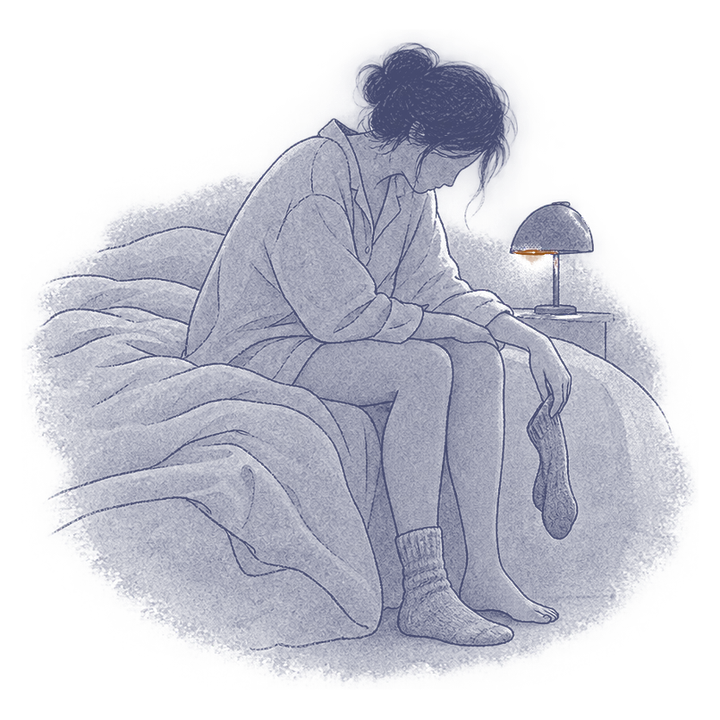
That fog of the first half hour, when your eyes won't stay open and a simple question feels like arithmetic, has a name: sleep inertia. It's a normal part of waking up13, even after a full night at your usual time1, so having it this morning doesn't mean you slept badly. For a while the brain runs slow and muddled on its way back to the day.
If the fog clears by mid-morning and the rest of the day goes well enough, that first half hour may be all that's happening. If it lasts until lunch, or all day, the answer often has less to do with how many hours you slept than with when you slept them, and in where the moment you woke fell in your body's night13. How broken the night was matters too.
Why is the first half hour so hard?
You may know the first half hour from the inside: you're up and moving, and your thoughts are still a few steps behind you. In a small imaging study of volunteers who had been short of sleep, blood flow returned to the deep structures of the brain within about five minutes of waking13, while the front of the brain, which does your planning and judging, took five to thirty minutes to follow. The brain comes back in stages, the deep parts first, so for a while you're awake enough to walk into the kitchen and not yet awake enough to remember why.
Even after a good night, the climb back takes a while. Researchers let healthy adults sleep a normal eight hours in a sleep lab, then tracked them through the hours after waking. Their alertness and mental speed came back quickly at first and then more slowly, over two to four hours2. Feeling alert returned sooner than doing well on a mental task, which is one reason how groggy you feel and how well you're doing don't line up neatly1 while the fog wears off. The first few minutes can be a poor guide to the rest of the day.
The researchers also watched what happened when the volunteers did the usual things to wake up. Getting up, eating breakfast, showering and sitting in ordinary room light didn't stop the impairment2, which was there whether they did them or not.
If you've ever blamed yourself for not snapping out of it, the people in that lab couldn't either. Coffee doesn't reach the start of it: in nap studies, even fast-acting caffeine gum may shorten sleep inertia without touching its first, worst minutes1. Those first minutes pass on their own, whatever you drink.
A closer look How was the eight-hour-night study done?
Researchers at Brigham and Women's Hospital ran this one in their laboratory (Jewett and colleagues2). Healthy adults slept a normal eight hours, ending at their usual wake time. Starting one minute after waking, the team measured how alert the volunteers felt and how quickly they could think. They kept measuring for four hours, on three separate mornings.
Feeling alert came back faster than performance. On the curves the researchers drew through the results, the sense of alertness did most of its recovering in roughly the first forty minutes, and performance on a mental task in roughly the first seventy (time constants of 0.67 and 1.17 hours). After that, both kept rising more slowly for hours.
One limit is worth knowing. The body clock's own morning rise happens at the same time, and in this design the two can't be pulled apart1, so some of that slow climb may be the clock and some the inertia.
Why can a full night feel like half a night?
Some mornings the alarm goes while everything in you still says night, and those are the mornings the fog is thickest. Your body clock keeps its own night, with its lowest point in the early hours. Sleep inertia is worst when you wake during that biological night13, even when the night before it was a full one.
Night owls tend to feel this most. People with a late-running body clock who have to get up early wake close to the low point of their body temperature, when inertia is strongest3. The clearest evidence comes from people diagnosed with a delayed body clock, and something similar probably happens, more mildly, to anyone whose clock runs later than their alarm. Researchers have a name for the gap between your sleep times on work days and on free days: social jetlag4. It's widest in people whose clocks run late.
A month-long study of college students at Harvard shows how far the same hours can drift. The students kept sleep diaries for thirty days, and the most irregular sleepers averaged 7.2 hours a day, much the same as the most regular at 7.35, though the irregular ones made up some of theirs with daytime naps. When the researchers measured the evening rise of melatonin, the body's signal that its night has begun, it came at about 9:30pm in the regular sleepers and just after midnight in the irregular ones. That was about two and a half hours later, which the authors likened to traveling two to three time zones west5. For those students the same seven hours took place at very different points in the body's night, and an early alarm would have found the irregular sleepers still deep inside theirs.
Each ring runs from the evening rise of melatonin to the hour the body was sleepiest. The two groups of Harvard students slept much the same number of hours a day, yet the irregular sleepers’ whole night ran later, its sleepiest point near half past six in the morning rather than a quarter to five5. These are group averages from 24 students. The evening melatonin rise differed from person to person by more than an hour.
From the studies’ own measurements
See this as a table
| What | From | To |
|---|---|---|
| Regular sleepers: melatonin rise to sleepiest | 9:32pm | 4:45am |
| Irregular sleepers: melatonin rise to sleepiest | 12:08am | 6:33am |
Why is Monday worse after sleeping in on the weekend?
Weekends can make the puzzle stranger, because a long Saturday morning is so often followed by a Monday that feels harder than Friday did.
It’s often said
Sleeping in on the weekend helps me catch up.
Why it can feel that way
After five early alarms, sleeping until your body lets you go feels like giving back what the week took, and that Saturday morning can feel wonderful while it lasts.
What’s going on underneath
Each later morning lets the body clock slide later with it. By Monday its night runs later too, and the weekday alarm rings while you're deeper inside it. The clearest picture comes from teenagers aged 15 to 17, sleeping at home. They stayed up a little later and slept in by about three hours on Saturday and Sunday, and by Sunday evening their clocks had moved about forty-five minutes later6. Monday's alarm was ringing earlier in their body's night than Friday's had. In adults the evidence comes from two weeks of waking later7, and it points the same way. Those later mornings also gave people more sleep, so the two effects can't be fully separated.
Is it because my alarm woke me out of deep sleep?
You may have heard that grogginess comes from being woken mid-cycle, out of deep sleep, and that you can avoid it by timing your alarm to ninety-minute sleep cycles. Researchers don't agree on the first part yet. Older laboratory studies found that waking from deeper sleep made the fog worse, while newer ones often find no link1. Where the effect does turn up, it's mainly in people who'd been kept short of sleep or had napped for a long time, and rarely in people who were well rested. In the eight-hour-night study, the stage people woke from made no detectable difference2.
For someone who slept a full night, the evidence mostly favors the clock: the stage you woke from probably matters less than where in your body clock's night the alarm found you. In lab studies that spread volunteers' sleep across every hour of the body clock, the gap between waking at its best and worst times was about three times bigger straight after waking than twenty minutes later13. None of this research supports timing an alarm to your cycles to the minute.
How short of sleep you've been matters too. In one laboratory study, researchers held volunteers to about five and a half hours a night, and their performance on waking was ten percent worse than after eight-hour nights, and still not back to normal seventy minutes later1. If your nights really are short because life won't give you more, how to get through the day after a bad night has more for those days.
Could I be sleeping less than I think?
Eight hours in bed may not be eight hours of unbroken sleep. In lab studies, researchers woke healthy volunteers again and again through the night, and the broken sleep brought daytime sleepiness, slower reactions and lower mood much as short sleep did8. How bad it got tracked how much sleep was lost or broken up8. A long night stitched together from many short pieces can leave you nearly as tired as a short one.
Two ordinary things can thin a night this way without announcing it. An evening drink helps you drop off, but it breaks up the second half of the night and cuts REM sleep from about two standard drinks, more with more910. Whether alcohol helps you sleep looks at that closely. Coffee can reach the night from much earlier in the day, and how long caffeine stays in your system has the detail. In a trial with young men sleeping at home, a large dose taken as long as twelve hours before bed still delayed sleep and changed its structure11. The men didn't rate their nights any worse unless they'd had it within a few hours of bed. Their sleep had changed well before it felt any different to them.
What might help this week?
Because waking in your body's night makes the fog thicker, the steadiest change is to the clock: a wake time that stays about the same every day, weekends included12. Sleep specialists count timing and regularity alongside hours12, and for your mornings that means an alarm that meets your body clock at the same point every day. No trial has tested this directly for morning tiredness in adults; it's a sensible step that follows from the body-clock studies above. It asks for steadiness and no extra time in bed, since long mornings in bed move the clock later.
Light is probably part of why timing matters so much. The irregular sleepers in the Harvard study spent dimmer days5 than the regular ones. When the researchers fed each group's light pattern into a mathematical model of the body clock, the difference in light mainly explained why the irregular sleepers' clocks ran later5. That's an answer from a model, and no one tested it by changing the students' light. A small adult study points the same way: when researchers moved people's wake times for two weeks, their clocks moved too, and the authors suggest the morning light that came with each wake time is likely part of why7.
So this week, a little daylight soon after you get up, most mornings, could help keep your clock where your alarm needs it. What light won't do is clear this morning's fog, which hasn't responded much to light after waking13. Nor did it stop the drift from a weekend of lie-ins: in the teenagers, an hour of blue light on waking didn't stop the weekend shift6.
-
If the fog lifts by mid-morning and the day is fine
-
If your weekends run much later than your weekdays
That gap is the social jetlag from earlier, and sleeping in can shift the clock later67, so Monday's alarm arrives deeper into your body's night. Bringing Saturday and Sunday mornings closer to your weekday time, a little at a time if that's easier, is a good place to begin.
-
If you're tired all day, every day, for weeks
In European surveys outside Germany, twenty-two to thirty-eight percent of people say they're tired13. Tiredness that lasts for weeks most often comes from sleep disorders, including breathing problems in sleep, or from depression, anxiety and stress13, so there are real things to look for. If your blood tests have already come back normal, that counts for something: with a normal history, examination and basic blood tests, anemia, thyroid problems or cancer are very unlikely to be the cause13. Normal bloods don't rule out a sleep disorder such as sleep apnea, low mood or badly broken sleep. The signs that make tiredness worth taking to a doctor can help you decide on a next step.
What the research says
- Grogginess on waking, sleep inertia, is a normal part of waking up. Well established
- Brain scans suggest the brain comes back in stages on waking, the deep parts within minutes and the front later. Early evidence
- The worst usually passes within about thirty minutes, and clear-headedness keeps returning for two to four hours. Good evidence
- Waking during your body clock's night makes the fog thicker. Good evidence
- Studies differ on whether waking from deep sleep makes the fog worse in well-rested people. Still debated
- In one small study of students, irregular sleepers slept much the same hours as regular ones with a body clock running about two and a half hours later. Early evidence
- Small studies suggest waking later, including sleeping in on weekends, moves the body clock later. Early evidence
- A night broken up by many wakings can leave you nearly as sleepy as a short one, depending on how much sleep is lost. Good evidence
- Small studies suggest morning light helps set the body clock earlier over days while doing little for the first-half-hour fog. Early evidence
Most of this comes from small studies of healthy volunteers in laboratories, college students and teenagers. What causes sleep inertia is still not fully known3, and body clocks differ from person to person, with late types tending to feel the timing most.
What can I tell myself tomorrow morning?
When the alarm goes tomorrow and the room seems to tilt, that slowness is, as far as the brain scans can tell, your brain coming back in stages, the deep parts first and the planning parts after. Your mornings depend on timing as well as hours12. Late and irregular wake times go with a clock that runs later57, so a wake time that stays the same is the sensible step that follows, and over a few weeks it may make weekday mornings a little easier. By the time you're dressed and at the door, the front of your brain has usually caught up with the rest of you.
Morning is when I am awake and there is a dawn in me.