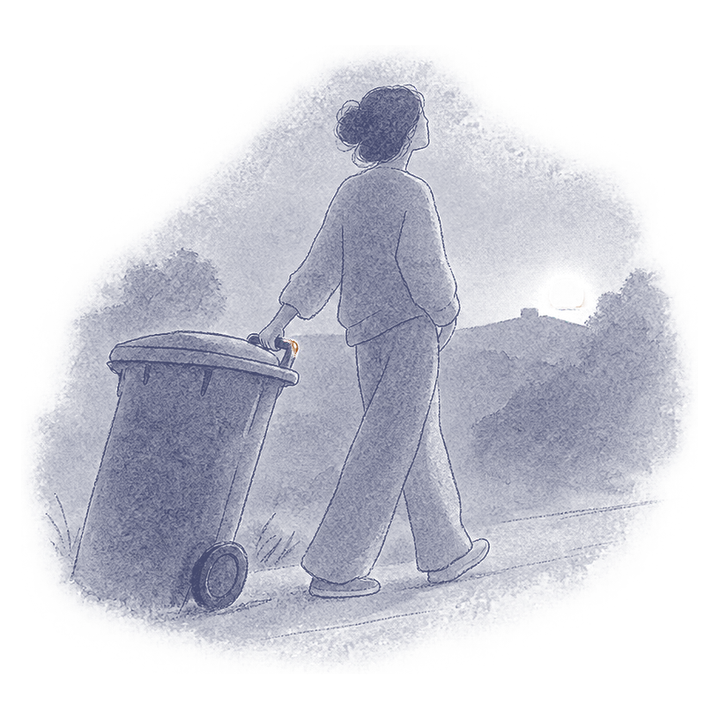
After dinner the tiredness can get so strong that the sofa starts to feel like bed. Then, somewhere around ten, it goes. By the time you lie down, your mind is clear and busy. If you're reading this late, you may be right inside that turn, in the stretch when the clock pushes hardest to keep you up89.
Two things are working as a pair. One is a sleep pressure that builds from the moment you wake, so by evening it's strong. The other is your body clock, which sends its own signal through the day and night. Together the two set when you sleep and how deeply5. Through the day the clock works against that growing sleepiness, and around your usual bedtime it stops.
Is there really a clock inside my body?
There is, and it keeps time in more places than you might expect. The one in charge is deep in the brain, in a small cluster of cells in the hypothalamus called the suprachiasmatic nucleus. It acts as the master clock for the body's daily rhythms, and it takes in light directly from the eye1. Researchers worked most of that out in rodents, and what we know about people is the textbook view based on their work.
Then there's how widespread the timekeeping is. When researchers take cells and tissues out of the body and grow them in a dish, far from any brain, they keep going through their daily rhythm1. Nothing tells them what hour it is, and they keep one anyway. Cells and tissues all through the body keep time like this1. So what's left for the brain's clock to do? It keeps them together, the way a conductor keeps an orchestra in time. In animals whose master clock has been removed, the clocks in different tissues drift out of time with one another1. When you eat can nudge the clocks outside the brain too1.
People noticed this inner timekeeping long before anyone could find it. In the 18th century the astronomer Jean Jacques d'Ortous de Mairan shut a mimosa plant away in constant darkness and watched its leaves go on opening and closing on their daily rhythm10, with no sun to tell them when. Centuries later, the 2017 Nobel Prize in Physiology or Medicine went to Jeffrey Hall, Michael Rosbash and Michael Young for working out how the clock is built inside a cell, in fruit flies, and the same principles run in human cells10.
A closer look How does a single cell keep time?
The prize-winning work began with a gene in fruit flies called period. The gene makes a protein that slowly builds up inside the cell through the night. Once there's enough of it, the protein switches off its own gene, so no more is made, and through the day what's there is broken down. When it has gone, the gene switches back on and the cycle begins again, taking roughly twenty-four hours10.
Nothing outside the cell has to tell it the time for this to happen. The loop times itself. That's how cells in a dish keep their rhythm, and it fits what de Mairan's mimosa showed long before anyone knew about genes: a living thing can keep time with no cue from outside. In mammals these loops run in tissues all through the body: in any one tissue, between three and ten in every hundred active genes rise and fall over the course of a day1. What light and the master clock add is to set all those loops to the same hour, and to the hour of the world outside.
Doesn't my body follow the clock on the wall?
Left to itself, your body clock keeps a day of its own, and it runs a little longer than the world's. In most people its own cycle lasts about twenty-four hours and nine minutes211, though some people's run shorter than a day2. Those nine minutes come round every day, so your inner day keeps ending after the outer one. With nothing to pull it back, your evenings would slide later night after night.
What pulls it back is light, and the eye has its own cells for the job. Alongside the rods and cones we see with, there's a third kind of light-sensing cell1. It responds slowly and needs fairly bright light, which suits it to reading the day rather than a passing flash1, and the rods and cones feed into it as well. Mice with no working rods or cones still reset their clocks to light12, which shows this pathway running on its own, apart from sight. And in some people blinded by the loss of their rods and cones, light still set their clocks and switched off their melatonin12, though they couldn't see it at all.
Each row down is a day, four weeks in all. The open rings stay in one column: a clock reset by light each morning keeps its evening where it was. The beads are the same clock left to itself, running twenty-four hours and nine minutes, the average measured in 157 healthy adults in a laboratory where light couldn't steer them2, so each day ends nine minutes later than the last and the minutes add up. People's clocks vary around that average, and some run shorter than a day2.
Worked out from the figures in the studies cited
See this as a table
| Day | Left to itself, nothing resetting it | Reset by light each morning | Worked out as |
|---|---|---|---|
| Day 1 | Where it began | Where it began | The starting point |
| Day 8 | About an hour later | Where it began | 7 days × 9 minutes, 63 minutes |
| Day 15 | About 2 hours later | Where it began | 14 days × 9 minutes, 126 minutes |
| Day 22 | About 3 hours later | Where it began | 21 days × 9 minutes, 189 minutes |
| Day 29 | About 4 hours later | Where it began | 28 days × 9 minutes, 252 minutes |
It’s often said
The body clock runs on a 25-hour day.
Why it can feel that way
It's a figure that has been repeated for decades, and it came from real experiments in which people lived for weeks cut off from daylight and their sleep drifted later.
What’s going on underneath
In those early isolation studies, people switched their own lights on and off, and that light itself shifted their clocks and skewed the measurement211. Once light was carefully controlled, the cycle came out at a little over twenty-four hours211, long enough to need setting each day and much closer to the world's day than the old figure.
How does my body decide when I'm sleepy?
By ten in the evening you've been awake longer than at any other point in the day, so the pressure to sleep is at its height. Why, then, is that so often the hour a second wind arrives? Researchers went looking for the answer by pulling the clock and the pressure apart.
In one experiment, eight men lived in time isolation for over a month on long artificial days, so that their sleep fell at every hour of their body clock's cycle8. That let the researchers measure the body clock and the sleep pressure separately, and the two turned out to matter about equally to how unbroken sleep stayed through the night8. Put back into an ordinary day, their timing looks almost back to front. The clock's push to stay awake peaks in the evening, just as pressure is highest. Its push to sleep peaks in the early morning, when pressure has nearly gone89. So the two balance each other. That's how you can stay alert through a long day, and sleep on through the hours when you've already had most of the sleep you need.
Your evening has a chemical marker too. The pineal gland makes melatonin, the body's signal of biological night: it's released during the clock's night, and light both resets its rhythm and switches its production off13. In eight adults living their ordinary lives, it began to rise roughly two hours before they fell asleep4. You might expect sleep to come easiest in those last evening hours, with the pressure high and the night signal close. When researchers measured how readily people fall asleep across the clock's cycle, they found the reverse: in the hour or few hours before people's usual bedtime, falling asleep is harder than at any other time1415. They call this stretch the wake maintenance zone, or the forbidden zone for sleep.
It shows in how sharp people are, as well. In a small lab study, 31 young adults kept awake for about two days did better on attention tests in those evening hours than they had earlier in the day, though they'd been awake longer16. If you're worn out by ten and yet something keeps you up, this evening window is probably the second wind you're feeling. If that's where you are tonight, Why am I wide awake at bedtime? has more on what helps. By the time your usual bedtime comes, the window has passed, and sleep comes more easily than it would have an hour or two before.
Why does light in the morning and the evening matter?
Light reaches you at different hours on different days: the window over breakfast, the street on the way to work, the lamp beside you late in the evening. Which hour it arrives in decides whether it moves your clock earlier or later. Researchers mapped this by sitting 21 adults in a lab under hours of very bright light, each at a different point in their body clock's cycle. Light in the late evening and the first half of the night, before the body's lowest temperature, pushed the clock later. Light after that point, toward and into the morning, pulled it earlier3. No long stretch of the day left light without effect, though at the turning point between later and earlier it caused no shift3. That lab light was far brighter, and lasted far longer, than most days bring, so the size of those shifts may not apply to yours. The direction does. Since the clock sets when sleepiness comes, light late in the evening tends to push your sleepiness later, and morning light tends to draw it earlier.
What happens when ordinary days change? For a small study, researchers took eight adults to the Colorado Rockies. The eight spent a week of their ordinary lives, and then a summer week camping, with only sunlight and campfires4. Out under the open sky, the light reaching them rose more than fourfold4. By the end of that one week, every measure of their inner clock had moved about two hours earlier, and their melatonin began to rise near sunset4, at the hour the light outside was going.
Evening light works the other way, and it needn't be bright to matter: ordinary room light before bed is enough to make melatonin start later13.
A closer look Can a lie-in or an ordinary lamp move my clock later?
Two studies show ordinary days moving the clock later. In the first, when healthy adults woke three hours later for two weeks, and so spent longer asleep each night and missed the early light, their melatonin rhythm moved about two and a half hours later17. The researchers think the missing morning light was the likely cause.
In the second, the lamp of an ordinary room was enough. Among 116 young adults living in a research center, room light before bed made melatonin start later in ninety-nine percent of them, and shortened its night by about ninety minutes, compared with dim light13.
It’s often said
Screens before bed wreck your body clock.
Why it can feel that way
Phones and tablets glow at exactly the hour the clock is most open to being pushed later, and it's easy to keep scrolling long past the point of tiredness.
What’s going on underneath
In a lab, reading on a tablet at full brightness for hours before bed, five evenings running, set the clock about an hour and a half later than reading a printed book. Even so, people took on average only about ten minutes longer to fall asleep18. So the clock looks far more sensitive to that light than sleep itself is. Outside the lab the picture is less clear. Among 16- to 25-year-olds, screen and phone use go with shorter sleep, and phone use at night goes with later bedtimes19. Studies can't yet say which causes which19, and the evidence that blue light in particular keeps people alert is inconsistent20. How does light affect my sleep? looks at this more closely.
Am I an owl because I was born that way?
If you're an owl, you probably know the nights of lying awake at eleven while someone beside you drops off in minutes, the mornings that arrive like the middle of the night, and the way you come alive in the evening just as everyone else is fading. Larks live the same thing turned around. Both are part of a wide spread: across American adults, the middle of weekend sleep spans almost ten hours, and the middle half of people have theirs between about 2:24am and 4:15am21. A midpoint of 4am is someone asleep at midnight and up at eight.
Some of where you fall in that spread comes with you from birth. Finnish researchers asked more than eight thousand pairs of adult twins whether they were morning or evening types, and found that genes accounted for about half the differences between people6. Since then, gene hunters have searched the genomes of hundreds of thousands of adults and found hundreds of places linked with being a morning person7. Each of those places matters only a little: the five percent of people carrying the most morning variants sleep on average about twenty-five minutes earlier than the five percent carrying the fewest7. Added together, the common variants the gene study could measure explain about a seventh of the differences between people7, well short of the twins' half. Nobody has fully explained that gap. Part of it is that the gene study counts only the variants it could measure, and the two methods differ in other ways too. What both find is that a real share of whether you're a lark or an owl runs in families. That part is something you came with.
The rest comes from the life you're living: age, sex and the light people live in explain a large share of the differences, alongside genes722. Across a national sample, weekend sleep moves later through childhood and the teenage years, is latest around age 19, and then drifts steadily earlier, until people of 70 sleep at much the same times as 10-year-olds21.
-
If mornings have always been a struggle
Dragging yourself through mornings like that, it's easy to wonder whether the trouble is you. Being an owl comes partly from the genes you were born with and partly from the light and the age you're living in, so hard mornings say very little about discipline. Early nights often mean lying awake longer, because you're trying to sleep in your clock's evening, when it's working hardest to keep you up. Late types feel the clash with work and school hours most, building up a sleep debt through the week and sleeping it off at weekends22.
Light can move an owl's clock too. One summer week under open sky can't promise the same of an ordinary week, but in that small study of eight campers, the latest types moved furthest4.
-
If you fade at dinner and wake early even on holiday
Nodding off at a 9pm dinner, or lying awake at 5am on a free morning with nothing to get up for, puts you toward the early end of the same spread. About a quarter of American adults have the middle of their weekend sleep before about 2:24am21.
-
If you've started waking earlier as you've got older
If you now wake before you'd like to, the clock itself hasn't sped up: in older people it runs no faster than in younger ones911. And yet the time they tend to wake moves earlier. That seems to come from weaker sleep pressure and a weaker early-morning signal from the clock to stay asleep911. Why does my sleep change as I get older? goes into it further.
Why do jet lag, late weekends and night shifts feel the way they do?
Each of them opens a gap between the clock inside you and the day outside. After a flight across time zones, the day outside has moved all at once, and the clock inside is still set to the place you left. The clock times sleep, hormones, body temperature and metabolism, so you feel that mismatch for as long as it lasts10. Sleepiness, hunger and wakefulness turn up at the wrong hours. Night work asks you to be awake through your clock's night and asleep through its day, when its push runs the other way89. How do I get over jet lag faster? and How do I sleep well on night shifts? take each in turn.
A weekend can open the same gap on a smaller scale, and you may know it best on a Monday, when the alarm rings while your clock still thinks it's night. In 15- to 17-year-olds sleeping at home, one ordinary weekend of going to bed an hour and a half later and sleeping in three hours later pushed their clocks about forty-five minutes later by Sunday23, and an hour of morning light on the weekend mornings didn't stop it23. Why can't my teenager fall asleep before midnight? has more for parents. Adults weren't studied, though the same may happen to them and be part of what makes Monday mornings so hard.
Morning is when I am awake and there is a dawn in me.
What the research says
- A small region of the brain acts as the master body clock, and cells throughout the body keep their own daily rhythms. Well established
- Under carefully controlled light, the human clock runs a little over twenty-four hours, about twenty-four hours and nine minutes on average. Well established
- Light in the late evening and early night moves the clock later, and light toward and into the morning moves it earlier. Well established
- Melatonin is the body's signal of biological night, and light switches it off. Well established
- In the hours before your usual bedtime the clock pushes hardest to keep you awake, which probably explains the late-evening second wind. Good evidence
- Whether you're a lark or an owl is partly inherited, and each genetic variant found so far makes only a small difference. Good evidence
- In one small study of eight adults, a week of natural light alone moved their clocks about two hours earlier. Early evidence
- It isn't yet known whether ordinary screen use shifts the clock, and the evidence that blue light keeps people alert is inconsistent. Still debated
Twin studies put the inherited share of chronotype at about half. The large gene study, of nearly 700,000 adults, found 351 places in the genome linked with being a morning person, and put the share at around a seventh7. That's partly because it counts only the common variants it could measure. The two methods differ in other ways too, though both find a real share of chronotype that runs in families.
A closer look How do researchers measure a clock that light keeps resetting?
The difficulty is that every light a person sees nudges the clock, so you can't simply watch someone's sleep and read the clock's length from it. Researchers found their way around this by putting people on days the clock can't follow. In the study behind the figure of twenty-four hours and nine minutes, 157 healthy adults, 52 women and 105 men aged 18 to 74, lived for about a month in a laboratory on a schedule known as forced desynchrony, built to remove light's influence2. With their sleep and waking spread across every hour of the body's cycle, the clock went on at its own pace underneath, where the researchers could measure it. Only about fourteen percent of the men and thirty-five percent of the women had a clock that ran shorter than a day2.
The eight men in the second-wind experiment lived on the same kind of schedule, for thirty-three to thirty-six days in time isolation, through 175 recorded sleeps8.
The clock inside you runs a few minutes long, and each day the light that reaches you tells it where the morning is. The time you grow sleepy is partly what you were born with and partly what your days keep setting, and tomorrow, when the curtain opens or the back door swings out onto the first gray light, it will be setting it again.