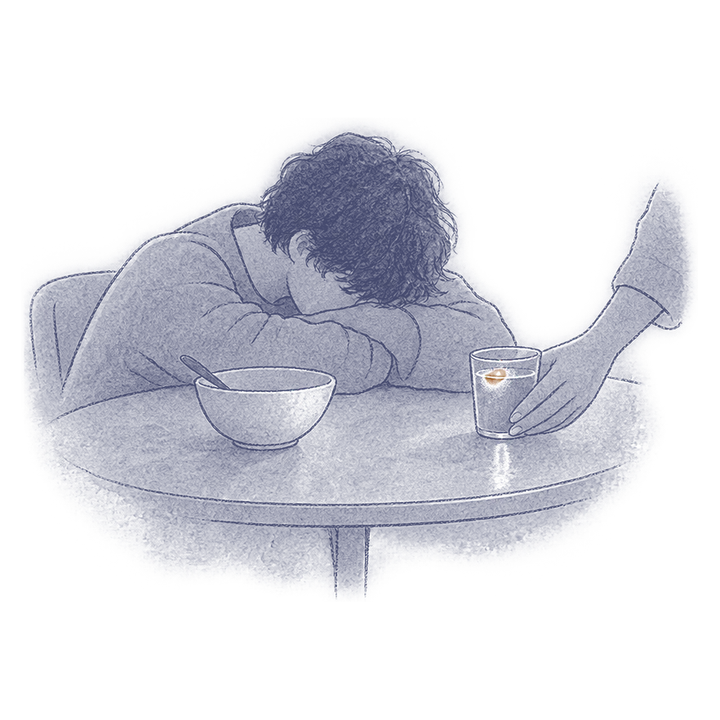

Perhaps it’s late, you’ve said goodnight more than once, and you can still hear them moving about on the other side of the wall. Or perhaps it’s the morning after, when the alarm went on ringing unheard upstairs and breakfast began with a door closing hard somewhere above you. You may have tried earlier bedtimes already, and found they mostly made for a teenager lying resentful in the dark. You may be wondering whether this is laziness, or something you’ve got wrong. Most of what’s going on underneath belongs to neither of you.
Is my teenager being difficult on purpose?
Around the start of puberty, most teenagers’ sleep timing moves up to two hours later1 than it ran in childhood. Part of the reason is that the evening rise of melatonin, the body’s own signal that night has begun, comes later. The American Academy of Pediatrics describes the average teenager as someone who has difficulty falling asleep before 11pm and is best suited to waking at 8am or later1.
The same slide later has been seen as young rhesus monkeys, rats, mice and marmosets2 reach their own adolescence, which suggests there's more to it than phones and parties. Not every late night is biology, and a teenager’s evenings matter to them for reasons of their own. Still, biology is a real part of why a 15-year-old lies wide awake at 10:30pm.
Why isn’t my teenager sleepy at 10pm?
If it’s 10pm, the bedtime you agreed, and your teenager is sitting up in bed as alert as they were at dinner, two things have shifted to make it so. The body clock now opens the night later, so melatonin rises later in the evening. And sleep pressure, the need for sleep that gathers through every waking hour, builds more slowly. In a small sleep-laboratory study it built up roughly half as fast in older teenagers as in children at the start of puberty3, and later studies have found the same slower build2.
One laboratory study shows what this looks like across an evening. The researchers woke younger and older teenagers at 8am, then gave them chances to fall asleep through the evening and on into the night. The older ones took longer to fall asleep at every point from 10:30pm to 2:30am2, right through the hours when a parent would hope they were long asleep. At the 10pm bedtime you set, then, your teenager’s brain may be in the most wide-awake stretch of its evening, and lights-out is asking for something their body can’t give yet.
A closer look How do researchers know a teenager’s clock has moved?
Most of this work tracks when melatonin begins to rise in the evening, which marks the start of the body’s night, and compares it with when young people fall asleep and wake. In one study that followed young people as they grew, 9 to 13 year olds fell asleep about an hour after their melatonin began to rise, while 15 to 18 year olds fell asleep about two hours into that biological night2. The researchers think the slower-building sleep pressure is what lets older teenagers stay up later into it.
In the study of sleep pressure itself, researchers in a sleep laboratory kept seven children around 12 years old and six teenagers around 14 awake for thirty-six hours3, recording their brain waves, and modelled how fast the need for sleep built and faded. Pressure built more slowly in the physically mature teenagers, though it drained overnight at the same rate. Later longitudinal and cross-sectional studies2 have agreed.
The animal studies matter for a different reason. When rhesus monkeys, rats, mice and marmosets2 show a similar shift around adolescence, it points to a biological part of the change, though it can’t say how much of any one teenager’s lateness is biology.
How much sleep does a teenager need?
Two expert bodies have looked at this, and their answers are close. The American Academy of Sleep Medicine recommends that teenagers aged 13 to 18 regularly sleep eight to ten hours4 in every twenty-four; the American Academy of Pediatrics puts the best range at eight and a half to nine and a half1. The need doesn’t shrink as they grow older2, and there’s more on how it varies in How much sleep do I really need?
Most teenagers sleep well short of that, and parents tend not to see it. In one US poll, nearly nine in ten high school students slept less than eight and a half hours on school nights, while seven in ten parents believed their teenager was getting enough1. Over months, a shortfall like that is linked with trouble in attention, learning and mood14. Where a teenager is running short, it’s often a late clock meeting an early alarm, and both ends of that can be worked on.
Why is getting them up for school such a battle?
If you’re back downstairs after the third call up the stairs, to a teenager who stirred, groaned and went back to sleep, the day has been long before it has properly begun. By their body’s reckoning, the alarm went off in the middle of the night.
One older study, still the one researchers return to, shows how far from waking an early alarm can find a teenager. Researchers followed forty students in a Rhode Island district as their school start moved earlier, from 8:25am to 7:20am, between 9th and 10th grade. The students didn’t go to bed any earlier; they woke earlier and slept less12. Then, at 8:30 one morning, the researchers gave the students a chance to sleep during a laboratory test, and nearly half of the 10th graders went into REM, or dreaming, sleep within ten to fifteen minutes. Falling into REM that fast is a pattern otherwise seen in narcolepsy, and here it turned up in young people who were simply going to school.
Seattle’s high schools moved their start the other way, from 7:50am to 8:45am. Students in one science class wore wrist monitors before and after the change. The sleep they gained came at the end of the night: they woke later while falling asleep at much the same time5.
The shaded stretch is the average teenager as the American Academy of Pediatrics describes them: hard to get to sleep before 11pm, best suited to waking at 8am or later1. The dots are when sophomores at two Seattle high schools woke on school days, measured by wrist monitor, the year before and the year after their start moved later5. They are different groups, so read it as a pattern: even after the change, the morning still began before that night was over.
From the studies’ own measurements
See this as a table
| What | From | To |
|---|---|---|
| Best-suited sleep for the average teenager | 11pm | 8am, or later |
| Morning | Woke, school-day median | School began |
|---|---|---|
| Seattle, before the change Slept a median 6 hours 50 minutes | 6:24am | 7:50am |
| Seattle, after the change Slept a median 7 hours 24 minutes | 7:08am | 8:45am |
Where people disagree is on what else follows from that extra sleep. The American Academy of Pediatrics reads the steady gains in sleep as reason enough to act, and recommends that middle and high schools start no earlier than 8:30am1. When Cochrane reviewers looked at eleven studies, the extra sleep turned up again and again. Results for grades, absences and alertness were mixed, though, and the reviewers judged the evidence very low quality6. Schools have real costs to think about too, from buses and sports to after-school jobs and younger siblings who need care at home. The fair reading is that later starts consistently give teenagers more sleep78, as they did in Seattle and Minneapolis, and the gains beyond that are less certain. Most of this research comes from the US, so a school system elsewhere may play out differently. If your teenager’s school is considering a later start, the sleep is the part the studies agree on.
A closer look What else did the later school starts change?
In Seattle, sophomores at two high schools taking the same science class wore wrist monitors for two weeks, one group the year before the change and a different group the year after5. On school days the later group slept a median thirty-four minutes more5, from six hours fifty minutes to seven hours twenty-four. Their daytime sleepiness eased and median grades in the class rose by four and a half points5, though the researchers had no comparison group and say it’s much harder to credit the extra sleep for the grades.
Something similar happened on a much larger scale in Minneapolis, where the high schools moved their start from 7:15am to 8:40am. The students’ bedtimes stayed much the same while they slept nearly an hour more1 on school nights, so there too the sleep they gained came as they woke later.
Is it okay to let them sleep in on weekends?
A Saturday sleep until 1pm can look like proof of laziness. It is also a body paying back part of the week’s debt, and that comes at a price for the clock. Researchers followed 15 to 17 year olds sleeping at home through an ordinary weekend, to bed an hour and a half later and up three hours later than on weeknights. That weekend shifted their body clocks about forty-five minutes later between Friday and Sunday10, so if that average shift held, a 7am alarm on Monday would reach them at what their body takes for roughly a quarter past six.
What sleeping in can repay has its limits. In one laboratory study, researchers limited teenage boys aged 15 to 19 to five hours in bed for a run of nights, then gave them two recovery nights of nine hours, much like a weekend sleep-in. Those two nights didn’t bring attention and memory back to where they started2. The American Academy of Pediatrics notes that sleep-ins, naps and caffeine ease sleepiness for a while without restoring full alertness1.
So there's no need to stop weekend sleep-ins, since taking them away would cost a teenager sleep they need. What the weekend can’t do is make up the week, so steadier sleep on school nights counts for more. Getting there means working on the clock, and bright light on school mornings is what pulls it earlier. Keeping the weekend wake time near the weekday one seems sensible too, but it hasn’t been shown to help: when researchers had teenagers get up earlier at the weekend and nap in the afternoon instead, their clocks still shifted later10. It costs little to try alongside the brighter mornings, and you’ll see how Mondays go.
Isn’t it really the phone?
You may already have taken the phone at bedtime and still found them awake an hour later, staring at the ceiling. That fits what the research shows: screens play a part in a late night without being the whole of it. Reviewing studies of children and teenagers, Hale and colleagues set out three ways screens can work on sleep: time on them pushes out time for sleep, what’s on them can stir a teenager up, and their light can affect alertness and the body clock11. Nine in ten of those studies found screen use linked to worse sleep11, mostly later bedtimes and less of it. Most of them caught a single moment. A teenager who is awake anyway may reach for a phone, so the phone may come from the late night as often as it causes one.
Researchers don’t agree yet on how much this matters. In a large UK study, teenagers kept diaries of their time, and the average effect came out small: each extra hour of screens a day was linked to about nine minutes less sleep on weekdays, and screens in the thirty minutes before bed to about one minute12. A review by leading teenage-sleep researchers finds that avoiding bright screens in the last hour hasn’t yet been shown to meaningfully change teenagers’ sleep2. An average can also hide some teenagers for whom screens matter a good deal more.
So the phone is one part of a full evening, alongside a later clock and a widening life, as homework and social lives fill out, and late nights are partly about friends and independence2. Taking it at bedtime may win back a little sleep, but on its own it won’t move the clock that keeps them awake.
What about energy drinks, coffee and soda?
An after-school can, or a coffee to get through the last class, can feel like the only way a short-slept teenager keeps going. The American Academy of Pediatrics notes that short-slept teenagers tend to use more caffeine1. A US study looked from the other side. Ninety-eight teenagers aged 11 to 17 wore sleep recorders at home for seven nights and kept a diary of their caffeine, and on days with more caffeine they took longer to fall asleep and slept less13. Read together, the two findings make a loop: a short night brings the can, and the can brings a later, shorter night. Most of the effect in that study came from caffeine in the afternoon or evening, so the after-school can is the one worth trading for something without caffeine. Energy drinks are linked to sleep problems too14, though that evidence comes mostly from surveys. How long a can at 4pm lingers is in How long does caffeine stay in your system?
Can a teenager’s clock be moved earlier?
If the curtains stay shut on a dark school morning and the kitchen stays bright until late, the light in your home may be nudging your teenager’s clock later at both ends of the day. In a laboratory study of 14 to 17 year olds, bright light in the hours around their usual bedtime shifted the clock later, and bright light around their usual waking time shifted it earlier9. The turning point came in the middle of their night’s sleep, so the same light can move a teenager’s clock either way, depending on when it reaches them. Younger teenagers are especially sensitive in the evening, and their melatonin has responded to light far dimmer than an ordinary room at home2.
In a very small pilot, researchers tried the morning and the evening together. Bright morning light moved teenagers’ clocks earlier when they slept long, while those the researchers kept up late in ordinary room light didn’t shift or shifted later15. With so few teenagers, the study can’t tell whether the evening light or the shorter sleep kept the second group’s clocks from moving earlier. Researchers suggest less light in the evening and more in the morning2 can help, though none of this has been tested in ordinary homes yet. It is still worth trying, since a brighter morning and a dimmer evening cost little and ask nothing of anyone at 11pm.
A closer look What happened in the small light study?
The pilot followed six teenagers on summer vacation, three in each group15. One group slept ten hours a night and had bright light in the morning, and their clocks shifted about two hours earlier15. The researchers kept the other group up four and a half hours later in ordinary room light, watching TV, so they slept less. Despite the same bright morning light, their clocks stayed where they were or moved later.
What the research says
- Around puberty, most teenagers’ sleep timing shifts later, by up to two hours. Well established
- Sleep pressure builds more slowly in older teenagers, so staying up later comes more easily. Good evidence
- Later school starts give teenagers more sleep, mainly because they wake later. Good evidence
- Whether later starts also lift grades, attendance and alertness: findings differ, and it isn’t clear yet. Still debated
- Sleeping in on weekends repays some sleep debt and pushes the body clock later. Good evidence
- How much screens shorten teenagers’ sleep: findings differ, with many studies linking them to worse sleep and large diary data finding a small average effect. Still debated
- Bright mornings with dimmer evenings may move a teenager’s clock earlier, though so far only small laboratory studies have tried it. Early evidence
Most of the school and screen research is from the US and the UK, and averages can hide teenagers for whom screens or caffeine matter a great deal.
Morning is when I am awake and there is a dawn in me.
How can I help without it turning into a fight?
To a teenager, a phone rule can feel unfair while the grown-ups’ phones stay out till midnight. A nightly fight over lights-out also keeps the whole house up later, and that includes you. Parents still have a part to play, and it can be a modest one. When researchers surveyed South Australian teenagers, those whose school-night bedtime was mainly set by a parent went to bed about twenty-three minutes earlier, slept about nineteen minutes more and felt less tired in the day16, without taking any longer to fall asleep. The bedtimes were modest, around 10:10pm on average, and a survey like this can’t show that they caused the extra sleep or say how they were agreed.
The American Academy of Pediatrics suggests a family media plan and a media curfew1, and describes changing sleep habits as a shared responsibility of families and teenagers themselves1. So one thing worth trying is a plan for devices that the whole household keeps, which asks the adults to put their own phones away at the agreed hour too. It asks less of everyone than a nightly confiscation, and it doesn’t single your teenager out.
How you raise it is worth some thought too. You could choose a time when neither of you is tired, a weekend afternoon perhaps, and start from how the mornings have been feeling for them. It may help to tell them that the later clock is real and nobody’s fault, and to set it out as a problem you share. Your teenager could then choose the details, such as where the phone charges, which lamp stays on in the last hour and when the weekend alarm goes. Whether handing them those choices eases the conflict hasn’t been studied yet, and you’ll see for yourselves how it goes in your own home.
-
If you’re the parent
You could start with the morning: the brightest light you have soon after waking. A weekend wake time that stays close to the weekday one is worth a try as well, though it hasn’t been shown to stop the weekend shift. Now and then you could ask how their mornings have been, in their own words, and leave the rest of the plan with them for a while.
-
If you’re the teenager reading this
Not being tired at 10pm and feeling awful at 7am is real, and it’s what bodies your age tend to do1. The things that move it are mostly up to you: getting outside or into bright light soon after you wake, and making the last hour of the evening dimmer, since evening light pushes the clock later and morning light pulls it earlier9. Keeping weekend mornings from drifting too far might help too, though nobody has shown yet that it does. You could try one for a couple of weeks and notice how your mornings feel.
When is it worth seeing a doctor?
What if the light is still on tonight?
Then it can stay on for one more night, since a clock that moved later through puberty doesn’t move back by Friday and doesn’t need to for things to ease. The hope is that, in time, the morning light and a dimmer last hour draw it a little earlier. That work happens in daylight, over breakfast and across the weeks: the curtains open early, the wake time the two of you agreed, and the bedroom door left out of it.