
Perhaps this is the second hour of it now. The same track comes round with the same turns, and every so often there’s a jolt, as if you’d nearly forgotten it for a moment and your mind snapped back to check. You know nothing can be done before morning, and knowing it hasn’t helped.
Putting a worry off until tomorrow can feel like turning your back on it, and on the bill or the person you’re frightened for. It moves the worry to the hours when there’s someone to call and something to be done, and at 2am there’s rarely either. If it’s still evening and you can feel the night coming, there’s something you could do before bed in What can I do earlier in the evening?
Why does it feel so much worse at night?
You may have noticed that the worry is bigger now than it was this afternoon, and that over breakfast it often looks smaller again. Part of that is mood, which follows a daily rhythm. Positive feeling is at its lowest and negative feeling at its peak in the small hours, roughly 1am to 4am1. Some researchers go a step further. They propose that in the hours the body expects to be asleep, the reasoning that would put a worry in proportion works less well1, partly because of the body clock and partly because of lost sleep. It’s an idea they’ve put forward in a review, and they haven’t measured it.
None of this makes your worry untrue. Some worries are every bit as serious as they feel at 2am. At this hour the same problem simply feels bigger than it will over breakfast. If it tends to wake you in the small hours already fully formed, Why do I keep waking up at 3am? is about that waking.
Why doesn’t going over it bring me any closer to an answer?
Lying awake turning the problem over feels like working on it, and that feeling is part of what keeps you there. Worry tends to run in broad, general terms: what if it all goes wrong, and what happens then? Going over a problem in that abstract way feels like analysis, but it’s unlikely to arrive at a concrete solution23. Thinking helps more when it asks something specific, like what exactly you could do next. In experiments, concrete thinking of that kind improved problem-solving3. In the middle of the night the concrete step is usually out of reach. There’s no one to ring and nothing is open. So the mind goes back round the what-ifs and finds them waiting where it left them.
Falling asleep asks for a different kind of thought altogether. Ordinary drifting off is made of loose sensory images, as reasoning lets go7. Does working at a problem get in the way of that? In one small study, twenty-one people spoke their thoughts aloud in bed at home over three nights, and wore wrist monitors that tracked their sleep. Working through problems was among the thoughts that went most closely with taking longer to fall asleep8. When you work the worry over in bed, step by careful step, you’re doing the very kind of thinking that falling asleep needs you to stop.
Isn’t letting it go for the night a bit careless?
It’s often said
If I stop worrying about it, I’m not taking it seriously.
Why it can feel that way
Worry can feel like standing guard over the problem, or over the person you love, as if stopping for a night might mean forgetting something, being caught unprepared or letting them down. Going over it feels like a way of getting ready for whatever is coming.
What’s going on underneath
You lie awake over it because it matters to you, and that caring doesn’t rise and fall with how much you go over the problem. People who believe worrying does them good tend to worry more9, which may be part of why it is so hard to stop. The going over, though, can wait for an hour when it can turn into something you do.
How is putting it off different from pushing it away?
You may already have tried telling yourself to stop thinking about it, and found it came straight back and left you more awake than before. Researchers who model insomnia count trying to control or push thoughts away among the things that keep a worried mind awake10.
Postponing works another way. You give the worry a time, and then you let it go without a fight. In trials, people learn to choose a set time later in the day for the worry, a worry time that lasts no longer than thirty minutes5. When the worry turns up before then, they acknowledge it with a short sentence and let it go, without getting caught up in it or trying to force it out5. The sentence one trial taught was Another worry arises, I acknowledge it, and now I let it go. You could borrow it or make up your own. Those trials were about daytime worry. Using the method at night, with tomorrow’s time as the place the worry waits, is an adaptation, and none of these trials tested it.
What you turn to in the meantime matters as well. In Oxford, forty-one people with insomnia took part in a study that lasted a single night. Those taught to fill their minds with a specific, engaging imagined scene fell asleep sooner, and had less frequent and less distressing thoughts before sleep, than those given no instructions6. A vaguer think about something else may not be enough against a real worry. In another study, researchers made healthy adults anxious at bedtime, then split them into three groups: some were told to distract themselves, some to push the thoughts away and some got no instructions at all. Distraction went with poorer sleep11. A single scene gives the mind somewhere particular to go: the garden of a house you grew up in, say, or a route you know by heart, walked slowly. If it slips, you can come back to it or pick another. And if you’ve been awake a long while, there’s more on whether to get up when you can’t sleep.
You may already have got up once to check the bank balance or search a symptom, and come back to bed more awake than when you left it. If the urge comes again, it can go on the scrap of paper with the rest, one more thing for the time you’ve given it.
When thou liest down, thou shalt not be afraid: yea, thou shalt lie down, and thy sleep shall be sweet.
What can I do earlier in the evening?
Perhaps the night is still ahead of you and the worry is already there, waiting for the lights to go out. One small trial tested giving it somewhere to go first. Thirty-three US undergraduates who slept poorly spent five nights writing about their worries. Those who wrote down each worry with possible solutions had fewer racing thoughts at bedtime, compared both with their own starting point and with students who wrote the worries down alone4. The two groups differed only in that next step. It fits a large review of repetitive thinking, which found concrete thinking helping more than abstract going-over3.
A to-do list is for tasks, and writing one at bedtime helped young adults in a sleep lab fall asleep faster12. How do I stop my mind racing at night? is about that kind of list. A worry with stakes needs a page of its own, where you name it plainly and write beside it the one small thing you could do about it, and when.
What if there’s nothing I can do until Thursday?
Some worries have no next step to take: a result that comes on Thursday, a choice that belongs to someone else, a call that has to wait. There isn’t much research on worries like these. The researcher behind that review of concrete thinking proposes that when a goal can’t be acted on, thinking about it in concrete terms may make it easier to stop thinking about for now3. For a hospital appointment, that might mean writing down what you will do when the day comes: go on Thursday at 10am, take the list of questions, and bring someone with you if there’s someone you’d like beside you. The waiting then has a shape and a day of its own, and the time you’ve set aside tomorrow can go on writing those questions. When the choice is someone else’s, a grown son deciding whether to leave his course, the page could list the part that is yours to do: what you might say to him, and when you’ll next call or see him.
How much do these things help?
You may be wondering whether any of this will work for you. The studies so far are small and short. The people in them were students, people who worry a great deal and people with an anxiety diagnosis. Postponing worry to a set daily time looked promising in earlier studies of children and psychology students, mostly in how long people spent worrying, while one study in people with generalized anxiety disorder found no effect5. Researchers don’t yet agree on how much it helps. Writing down the next step has had mixed results too. Among 232 Australian teenagers, a fifteen-minute constructive-worry exercise changed neither how long they took to fall asleep nor their bedtime worry13.
So where does that leave you, with one real worry tonight? No one knows yet how much any of this helps at night. Still, trying it costs a few minutes and a scrap of paper. A specific scene or a written next step also has more behind it than a general effort to stop thinking. Over a few nights, you can see for yourself whether it gets any easier to let the worry pass when it comes round.
A closer look Who was in the worry-postponement trials?
At an outpatient clinic at the University of Münster, about eighty adults aged 18 to 65 with generalized anxiety disorder or health anxiety had two sessions, a week apart, learning worry postponement or waited for their turn5. Among those with generalized anxiety, worry came down further for the people who had learned the method than for those still waiting, and eight of twenty reached the recovery threshold for worry, against two of twenty-two on the waiting list5. The health-anxiety group changed little, and across both groups together the difference fell narrowly short of statistical significance5. With only a waiting list to compare against, simply expecting to be helped may account for some of the change5.
In a two-week US trial of fifty-three people who worry a lot, a daily thirty-minute worry period at a set time and place reduced worry, anxiety and insomnia symptoms more than letting worry come as it would14, going by their own reports.
Each ring is a group’s average worry score before, and the dot its score a week after the sessions, on a questionnaire that runs from 16 to 80, where higher means more worry. In adults with generalized anxiety disorder at a clinic in Münster, the group that learned worry postponement came down further than the group still waiting, though sleep wasn’t measured. Figures from the Münster trial5.
From the studies’ own measurements
See this as a table
| Group | Average score before | A week after the sessions | Change |
|---|---|---|---|
| Learned worry postponement | 63 points | 54 points | 9 points lower |
| On the waiting list | 65 points | 62 points | 3 points lower |
What the research says
- Mood tends to be at its lowest in the small hours, so a worry often feels bigger then than by day. Good evidence
- In experiments, mostly in people prone to rumination or depression, concrete thinking about a difficulty helped problem-solving more than abstract going-over, which is unlikely to reach a concrete answer. Good evidence
- In people who sleep poorly, thoughts in bed often turn to solving problems, which is unlike ordinary drifting off. Good evidence
- It isn’t clear yet how much postponing worry helps: small trials in high worriers and adults with generalized anxiety found less worry, while one earlier trial found no effect. Still debated
- Findings differ on writing a worry down with possible solutions: it eased bedtime racing thoughts in a small trial of students and made no difference in a larger study of teenagers. Still debated
- In one small study over a single night, people with insomnia taught to picture a specific scene fell asleep sooner and had less frequent, less distressing thoughts before sleep than those given no instructions. Early evidence
- None of the studies here tested postponing one real worry at night on its own. Not well studied yet
People differ in what helps them, and none of these studies followed people for longer than a few weeks.
When is it worth talking to someone?
Sometimes worry runs on most days for a long stretch, is hard to control and colors the daytime too. Worry like that over six months or more is part of generalized anxiety disorder, and it’s worth talking to a health care provider about it15. There’s no need to wait six months before you ask. The same is true of low mood or loss of interest most of the day, nearly every day, for two weeks or more16.
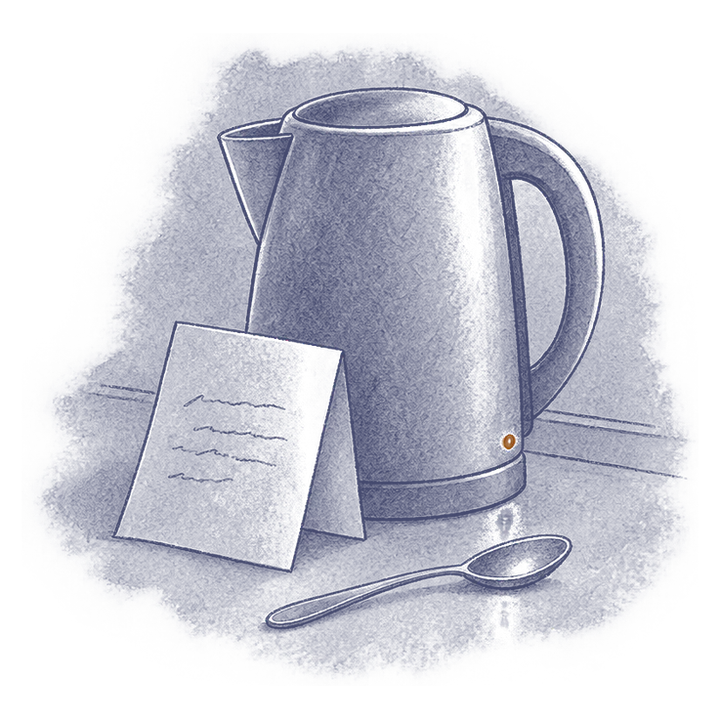
On most nights, though, the worry is about something real that will still be there in the morning, when there’s a phone to pick up and a next step to take. Until then it can wait on the scrap of paper by your bed, with tomorrow’s time written on it, or by the kettle, folded into a note with its next step beside it.