It often begins earlier than you'd expect, as a thought about tonight somewhere in the middle of the afternoon, and by evening it follows you from room to room. You may catch yourself finding one more thing to do so you don't have to go up, or going up at nine to give sleep every chance, and then lying there checking whether it's coming. At this hour, the waiting can be harder than the night itself. And if the night has already come and you're reading this awake in the dark, the plan for being awake in What can I do with this evening? is there for this hour too.
Why has bedtime started to feel like a test?
A few bad nights do more than tire you: by the next evening, part of you is already expecting another one. The explanation sleep researchers use most begins with worry about sleep and about how tomorrow will go5. That worry raises the body's alertness and turns your attention to watching for signs that sleep isn't coming. It also makes the night and the day ahead look worse than they are. In bed it can run as a string of questions: am I drowsy yet, is that sleep coming, what time is it now. In small studies, people who struggled to fall asleep spent that time thinking about not sleeping6, and the more those thoughts ran7, the longer sleep tended to take. So the hour before bed turns into the run-up to an exam, and the alertness an exam brings is exactly what keeps sleep at a distance.
Then you try harder, because effort is what usually works when something matters. It might be the herbal tea drunk as a duty, the app, the routine that has to go exactly right, or one more look at the time. Researchers call all of this sleep effort8, and people with insomnia score higher on it9 than good sleepers. Sleep arrives on its own and can't be steered directly, and researchers think trying to steer it helps keep poor sleep going8.
Is trying always the problem, though? One small experiment with normal sleepers suggests it isn't. The researchers asked some people to fall asleep as fast as they could and others to drop off whenever they liked. While calm music played, the ones trying hard fell asleep sooner10. When brisk marches kept their minds busy, trying made sleep slower10. What we'd take from it is that effort does its harm when the mind is already busy, and at ten o'clock, worry is the marching music. If that's right, easing how much tonight matters may do more for you than finding a better technique. Watching the clock works the same way: in other small experiments it added worry and lengthened the wait3.
Read the loop clockwise from the top, with each step in the explanation researchers use most5 feeding the next. The last step, a slow night that seems worse than it was, leads back to the first. Effort is part of the loop, and researchers think more of it8 helps keep the loop going. The lit step, how much tonight seems to matter, is the one an evening can ease.
Drawn as an illustration of the pattern
See this as a table
| Step | What happens | Which feeds |
|---|---|---|
| 1 | Tonight seems to matter | The body grows more alert |
| 2 | The body grows more alert | Watching and trying for sleep |
| 3 | Watching and trying for sleep | A slower night that seems worse |
| 4 | A slower night that seems worse | Tonight seems to matter |
After a few nights spent lying awake, the bed and the bedroom can themselves become cues for wakefulness and frustration4. That's one reason you can be nodding on the sofa and wide awake the moment your head meets the pillow. It feels absurd and unfair, and it's a learned link, the kind that stimulus control is designed to undo11. Researchers who ran a trial in early insomnia describe a link only a few nights old as still in its infancy, and so easier to loosen12. A few hard nights haven't made anything permanent.
What if tonight is another bad one?
At ten o'clock it can feel as though everything depends on the next few hours. The research gives tonight a much smaller part. In a year-long US study, researchers followed people who'd been sleeping well, and more than a quarter had a spell of poor sleep1 lasting weeks at some point that year. A survey of UK adults13 found a similar share. Of those whose good sleep turned into a run of bad nights, much as yours may have, nearly three in four were sleeping well again1, usually within days to weeks. About one in five carried on with poorer sleep for longer.
A short night also works in your favor in one way. In a diary study, good sleepers in a bad patch usually had a good night after about one poor one, while people with insomnia did after about three2. The researchers put this down to sleep pressure building across the short nights. That pull is likeliest to help when you're a few nights into a bad patch. It's less dependable once poor sleep has gone on for months. Some people's sleep is also more easily stirred by stress14 than others', even though on an ordinary night they sleep like anyone else. In them, alertness can override the pull toward sleep14 even after a disturbed night.
The day after is shaped partly by what you believe about the night. In one experiment, people with insomnia were given made-up feedback from a wrist device about the night before. Those told they had slept badly felt less alert and more tired by evening15 than those told they had slept well, though their reaction times were no different. The experiment suggests that believing you slept badly, here because a device said so, can add to how tired the next day feels.
Oh sleep! it is a gentle thing, Beloved from pole to pole! To Mary Queen the praise be given! She sent the gentle sleep from Heaven, That slid into my soul.
Would an early night give sleep a better chance?
It’s often said
After a bad night, go to bed early and sleep in to catch up.
Why it can feel that way
After a short night it seems only sensible to give sleep more room. An early night could make up what was lost, and a morning sleeping in could cover the rest. Cancelling the evening's plans feels like looking after yourself.
What’s going on underneath
The extra hours seem to work against the sleep pressure a short night builds. A small diary study found more time in bed went with longer runs of poor nights2 in people with insomnia, though not in good sleepers. And in an early study that followed students for a year, those who relied more on habits to protect their sleep had worse insomnia a year on16. The authors' own example of such a habit was getting up later to catch up. For a brief bad patch, the diary study's researchers advise changing very little. If you do take an early night or sleep in, you could give the time back the next night by going to bed a little later or getting up a little earlier.
What sleep clinicians suggest instead is to lie down only once you're sleepy411, the first step of stimulus control. Sleepy here means heavy eyes, or your head beginning to nod over a page, the kind of thing you notice without having to look for it. That makes bedtime the moment sleepiness arrives, where before it was a fixed hour to report for. If no heavy-eyed moment comes, you could simply go up at your usual time.
What can I do with this evening?
If you've already worked through the usual list, with no screens, the warm drink, the herbal tea and the app, it may have started to feel like a set of rules. A list of rules can't make a night go well by itself, and followed too strictly it turns into more of the effort that keeps sleep away. The tips you like can stay, as long as you don't need them to work.
In its place, you could spend the last hour on something you'd enjoy anyway: a book, a film, a puzzle, a long talk on the phone. Nobody has studied an unhurried hour as such, and it isn't a treatment. What it does is give the evening back to you, and leave sleepiness to come when it comes. The phone stays face down through all of it.
It can help, too, to have a plan for being awake, so that being awake stops feeling like an emergency. Clinicians suggest a short list of things you find pleasant and absorbing, a podcast you like or a chapter of something good, because picking something boring on purpose is another way of trying to sleep4. The idea is to wait for sleep and let it find you. Whether to get up at all is a question with its own page, and either way the list is there for whichever hour you need it.
Some people find it helps to give up the aim of sleeping altogether, even to lie there deciding to stay awake a while and see what happens. It's a recognized technique called paradoxical intention. A review of ten trials in people with insomnia found it eased insomnia and the anxiety of performing at sleep17. Those trials were weak, though, and the US guideline found too little evidence11 to recommend it on its own. If it starts to feel like one more task, you can stop. Tonight doesn't have to go well.
What if this has been going on for months?
-
If it's been a few nights or a few weeks
This is the stretch when bad runs most often clear up by themselves, so the job is mostly to keep from getting in their way. Help can work early, too: in a small trial in North East England, adults diagnosed with insomnia that had lasted up to three months were offered a single hour-long session of CBT for insomnia with a leaflet, and six in ten had recovered a month later12, against three in twenty of those left to wait.
-
If the dread and the bad nights have gone on for months
Sleep guidelines are clear that the usual list of sleep tips isn't enough11 on its own to treat long-running insomnia. For you, CBT for insomnia is the recommended first treatment1118, and guidelines recommend it in person or through a digital program18. Its parts take on the very loop in the figure above: the worry about sleep, the effort of trying and, through stimulus control11, a bed that has come to mean lying awake. A health professional can help you find it, and where trained clinicians are hard to reach, a digital program can be the way in.
Questions people ask
Why do I sleep fine on holiday, or in front of the TV?
There isn't much research on this yet, though one likely reason is that a hotel bed or the sofa has none of the history your own bed does, so it hasn't become a cue for lying awake4, and nothing is riding on whether you drift off there.
Could my sleep tracker be making this worse?
If the first thing you do each morning is check last night's score, it's worth thinking back to the wrist-device experiment above. People handed a bad score felt worse as the day went on15, though the score was made up. If yours decides how the whole day feels, you could put it away for a while and see how the mornings feel.
Do I need to give up my bedtime tea and routine?
There's no need to, if you enjoy them, and the trouble only comes when a routine has to be done exactly right, because then it becomes part of the effort8 of trying to sleep. Keeping the parts you like, and letting a missed one pass, means none of them has to work.
A closer look How were the studies of trying to sleep done?
The experiment on trying hard split its sleepers into two groups10, some told to fall asleep as fast as they could and others whenever they liked. Some tried with calm music playing and others with brisk Sousa marches, there to keep their minds busy the way worry does. It was a single experiment, and only its published summary is available.
The clock studies ran in two parts3. In the first, thirty good and thirty poor sleepers were asked either to watch a clock or not while trying to sleep. In the second, thirty-eight people with diagnosed insomnia watched either a clock or a display of digits that had no meaning. Clock-watchers worried more and took longer to fall asleep. Among those with insomnia, they also overestimated how long they had lain awake.
In the device study, sixty-three adults with insomnia15 were randomly given made-up feedback when they rose, saying they had slept well or badly. They then rated how they felt through a single day while their reaction times were tested.
What the research says
- Runs of bad nights are common, and most clear up within days to weeks. Good evidence
- Researchers' leading explanation is that worry about sleep and about tomorrow raises alertness and helps keep poor sleep going; its support is still early. Early evidence
- In one small experiment, trying hard to fall asleep made it take longer when the mind was busy. Early evidence
- Small experiments suggest that watching the clock while trying to sleep adds to worry and slows sleep. Early evidence
- Findings differ on how reliably a short night is followed by a better one; it came sooner in people whose sleep had been good until recently, so it may help most early in a bad patch. Still debated
- In one small diary study, going to bed early or sleeping in to catch up went with longer runs of poor nights in people with insomnia. Early evidence
- In one small exploratory study of students, with few followed to a year, habits used to protect sleep predicted worse insomnia a year later. Early evidence
- Early trials in people with insomnia suggest that letting go of the aim to sleep (paradoxical intention) may ease insomnia, and stronger studies are still needed. Early evidence
- Sleep hygiene tips alone aren't enough to treat long-running insomnia. Well established
- CBT for insomnia is the recommended first treatment when poor sleep has lasted months. Well established
Much of this comes from small studies, and the findings about time in bed and the rebound after a short night come mainly from people with diagnosed insomnia. No study has yet compared how bad people expect tomorrow to be with how it goes.
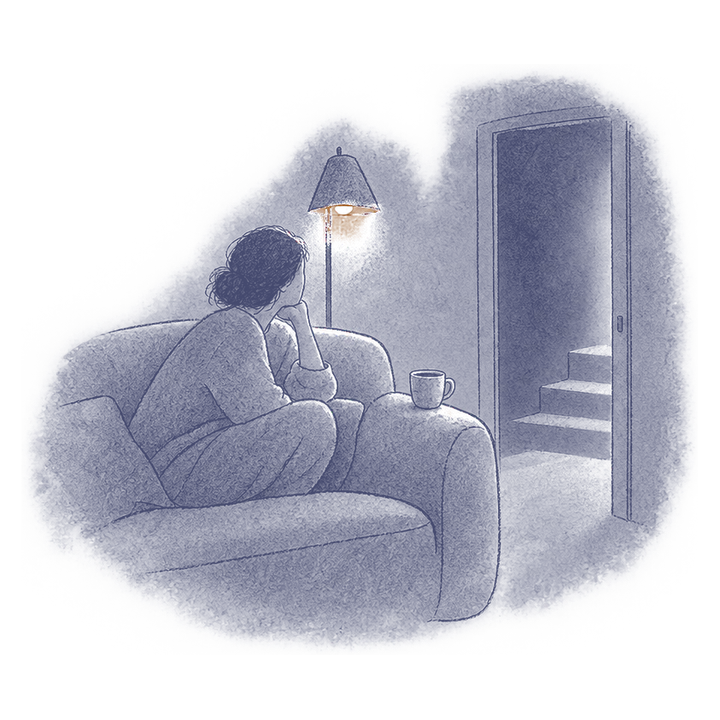
So if you're still on the sofa as you read this, there's no hurry to go up. The cup can go cold and the phone can lie face down. When your eyes grow heavy, the stairs will still be there.