Maybe it was the alarm breaking into a dream, or a dream so real you reached for your phone to check whether that message was ever sent. Maybe it's the bar on your sleep tracker's chart that grew one night and shrank the next, or the flicker under a partner's closed eyelids near morning. Each of these is REM. In every one of them, a brain is hard at work inside a body that's lying perfectly still.
What is happening in REM sleep?
If you watched a cat go into REM sleep, you could see it happen: its head and legs go completely slack, its eyes dart under closed lids, its breathing turns uneven and its paws and whiskers twitch1. Sleep researchers recognize the same state in people by three things measured together: muscles gone slack, rapid eye movements and a cortex as active as it is when awake12. That pairing, a brain lit up inside a body switched off, is found nowhere else in the day or night. It's why one of REM’s older names is paradoxical sleep1.
It may help to picture two switches. One is for the brain, and it sets how busy the brain is. The other is for the muscles that move the body, and it sets whether they can move at all. Most of the time the two go up and down together. In REM they part: the brain’s switch rises nearly all the way, while the brainstem keeps the body’s switch down. So REM doesn’t belong on the scale of light and deep sleep. It's a state of its own, as distinct from the rest of sleep as it is from waking12.
The state was first reported in 1953, when recordings of sleeping adults showed bursts of brain activity and rapid eye movements in the middle of sleep1. Until then, scientists had pictured sleep as something passive, simply the absence of waking1, and here was the brain in the middle of the night, busy. Early scans of sleeping people have begun to show what it's busy with. In REM the parts that handle feeling and memory are lit, along with the parts at the back of the brain that make pictures, while the front part, which plans and keeps a check on yourself, is among the least active3.
REM arrives four or five times a night, roughly every hour and a half to two hours4, weaving among the other stages that What happens while we sleep? describes. While it lasts, the rest of the body follows its own course. Heart rate and breathing speed up and turn irregular, and for a while the body stops regulating its temperature2. Against the stillness come brief twitches, especially in the face, and bursts of eye movement2, so someone lying beside you near morning might see your eyes flicker under the lids while the rest of you lies still.
I sleep, but my heart waketh:
How can my body be so still while my brain is so busy?
The body’s switch is thrown deep in the brainstem, and it works in steps. When REM begins, a small cluster of nerve cells there switches on. It rouses other cells lower down, toward the spinal cord, and these apply a chemical brake to the nerves that drive the muscles, so the muscles fall silent2. A few are spared: the diaphragm and breathing muscles, the eye muscles and the tiny muscles of the inner ear2. That's why you go on breathing and your eyes go on moving while the rest of you stays put.
Work in rats and mice shows how much depends on that small circuit. When researchers remove the cells that switch on, or the ones lower down that apply the brake, the animals still enter REM but without the stillness, and they move as if acting out their dreams2. Horses show the same switch from the outside. A horse can doze on its feet but has to lie down for REM, and one that won’t lie down can slip into REM standing, lose its muscle tone all at once and fall1.
The usual explanation for the stillness is that it keeps us from acting out our dreams while the brain’s movement areas are busy5. Some researchers doubt it, because dreams come outside REM too1. Up to 70% of wakings from non-REM sleep bring a report of a dream6, so REM and dreaming overlap without being one and the same. Why do we dream? picks up from there.
Read across, the two switches move together, except in REM sleep, where the brain’s stays up while the body’s is down, and in waking unable to move, until the body’s comes back up7. The switches are a sketch, with no values to read.
Drawn as an illustration of the pattern
See this as a table
| When | The brain | The muscles that move you | In the drawing |
|---|---|---|---|
| Awake By day | Awake and busy | Free to move | Brain switch up, body switch up |
| REM sleep Mostly late in the night | Asleep, yet almost as busy as awake | Switched off; breathing and eyes go on | Brain switch most of the way up, body switch down |
| Waking unable to move Now and then, for a moment | Awake: you see the room and breathe | Still switched off, for now | Brain switch up, body switch down |
| Then Seconds or minutes later | Awake | Movement comes back | Brain switch up, body switch up |
A closer look Do animals and babies have REM too?
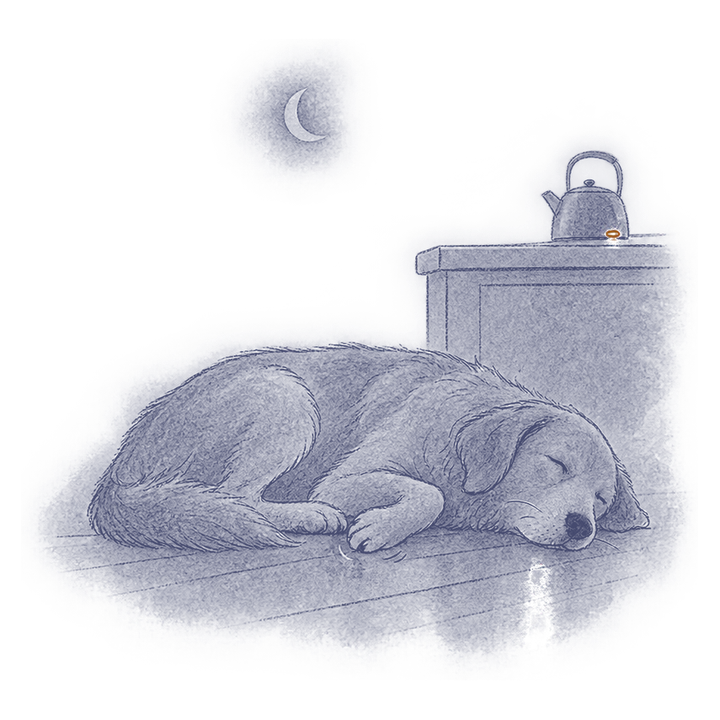
Every land mammal studied has REM sleep, and birds have much of it too, though a bird’s REM usually lasts under ten seconds and its muscles don’t fully slacken, so it can stay perched, even on one foot1. So a dog paddling its paws on the kitchen floor at dawn is very likely in REM as well.
Where REM ends is still argued over, and the owl shows why. Its eyes are fixed in their sockets, so can it have rapid-eye-movement sleep at all? It seems so: owls have REM without eye movements1. The platypus turns the puzzle the other way, since it twitches its bill while its cortex stays in slow waves1. And claims of REM-like sleep in lizards such as the bearded dragon are contested1.
REM begins long before we can wonder about it. It's the brain’s main state before birth, and a newborn gets about eight hours of it a day, where an adult gets about two1. In young animals the abundant twitching of REM may help the developing brain map its own body1, an idea that comes mostly from work in infant rats and cats.
Why are my dreams so vivid just before the alarm?
In the last hour before the alarm, the dreams can feel fuller than anything earlier in the night, crowded and bright and hard to leave, and that last hour is where REM gathers. Each REM period of the night runs longer than the one before4, so the longest come in the hours before you usually wake, and their timing follows your body clock more than how long you’ve been asleep8.
Researchers found this by setting sleep loose from the clock. Volunteers lived in a laboratory on twenty- or twenty-eight-hour days, so their sleep fell at every hour of the body’s day. Their deep sleep mostly followed how long they'd been awake. Their REM kept to the body clock. It peaked one to two hours after the body’s temperature reached its daily low, close to the usual time of waking8.
So on an ordinary night the early hours have most of the deep sleep, and the later ones are dominated by REM910. An alarm set two hours early trims the very hours richest in it, since cutting the last hours of a night takes mainly REM910. A night that starts two hours late and ends when you wake on your own probably keeps more of its REM. The clock’s REM-rich hours still arrive at their usual time, though no study has yet set the two nights side by side.
Those last dreams are also the ones best placed to stay with you. Dreams seem to be laid down in memory only if you wake, at least briefly, soon after them. Those not thought over on waking fade fast911. One line of research finds that people who recall many dreams wake more during the night11. So waking straight out of one of the long REM periods of early morning, on a slow weekend morning or with the alarm cutting through the middle of a story, likely gives a dream its best chance of coming with you into the day.
A closer look How do you pull sleep away from the body clock?
In these experiments, called forced desynchrony, volunteers live in a laboratory by a day of the wrong length. Bedtime comes at a different hour of the body’s day each time, until their sleep has fallen at every hour of it. One such study brought in twenty-four people, young men and older adults12. Between them, they slept 482 recorded sleep episodes, scattered across the body clock12. The share of their sleep spent in REM rose and fell markedly with the clock, and was highest just after the body’s temperature reached its low point12.
When the young men slept at their usual times, their REM climbed steeply through the night, while in the older adults it was spread more evenly, with more of it early on12. Across studies like it, the body clock has a strong hand in REM, alongside how long you’ve slept8.
What happened when I woke up and couldn’t move?
Perhaps it happened only a little while ago. You came up out of sleep in the dark, aware of the room and fully yourself, and your body wouldn't answer. You couldn't so much as lift a finger. It's a hard thing to put into words for anyone the next day. About one in thirteen people have had at least one episode13, and it has a name, sleep paralysis, and a plain mechanism. The stillness of REM carries on for a short while after the mind has woken. You can see and breathe and know where you are, but you can’t yet move5. The brain’s switch has come up and the body’s hasn’t followed yet, and within a few seconds or a few minutes, movement comes back7.
What can make it frightening is what often comes with it. Most episodes bring hallucinations, often a sense of someone in the room or a pressure on the chest5. One proposal is that the brain’s fear circuits, which are active in REM, stay on for a moment after you wake, with nothing in the room to explain them5. It's only a proposal so far, since nobody yet knows which brain regions are involved. Not every episode is frightening, either: in one survey as many as one in five people who’d had it had also had pleasant episodes5.
Sleep paralysis is also a common feature of narcolepsy, a rare neurological condition5. That's a different matter, and What is narcolepsy, and could I have it? covers it. For most people, sleep paralysis is an occasional thing. Only about one in two hundred healthy people have it several times a week, and it's linked with short or broken sleep, jet lag, shift work, stress and anxiety513. Each time, the body’s switch comes back up, and you can move again.
What is REM sleep for?
More than sixty-five years after REM was found, researchers still don’t agree on what it's for. They've proposed many theories and ruled out few1. Memory is the idea you hear most, and both sides of that argument have good evidence to point to.
The case for memory is strongest in animals. In many studies in rats, mice and cats, REM rises after learning, and keeping the animals out of REM impairs their learning of complex tasks10. The memory-side reviewers themselves note that many of those studies kept the animals from REM in stressful ways10. In people the picture is patchier. The clearer findings are for skills, such as a visual task that improved overnight unless REM was blocked10, and reviewers who favor a memory role call the evidence in people surprisingly inconsistent10.
The strongest evidence on the other side comes from people too, and one of them is hard to forget. One man was left with little or no REM after a shrapnel wound to his brainstem. He went on to finish law school, and then to practice law9. He's one person, so his case can't decide the question alone. Still, law school is a hard place to get through on a memory that isn't working. Then there are the drugs. Some older antidepressants can abolish REM for months or years, and the millions who've taken them show no sign of memory loss9. Nobody tested those millions carefully, so this is a matter of noticing what didn’t happen.
Today’s antidepressants keep the question alive. Many common ones, SSRIs and SNRIs among them, delay and reduce REM14. On one point the two sides meet: even researchers who favor a memory role accept that losing REM on antidepressants doesn’t bring obvious memory problems10. They part over why. One side suggests the drugs’ own chemistry may stand in for whatever REM does10, and skeptics reply that the drugs push brain chemistry the opposite way to REM9.
That shared ground says something plain. Whatever REM does for memory in people, it isn’t something anyone visibly misses when it’s gone. It may still do something subtler, and the animal work keeps that possibility alive, so what REM is for stays an open question. These are findings about what REM does, and they leave anyone’s treatment where it is. If you take one of these medicines and have questions about it, your prescriber is the person to ask.
A closer look What else do the two sides point to?
Taking away REM in people mostly leaves memory for word lists untouched10, which is part of why the clearer findings are for skills. In one experiment, healthy men took a modern antidepressant after learning. It suppressed their REM, yet they remembered word pairs and a finger-tapping skill no worse, and their tapping improved more15. The researchers themselves favor a link between sleep and memory, which makes the result worth noticing.
The skeptics also look across species. How much REM an animal gets doesn’t track how clever it is: the platypus has the most yet recorded, while whales and dolphins have very little, perhaps none9. Reviewers on the memory side reply that comparing learning ability across species is difficult and inconclusive10.
It’s often said
REM is when the brain processes your emotions
Why it can feel that way
When you wake from a dream that's still full of feeling, it's easy to believe something was being worked through in the night. The brain’s emotional areas are active in REM3, which seems to fit. Popular books tell it with confidence.
What’s going on underneath
The idea has a name, “sleep to forget, sleep to remember”, and some support. In one small brain-imaging study, young adults saw upsetting images, slept and saw them again the next day. Those with more REM-like brain activity overnight showed less response in the part of the brain that reacts to threat, and felt less about the same images16. Another experiment found the opposite. Young adults looked at upsetting pictures, and for those who then spent the day awake the sting faded, while those who slept through the night kept it. The more REM they had, the more of it they kept17. These are small laboratory studies in healthy young adults, and a major review calls the question open10.
What happens if I miss some REM?
Perhaps you've looked at a tracker after a late night or a few drinks, seen the REM bar shorter than usual, and wondered whether something was lost for good. (How well a tracker can tell REM from the rest of sleep is a question of its own, taken up in What is deep sleep, and am I getting enough?) The brain notices a loss of REM and makes some of it up. People woken each time REM begins try to enter it more and more often, and on the nights that follow, REM comes back in greater amounts than usual49. That return is called REM rebound, and the same rebound follows stopping medicines that suppress REM, or alcohol withdrawal4.
An early idea held that people kept out of REM would begin to hallucinate or fall ill. In 1975 a researcher named Vogel gathered the experiments together, and the review found REM deprivation was not harmful to healthy people, nor to people with depression or schizophrenia918. Those were short laboratory studies, and a night with less REM than usual is the kind of loss they looked at.
Does every animal make up lost REM? One study of fur seals suggests not. Researchers kept four fur seals in seawater for ten to fourteen days, and their REM fell from about eighty minutes a day to three. Back on land, the seals made up almost none of it19. The researchers wonder whether REM partly serves to rewarm the brain after deep non-REM sleep, which might also be why it grows toward the end of the night19. It's an idea from four seals, and it waits to be tested in people.
What the research says
- In REM the brain is nearly as active as when awake, while almost every muscle that moves the body is slack and the eyes move rapidly. Well established
- REM follows the body clock and gathers in the last hours before the usual time of waking, so cutting a night short at the end takes mainly REM. Well established
- About one in thirteen people have woken unable to move at least once, as the stillness of REM lingers after waking; movement returns within seconds or minutes. Good evidence
- In people, lost REM is partly made up on the following nights. Well established
- Short spells without REM haven’t been shown to harm healthy people. Good evidence
- Whether REM helps lay down memories isn’t clear yet: animal studies support it, while people who lose REM on some medicines show no obvious memory loss. Still debated
- Whether REM takes the sting out of upsetting memories isn’t clear yet, as small studies find both. Still debated
- Why the body stays still in REM is debated: many researchers think it stops dreams being acted out, and others doubt it, since dreams also come outside REM. Still debated
Most of what’s known about REM, memory and emotion in people comes from small laboratory studies in healthy young adults, and the brain circuits that keep the body still were mapped in rats, mice and cats.
What REM is for may take years more to work out, but what it is fits in one picture. In the last hours of the night, the body clock turns toward morning. The parts of the brain that handle feeling and pictures light up, and the eyes move behind closed lids. Almost every muscle that moves you goes slack, its switch set apart from the brain’s for a while, the same way it is in the dog paddling its paws on the kitchen floor. Most mornings the two come back into step as you wake, and you bring a dream out with you, or nothing at all. Once in a while one lags a few seconds behind the other, and then it catches up.