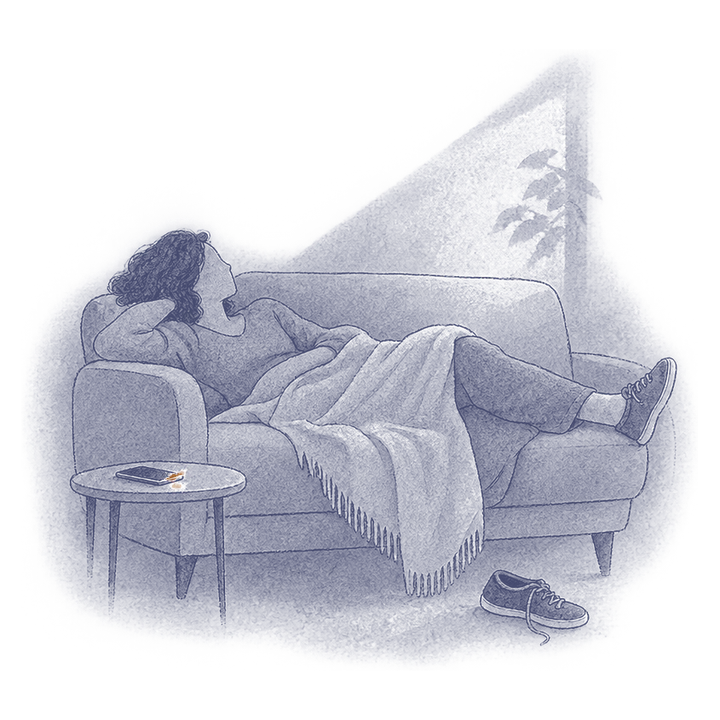
Somewhere after lunch the afternoon slows right down. You read the same line twice, your eyelids drag, and the sofa, or even your folded arms on the desk, starts to look very inviting. Alongside the tiredness there's often a small voice saying that napping is lazy, or something for the old. And there's a second worry, that a nap now might be paid for tonight, lying awake at midnight when you most need to sleep.
Is it all right to take a nap?
It is, and for most people who sleep reasonably well it helps, however much a nap can feel like something to apologize for. When researchers pooled controlled studies of an early-afternoon nap in working adults and students, the people who napped did better than those who rested awake1, alertness most of all, and the benefit lasted about two hours1. The effect was modest, the size you'd notice as an afternoon that goes a little more easily.
The sleepiness you feel after lunch comes mainly from the body clock1, and it arrives even when people skip lunch and can't see the time6, though a heavy, starchy lunch can deepen it6. What the studies say about a nap's length and timing makes most sense once you picture where its sleep comes from.
Enjoy the honey-heavy dew of slumber. Thou hast no figures nor no fantasies Which busy care draws in the brains of men. Therefore thou sleep’st so sound.
Will a nap take something from tonight?
A little, and how much depends on the nap. From the moment you wake, sleep pressure builds the longer you stay awake and drains away while you sleep7. Alongside it, your body clock pushes toward alertness by day and sleep at night2. A nap draws on that same pressure, the store your night is built on. A short, early nap takes the edge off and leaves plenty for bedtime, while a long or late one spends some of what tonight needed.
You can see the store at work in a lab study of healthy young men who napped in the early evening. That night they took longer to fall asleep8, and the deep sleep of their first cycles was weaker, as if part of the night's pressure had already been spent8.
How long is a good nap?
The clearest answer comes from a lab study of twenty-four young people who sleep well. Each spent a night at home with only five hours of sleep, then came in and napped at 3pm, a different length on different days. Ten minutes of sleep helped straight away9, and some of that help lasted about two and a half hours. Thirty minutes first left people groggier and slower9 than before they lay down, and only lifted them after that. Five minutes did little9, and twenty helped once a short wait had passed.
Those are minutes of sleep, and the time you spend lying there is longer, since it takes some minutes to drop off3. A review of lab studies draws much the same line: after a short night, naps of up to about twenty minutes of sleep bring no grogginess, while thirty minutes clearly does3. So somewhere between ten and twenty minutes asleep is what to aim for. How clearly you wake from it depends on how much sleep you had before and on the hour10. After a really short night, you might keep to the shorter end and still expect a little fog, because heavy sleep loss can leave you groggy even after a short nap3.
Perhaps you've heard that a ninety-minute nap lets you finish a full sleep cycle and wake fresh. There isn't much research yet testing that rule for how clear you feel on waking. The longer nap's best support comes from learning, where one small study found that naps of sixty to ninety minutes, with their deep and REM sleep, helped people learn a visual task about as much as a night's sleep11. If you picture the store, a nap that long would likely spend a good share of what tonight was going to draw on.
The same young good sleepers, after a short night, napped for each length on a different afternoon, and were tested for the hours after9. Read down the rows: the longer the nap, the later its help arrived, and the longest cost a groggy spell first. The study gives when each benefit began and ended, but not how big it was, and not when the fog after the thirty-minute nap lifted, so where that nap’s help begins isn’t known.
From the studies’ own measurements
See this as a table
| Version | Groggier and slower on waking | Better than with no nap | Note |
|---|---|---|---|
| 5 minutes of sleep | No | Not for any clear stretch | Few benefits |
| 10 minutes of sleep | No | From the start to 155 minutes after waking | Helped at once |
| 20 minutes of sleep | No | 35 to 125 minutes after waking | Helped after a wait |
| 30 minutes of sleep | Yes, on waking | Once that passed (when isn’t reported), to 155 minutes after waking | Groggy first, then helped |
Why do I sometimes wake from a nap feeling worse?
That groggy, muddled spell is sleep inertia, the slowed, groggy state just after waking2. Short naps are less likely to bring it, probably because deep sleep usually begins about thirty minutes in2. A longer nap is more likely to pull you up out of that deep sleep, though researchers still argue over how much the deep sleep itself is to blame. The fog is also worse after sleep loss2, which is why the afternoon after a short night is when a long nap is most likely to leave you foggy.
The fog does pass, and you can simply wait it out. It usually lifts within about thirty minutes, sometimes fifteen2, though full recovery can take an hour or more. You might reach for cold water on your face, a bright light, the radio or some cool air, and these help only a little, or only briefly2. While it lasts, how sharp you feel is a poor guide to how sharp you are: in one study, people rated their performance better after a thirty-minute nighttime nap even though it was measurably worse2.
If you drink coffee, you could have a cup just before you lie down for a short nap, which is the best-supported way to wake clear-headed2. In one small lab study, young adults who had about two cups' worth of caffeine just before a twenty-minute nap12 were less sleepy and sharper for the hour afterwards than with the nap alone. How late in the afternoon a cup can be and still leave tonight's sleep alone is the question taken up in How long does caffeine stay in your system?.
A closer look Why is waking from deep sleep so hard?
An older study described in a review woke people either from deep, slow-wave sleep or from the lighter stage before it. Those woken from deep sleep performed 41% worse than before the nap2, while those woken from lighter sleep did about as well as people who had stayed awake. It's one reason the review's authors think short naps probably wake you more cleanly, though later work has made the deep-sleep link less certain than the link with length.
Sleep loss makes the fog thicker. In one lab study, researchers gave some people a little under six hours a night to sleep and others eight. Those with less were 10% worse on waking2, and seventy minutes later they still hadn't recovered2.
At the far end, a study kept people from proper sleep for sixty-four hours, and those given twenty-minute naps every six hours did worse just after waking than those kept awake throughout2. That was extreme deprivation, nothing like an ordinary afternoon.
It’s often said
Naps just don't work for me.
Why it can feel that way
The nap that went wrong: lying down for twenty minutes and waking ninety minutes later in a dim room, mouth dry, unsure what day it is, foggy for the rest of the afternoon and then lying awake at midnight. After a few afternoons like that, it starts to look as if your body simply doesn't do naps.
What’s going on underneath
What went wrong was usually the length and the hour. In the lab, thirty minutes of sleep left people worse before it made them better9, and an evening nap made falling asleep that night slower8. Ten to twenty minutes of sleep early in the afternoon, with the alarm set before you lie down, is a different nap, and you needn't fall fully asleep for it to help: in a driving study, a short nap still helped people who only dozed5.
What's the best time of day for a nap?
The early afternoon tends to suit a nap best, whether that's a lunch break or a day at home, while the body clock's dip is under way and there are still many hours left before bed. In the pooled studies, naps that began before 1pm improved performance more1 than ones started later. Every nap in them began between 12:30 and 2:45pm, so this compares early afternoon with slightly later afternoon. A nap taken sitting up, at a desk, on the train or in a parked car with the seat tipped back, can still help, even if you only doze without properly falling asleep5. The alarm matters all the more there, where nobody is going to wake you and the afternoon picks up again the moment you open your eyes.
Later than that, the store has less time to fill again before bed. In one small study, sixty-two healthy young adults wore wrist trackers for eight days. Those who napped within seven hours of bedtime13 slept more brokenly and less well, and so did those who napped three or more times in the eight days. For someone who goes to bed at 11pm, seven hours before means about 4pm, though the cut-off was that small study's own grouping.
If last night was short, a nap today can be part of getting through the day after a bad night, and the same advice applies. It works best kept brief, taken soon after lunch and stopped by the alarm, so the pressure you build through the afternoon is still there when you go to bed.
Can a nap help if I'm drowsy at the wheel?
It can, and here the studies are small but agree with each other. In one, sleepy people sat down to an afternoon drive in a simulator, then took a thirty-minute break. A break on its own did nothing14, while a nap of under fifteen minutes or a coffee during it cut both errors and sleepiness. When a later study tried coffee and a short nap together, sleepy drivers on a two-hour afternoon drive drifted out of lane far less than with coffee alone5. Opening the window or turning up the radio only buys a little time15 to find somewhere to stop.
So if your eyes are closing on the road, please pull over somewhere safe for a coffee and a short nap, and give yourself about half an hour after waking, while the grogginess lifts, before you drive on.
What if my nights or my hours are different?
-
If you've had trouble sleeping most nights for a while
You may know the trap from inside: exhausted in the afternoon, you doze off, and that night sleep is even harder to find. A nap spends some of the pressure that gets you to sleep at bedtime, so for you the advice runs the other way from the one for good sleepers. The sleep specialists' guideline recommends4 CBT for insomnia for chronic insomnia, and skipping daytime naps is part of it4. If you lie down exhausted and can't drop off at all, that fits too, since finding it hard to nap even when tired16 is a listed sign of insomnia. Without an afternoon doze, all the pressure built since morning is still there at bedtime. For the hours between, there's How do I get through the day after a bad night?.
-
If you work nights
If your main sleep happens by day, the advice about not napping late isn't meant for you, because your night is a day. For night-shift workers, planned naps during the shift reduce sleepiness and improve performance17, and naps of twenty to forty minutes around 2 to 3am helped while rarely cutting into the sleep after the shift17. Longer naps late in the night bring more grogginess, and a sixty-minute nap at 4am slowed reaction times17. Still, one nap won't replace your main sleep, so the daytime sleep after a shift is the one to protect first. How to do that is the subject of How do I sleep well on night shifts?.
-
If you need naps even after a full night's sleep
If you sleep a full night and still can't stay awake in the day, that's a different conversation, the one in Why am I still tired after a full night’s sleep?. Long daytime naps can be a sign of poor night sleep, such as sleep apnea18. Some sleep conditions also change how naps behave. In narcolepsy, short naps are usually refreshing3 and planned naps are part of treatment19. In idiopathic hypersomnia, waking from one can bring a confused, slow spell, sometimes lasting hours3.
Are long naps bad for your health?
If yours is a short nap after lunch, the studies behind the headlines have little to say against it. The links that worry people most, with heart disease and early death, show up with naps of an hour or more a day, in studies where many of the people were older. A broader link with a higher death rate counts all napping and doesn't sort it by length.
The clearest of them pooled eleven studies that had followed about 150,000 people for eleven years on average. Those who napped an hour or more a day had an 82% higher rate of heart and circulatory disease18 than people who didn't nap, and a higher death rate too, while naps under an hour weren't linked to either18.
These are associations, and the long nappers may have been napping because something was already wrong. The researchers themselves note that people who are already sicker, older or retired are more likely both to nap long and to have heart trouble18, and long napping may be a sign of illness or poor night sleep18 rather than the cause of anything. If you're wondering whether napping itself could be doing the harm, the studies built to test that, using genes, haven't answered it. Their answers are mixed20, and on Alzheimer's disease they found no genetic link20. All of that work looks at how often people nap; none of it measures how long.
A later, larger pooling found napping linked to a higher death rate overall21, but that figure set people who napped beside people who didn't, without sorting them by how long they slept. For heart disease, the link showed up only21 among people who were older, women or long nappers. The risk also dipped a little as naps lengthened up to about twenty-five minutes a day21, and rose only after that. A twenty-minute nap after lunch falls inside that dip.
So, what about this afternoon?
If it's early afternoon and your eyes are heavy, you could. Picture the day's sleepiness as a store that fills from the moment you wake and is spent at night. A short nap after lunch takes a cupful from it, and the alarm keeps it to one. Then the rest of the afternoon and evening go on filling the store, hour by hour, the way every waking day does. By bedtime there's plenty there again. And if your nights are the hard part, you can leave the store untouched today and go to bed with all of it still there.