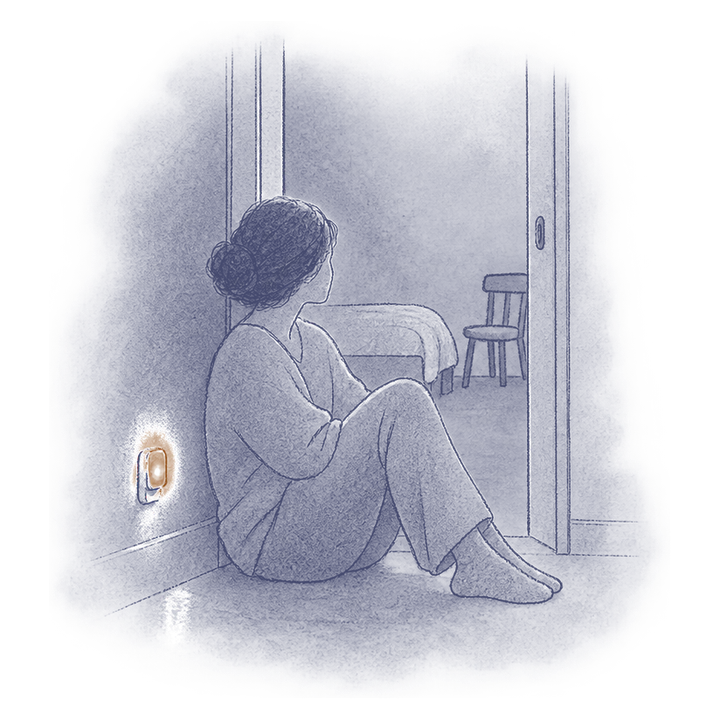
Perhaps bedtime began at seven, and it was long past eight before you could leave their room. What was left of the evening went quickly. Then at 1am there was a voice in the dark, or a small shape at your door, and the only thing that got them back to sleep was lying down beside them again. By morning you’re both worn through, and somewhere in the fog you're wondering whether this is your fault.
What can I do if they’re calling for me right now?
If you’re reading this with a child asleep across your pillow, or have come back from getting one to sleep down the hall, tonight doesn’t have to be the night anything changes. The small hours are for getting you both back to sleep. Your help does the most good earlier, at bedtime, and that can wait for another evening.
Why does my child keep waking up and calling for me?
A child’s night, like ours, is a run of sleep cycles, and in the minutes when one cycle ends and the next begins, sleep is at its lightest. When researchers recorded healthy children asleep in the laboratory, from toddlers to 18-year-olds, brief awakenings turned up at every age3 as an ordinary part of the night. Your child waking at 1am or 3am is doing what every sleeper does, and whether they call for you depends on the moments that follow.
The clearest view of those moments comes from babies. In one American study, eighty families let researchers film their babies at home with infrared cameras over four nights, and the babies who got themselves back to sleep woke just as often as the ones who cried out4. They woke like everyone else and dozed off again without a sound, so their parents often didn’t know they had woken at all. The cameras caught something about bedtime too: babies who were put down awake were more likely to get themselves back to sleep later in the night, while those who needed a parent to fall asleep at the start of the night tended to need one again in the middle of it4.
Those were babies up to a year old, and none of the studies here filmed older children. For an older child, it’s an idea borrowed from the little ones, and it’s the one the approaches that ease night waking in young children5 are built on. Seen that way, a child who falls asleep with your hand on their back, or with you lying beside them, comes up out of sleep at 1am into a room where the hand has gone, and it makes sense that they’d call out for it. It’s something they’ve learned in the most ordinary way, from many nights of being comforted, and so it’s something they can learn differently, a little at a time.
Two drawn nights with the same brief wakings, since brief awakenings are part of every child’s night3. What differs is whether what was there at bedtime is still there at 2am. The pattern was filmed in babies up to a year old4, and real nights are less tidy.
Drawn as an illustration of the pattern
See this as a table
| Falling asleep | There as they fall asleep | Still there when they wake | At each waking |
|---|---|---|---|
| Falls asleep on their own | The room, just as it stays all night | Yes, through the night | Turns over and drifts back |
| Falls asleep with you beside them | You, lying beside them | No, gone before they wake | Calls out for you |
| Which waking | What |
|---|---|
| The third of five, in every night | The waking at 2am |
A closer look What did the videos of babies at night show?
The study filmed eighty babies aged 3, 6, 9 or 12 months4 in their own homes in the US, with infrared cameras running through four nights, so researchers could see each waking as it happened, whether or not anyone heard it. A baby who cried or called out on waking was counted as signalling, and one who went back to sleep without calling was counted as soothing themselves.
Each family was seen over those four nights and no longer, so the study shows bedtime and the middle of the night going together without showing that changing one changes the other. That evidence comes from the treatment studies in young children, where steady changes at bedtime reduced night waking for most of them5.
How much sleep does my child need?
When your child seems to get by on less sleep than their friends, or you catch yourself counting their hours at the end of a long day, how their days go tells you more than any single number. Sleep specialists suggest ten to thirteen hours in every twenty-four, naps included, for children aged 3 to 5, and nine to twelve hours for children aged 6 to 126. The ranges are wide because children’s need differs from one child to the next6, shaped by their genes, their health, their habits and their surroundings. A child who sleeps at the short end and has good days may well be getting what they need. The ranges for grown-ups are in How much sleep do I really need?
Too little sleep in a child can catch a tired parent by surprise, because it rarely looks like yawning. Children who regularly sleep less than they need have more trouble with attention, behavior and learning6, and one small experiment in Canada showed how quickly that can appear. The researchers asked thirty-four healthy children aged 7 to 11 to go to bed either earlier or later on school nights. Then their teachers, who didn’t know which child was doing which, rated them in class. The children who gained about twenty-seven minutes a night seemed less restless and impulsive to their teachers, and those who lost about fifty-four minutes seemed worse7. (Researchers in Israel saw something similar: when they shifted children’s sleep by an hour for three nights, the change showed up on computer tests of thinking and attention8.) So the child who is fidgety, tearful or wild by late afternoon may be running short of sleep, even with no yawn in sight.
Does a bedtime routine really make a difference?
Most parents have tried a routine of some kind, and know how one story can turn into three. So it’s worth knowing what happened in one American trial. Researchers asked 405 mothers whose children had a sleep problem to begin the same short routine every evening: a bath, a massage with lotion, then cuddles or a song, with the lights out within half an hour. The mothers changed nothing else about how they put their child down. Within two weeks the children were falling asleep faster and waking less, and their mothers’ mood had lifted too9. Those children were all under 3, younger than yours, and the trial was funded by Johnson & Johnson, whose products were used in it.
No one yet knows why routines help10. They may ease the worries and fears that come at bedtime, or they may simply come along with other steady habits in a home. Which parts of a routine matter hasn’t been studied, so yours doesn’t need a bath, or a set length, or anything bought for it. What seems to count is how often it happens: in a large survey of families with young children, the more nights a week a family kept one, the better the children slept10. That’s a good reason to choose a routine short enough to manage on a night when you’re tired, or alone, or putting two children down at once.
A closer look What did the big survey of bedtime routines find?
The survey asked the mothers of 10,085 children up to age 5, in thirteen countries10, how their children slept and how often they kept a bedtime routine. Among preschoolers, fifteen percent of mothers who kept a routine every night felt their child had a sleep problem, against thirty-nine percent of those with none10, and daytime behavior problems were less common in families with a nightly routine.
It compares one family with another at a single moment, so it can’t show that the routine made the difference, though it fits with what the trial found. Like the trial, it was sponsored by Johnson & Johnson.
It’s often said
If they’re tired and cranky, an earlier bedtime will sort it out
Why it can feel that way
A child melting down at six in the evening looks as though they need their bed, and more sleep does help: in the Canadian experiment, the children who slept a little longer were steadier in class7.
What’s going on underneath
An earlier bedtime helps when a child can fall asleep at it, and their body clock decides when that can be. In one small study of toddlers aged about two and a half to three, the body’s evening signal for sleep came at very different times, from about 5:30pm to 9pm11. Their parents put them to bed only about forty minutes after it, where grown-ups go about two hours after theirs11. So how soon is too soon? One toddler in five was in bed before the signal had come, and in some of them bedtimes set too close to that signal went with a longer time to fall asleep and more resistance11. Clocks also seem to run later as children grow11, so a bedtime that suited your child at four might come too soon at nine. A long fight to fall asleep can simply mean they aren’t ready yet.
If bedtime has become a long wait in the dark, one approach with evidence behind it in young children is bedtime fading5: setting bedtime close to the time your child falls asleep now, so that sleep comes quickly, then bringing it earlier by small steps once it does. For the bigger shift that comes with the teenage years, there’s Why can’t my teenager fall asleep before midnight?
How can I help them fall asleep without me?
If you lie beside your child each night until their breathing slows and then creep out, it may last only until the first waking, when they look for you again. Researchers have looked closely at how young children, mostly under about 5, learn to fall asleep without a parent, and the results are encouraging: more than eight in ten of the children treated improved in a way that mattered, with the gains lasting for months5. School-age children have had far less attention, with too few good studies to say how well the same approaches work12 at that age. So for an older child, parents borrow the methods from younger ones, along with the idea underneath them: that the way a child learns to fall asleep at bedtime is the way they’ll look for again at 2am.
One approach, leaving protests unanswered altogether, has strong evidence in babies and toddlers, though the studies here didn’t test it in children of school age. If you’d rather move a step at a time, there are gradual ways too, with evidence of their own in young children, and two of them are in the box below. If brothers or sisters share a room, you could settle one before the other, or put them down at different times, and take each step more slowly.
A closer look Which approaches have the most evidence behind them?
The American Academy of Sleep Medicine gathered fifty-two studies of behavioral approaches to bedtime problems and night waking5, and nearly all of them found the approaches effective. The strongest evidence was for teaching parents an approach ahead of time and for leaving protests unanswered altogether. The gradual ways5 had evidence of their own in the same young children: checking on a child at lengthening intervals, and setting bedtime when they really fall asleep and then bringing it earlier.
A later pooling of trials rated the evidence as moderate for young children and low for older ones, largely because few good studies exist12. Low here means there is too little research to be sure, which is different from the approaches failing. Moving a chair a little further from the bed each few nights, as in the box above, hasn’t been tested as a method of its own; it follows the same idea of small steps at bedtime.
-
If your child is 3 to 5
This is the age most of the research covers, and here behavioral approaches help children fall asleep faster and wake less12. A short routine, a bedtime that suits their clock and small steps toward falling asleep without you are all things you can manage at this age. In the routine trial, with children a little younger, the change showed within two weeks9.
-
If your child is at school
At this age you can try the same ideas with more conversation. A child of 8 or 10 can help make the plan, choose the routine and say what would make the dark easier. Two things change as they grow: their body clock runs later than it did11, and fears at night often grow more common from 7 to 913. A new struggle at bedtime may be about one of these.
-
If your child has ADHD, autism or another condition
You’ll recognize some of this, but your child’s nights may be different. Children with ADHD, autism and other neurodevelopmental conditions have sleep problems more often and of more kinds14, including trouble falling asleep, body-clock problems and breathing problems in sleep, and the general advice was tested mainly in typically developing children1214. Your child’s doctor or a sleep specialist who knows the condition is the best place to find advice made for them.
What do I do about ‘one more drink, one more story’?
Bedtime can stretch to an hour of encores: a drink of water, the toilet, a question about where people go when they die, a sudden worry about the wardrobe. In one small American trial, researchers gave nineteen children aged 3 to 6 who resisted bedtime a bedtime pass, a card they could trade for one visit or one trip out of the room. Once it was spent, their parents didn’t answer further calls. Compared with families who simply kept a record, the children left the room and called out far less, and stopped protesting sooner each night15. The change was still there three months later, and their parents liked it15.
With only nineteen children it’s a small beginning, and the trial didn’t set out to say why the pass works. One guess is that it gives a child a little control and the certainty that you’ll come once. It also gives you a way to meet the fifth request for water with a smile and a reminder of the card. The pass is meant for stalling and curtain calls. If your child is truly frightened, that’s a different call, and you’d go to them and reassure them, pass or no pass.
My child says they’re scared of the dark. What helps?
Fear at bedtime is real to a child, even when nothing is there. In a study of 176 Dutch schoolchildren aged 4 to 12, nearly three in four said they had fears at night13. Wouldn’t you expect those fears to fade as a child grows? In that study they did the opposite. Comparing children of different ages, the researchers found that fears grew more common from 7 to 9 and stayed steady to 121316, so fears at night were more usual among the eight-year-olds than among the younger children. Their parents greatly underestimated how often it happened13, so your child may be frightened at night more often than they tell you.
When the researchers asked where the fears came from, almost four in five children traced them to something frightening they’d heard, seen or been told13: a film, a story at school, the news on in the kitchen. Many had their own ways of coping13 that they found helpful. So it may help to listen first, to ask what they think about when the light goes out, and to ask what they already do that makes it better.
For fears that really disrupt sleep, therapists use step-by-step practice at being in the dark, brave imagery, coaching a child in what to say to themselves, and rewards1617, often within a few sessions, though most of those studies are small. Those programs were for children with significant fears, but their ideas can be borrowed at home: a few minutes more each night with the light a little lower, a story in which your child is the brave one, a sentence of their own to say in the dark, and praise in the morning for the night they managed.
From breakfast on through all the day At home among my friends I stay; But every night I go abroad Afar into the land of Nod.
Is it all right if they come into our bed?
How often a child ends up in a parent’s bed depends a great deal on where you live, from about one schoolchild in twenty regularly sharing in Italy18 to more than a third sharing a bed or a room in eight Chinese cities19. Many families share by choice.
If sharing works for your family, these studies give no clear reason to stop, though researchers read them in two ways. One reading sees sharing as a possible small cost: in China, children who shared went to bed later and slept a little less, though the differences were too small to matter clinically19. The other sees it as a family’s answer to trouble already there: in Italy, children who co-slept had more bedtime resistance, worry at night and night waking18, but sharing often looked like a family’s way of coping with a sleep problem the child already had, or simply a family habit18. Both studies looked at families at a single moment, so neither can say which came first, and researchers don’t agree yet.
If you’d like your bed back, you could walk them back each time, in the same brief way, so their own bed becomes the place the night begins and ends. All of this is about children past babyhood; babies have their own safe-sleep guidance, in How much should my newborn sleep, and how do I keep them safe?
A closer look How were the bed-sharing studies done?
Both were surveys of parents, and the Italian one asked about 901 schoolchildren18 and counted only regular, long-lasting co-sleeping. The Chinese one covered 19,299 schoolchildren in eight cities19 and counted sharing a bed or a room, so the gap between the two countries is only a rough one.
In Italy, the children who co-slept didn’t have more behavior problems18 than the others, and the researchers there saw sharing more often as a response to trouble already there. The researchers in China read their small differences in bedtime and sleep length as a possible cost of sharing19.
Do screens keep children awake?
Perhaps the tablet comes out to fill the last half hour before bed, or an older child’s phone charges on the nightstand all night. When researchers pooled twenty studies of young people, the ones who used a phone or tablet at bedtime had about twice the odds of sleeping too little, and were more likely to sleep poorly and be sleepy in the day20. Even a phone nobody touched seemed to matter: a device left in the bedroom and not used went with shorter sleep20. Those were mostly teenagers, and a link like this can’t show the phone is to blame. Where researchers helped children aged 2 to 13 cut screen time by about half an hour a day, the children gained about eleven minutes of sleep a night21, a small gain and an uncertain one. There’s little research on charging devices outside the bedroom as a step of its own; the reason for it is that unused phone on the nightstand. It still seems a sensible step, especially as your child gets older, and one to take alongside the routine and the bedtime rather than in place of them.
What the research says
- Children aged 3 to 5 need ten to thirteen hours in every twenty-four, and children aged 6 to 12 nine to twelve, with real variation between children. Well established
- Brief awakenings are a normal part of every child’s night. Good evidence
- In one study of babies, how they fell asleep at bedtime matched what they needed when they woke in the night; it hasn’t been watched as directly in older children. Early evidence
- Behavioral approaches to bedtime problems and night waking work for most young children, mostly under about 5. Well established
- For school-age children, there are too few good studies to say how well these approaches work. Good evidence
- A regular bedtime routine goes with better sleep in young children. Good evidence
- In one small study of toddlers, bedtimes set too close to the body clock’s evening rise went with a longer time to fall asleep and more resistance. Early evidence
- Fears at night are common between 4 and 12 and grow more common from 7 to 9. Good evidence
- Researchers don’t agree yet whether sharing a bed affects a school-age child’s sleep or follows from sleep problems already there. Still debated
- In early studies, cutting screen time added about eleven minutes of sleep a night in children aged 2 to 13, and it isn’t clear whether less screen time was the cause. Early evidence
Most of what we know about helping children fall asleep on their own comes from children under 5, and children vary widely in how much sleep they need and when their body clock is ready for it.
When is it worth talking to a doctor?
Snoring now and then is part of childhood, and sleep apnea, where breathing is blocked again and again in sleep, is much rarer: only a few children in a hundred are described by their parents as snoring ‘always’, and apnea affects about one to four children in a hundred22. It is most common between ages 2 and 8, often because of large tonsils or adenoids23. When they’re the cause, removing them is the usual first treatment24, and there’s more about it in Do I have sleep apnea?
Questions people ask
Is melatonin something to try for my child?
Melatonin, and any other medicine or supplement for a child’s sleep, is a decision to make with your child’s doctor, who knows your child. If you’re wondering about it, it’s worth raising at an appointment, and there’s more about melatonin itself in Is it okay to take melatonin every night?
What about night terrors or sleepwalking?
These are different from the wakings described here, and each has its own page: What are night terrors, and what should I do when my child has one? and Why do people sleepwalk, and should I wake them?
And what about my own sleep?
If you’re reading this the morning after, with a day to get through on a few broken hours, you’re short of sleep too. A child’s broken nights affect the whole family2, and in the routine trial, when the children’s sleep improved, their mothers’ mood improved with it9. If today is one of the foggy ones, How do I get through the day after a bad night? has a few things that help.
You don’t need a perfect plan, an empty evening or a partner to take turns. A single small change, kept up for a week, is a fair beginning: the same short routine each night, a chair a little further from the bed, one bedtime pass on the pillow. For most young children, steady changes like these ease the nights5, until the 2am waking becomes what it is for the rest of us, a moment of coming up out of sleep, finding the room just as it was, and turning over to go back down.