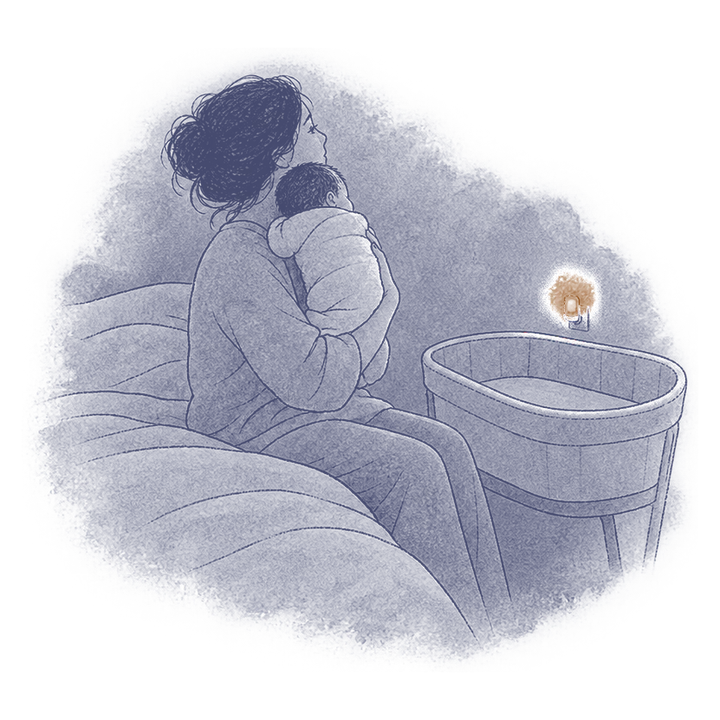
In these first weeks the days stop having edges. Night and day run together into one loop of feeding, changing and settling, and the baby at the center of it seems to sleep all the time, while you hardly sleep at all. That mismatch you’ve noticed is real, and it comes from the way a newborn’s sleep is made.
Is it normal that my baby sleeps in little bits, day and night?
Yes. In the first weeks a newborn’s sleep comes in cycles spread evenly across the whole twenty-four hours12. Every three to four hours or so they wake to be fed and cared for, then drift off again. Nothing in their body yet tells them that night is the time for the longer sleep, so the rounds fall as readily at 3am as at noon.
Added up, those rounds come to a great deal, somewhere from fourteen3 to eighteen hours a day12, and the experts each draw the usual range a little differently within that. So the people who told you babies sleep a lot were right about the hours, and you’re right that it doesn’t feel that way, because none of those hours lasts long. Babies differ widely, too, some sleeping much more than others, some in longer stretches and some in short bursts2, and there’s room for your baby anywhere along that spread. Waking in the night belongs to all of it, and the NHS says newborns wake again and again for the first few months2.
Both strips show the same twenty-four hours, from 6am to 6am. In the first weeks, sleep comes in cycles spread across the whole day and night, broken every three to four hours or so to be fed1, with nothing yet drawing it toward the dark. Later, as day-night rhythms come through4, the longest settled stretch at night grows, most of all between about 1 and 4 months5. Real days are far less tidy.
Drawn as an illustration of the pattern
See this as a table
| When | What it’s like | Its shape in the drawing | At the marked hour |
|---|---|---|---|
| In the first weeks | Rounds spread across the day and the night | Short rounds spread evenly across the day and the night, with a waking every three hours or so | Awake, to be fed |
| Weeks or months later | Naps by day, and a longer stretch at night | Naps by day, and the sleep gathered into a longer stretch at night with one waking in it | Asleep, inside the long stretch |
| Part | What |
|---|---|
| The soft rounds | Asleep |
| The bare line between them | Awake, to be fed and changed |
| The hairline at 3am, through every strip | A 3am feed |
Why are they so restless, and why do they wake when I lay them down?
The baby is asleep at last in your arms, heavy and still, and the instant they touch the mattress their eyes open. Or they lie in the crib twitching, grimacing and snuffling, and you wonder whether they’re asleep at all. Very often they are, in what’s called active sleep, the newborn form of REM sleep. About half of a newborn’s sleep1 is this kind, and it looks restless because so much is moving in it: small movements of the face and limbs, eyes moving under the lids, and breathing and heartbeat that speed up and slow1.
Until 2 to 3 months, babies also tend to fall asleep straight into active sleep1, and each sleep cycle is short, about fifty to sixty minutes1. That may be part of why a baby who seemed deeply asleep a moment ago can wake as you lay them down, because in those first minutes they may still be in that light, stirring kind of sleep.
Researchers think the twitches themselves may be doing something for the baby. Each jerk of a foot sets off a small burst of activity in the growing brain, which may be helping the brain map its own body16 through the eight hours or so a day that young babies spend in this kind of sleep.
Is it normal for them to breathe like that?
Maybe you’ve stood over the crib in the dark, waiting for the next breath. Newborns breathe fast by our standards, about forty to sixty breaths a minute7, and in active sleep the rhythm is uneven. Many also have periodic breathing, in which breathing speeds up, slows and pauses, then starts again. In one small German study that recorded thirty-seven healthy babies overnight at 1 and 3 months, more than nine in ten breathed this way8, and only a small share of their pauses were long ones.
What tells you more than the pause is the rest of the baby. A short pause in a baby who is a good color, and who wakes and feeds as usual, is part of how young babies breathe. A pause that comes with a change in color, with hard work to breathe, or with a baby who is floppy or hard to wake9 means calling 911 straight away. The full list is under when it’s worth calling someone. Nobody can watch a baby all night, and nobody is asked to, because the things that keep a sleeping baby safe are all done before you lie down yourself.
Why are they awake at night and asleep all day?
Your baby may be wide awake at 2am, eyes open in the dark, then sleep soundly through the afternoon while the house goes on around them. The body’s master clock is already formed before birth410, but it isn’t yet running their days, so for the first weeks nothing gathers a newborn’s sleep toward the night. Clear day-night rhythms usually come through after about 2 months410, and later in babies born early.
Light and dark seem to help build that clock, and they’re something you share with your baby. In one UK study, researchers followed fifty-six healthy babies in their own homes at 6, 9 and 12 weeks, with a small monitor on each baby’s ankle and a light monitor nearby. Over those weeks the share of their sleep falling at night rose steadily11, and the babies who slept better at night had spent more time in light in the early afternoon11.
That study shows the two going together, and it can’t prove the afternoon light did the work. The firmest experiments come from babies born early and cared for in hospital, who line up with the twenty-four-hour day better under a day-night lighting cycle10 than under constant dim light.
Sweet dreams form a shade O’er my lovely infants head, Sweet dreams of pleasant streams, By happy silent moony beams.
When will they sleep for longer at night?
At 3am it can seem as if every other baby you hear about is already sleeping through, and yours is the one who isn’t. A study in New Zealand followed this closely. Parents of seventy-five healthy babies kept sleep diaries for six days every month through their baby’s first year. The longest settled stretch at night grew most between about 1 and 4 months512, and by about 3 months half of the babies5 were settled from midnight to 5am. Settled didn’t mean unbroken, because the study counted a baby who woke without calling out as settled.
The other half were still on their way, and even at 12 months eleven of those seventy-five babies5 still weren’t settled from midnight to 5am. The NHS says some babies of 3 to 6 months2 sleep five to eight hours or more at night, and some don’t yet. There’s no date by which your baby ought to be sleeping through.
Questions people ask
Will cereal in the bottle help them sleep longer?
It doesn’t seem to. The evidence is one older US trial, from 1989. In it, babies started on rice cereal at 5 weeks were no more likely to sleep through the night13 than babies started at 4 months.
Should I keep them awake in the day so they sleep at night?
No. The NHS suggests letting them nap by day in the ordinary light and noise of the house, and keeping night feeds dim and still2. Keeping a baby awake to tire them out isn’t part of its advice.
Would a breathing monitor make them safer?
No. Home breathing and heart monitors don’t detect or prevent SIDS14. What does lower the risk happens each time you lay them down: on their back, in their own bare crib or bassinet, in your room.
How do I put them down safely?
Relatives, leaflets and the internet often disagree, and a dozen swaddles tend to arrive with as many opinions. The American Academy of Pediatrics’ guidance has several parts, but three of them matter most, and once they’re habits they ask nothing of you at 3am. For every sleep, day and night, your baby goes down:
- On their back, naps included, until their first birthday. Side and front aren’t safe, even for a nap1415, and that includes babies with reflux.
- In their own bare, flat space, a crib, bassinet or play yard with a firm, flat mattress1415 that meets federal safety standards and nothing on it but a fitted sheet: no pillows, quilts, blankets, bumpers, stuffed toys or positioners14.
- In your room, close to your bed, which is safer than sharing your bed and safer than a separate room1415. The NHS in the UK advises this for at least the first 6 months2.
The rest comes down to everyday things, like what they wear and the air around them. Your baby needs dressing only for the room, with no hat indoors, and a wearable blanket or an extra layer takes the place of loose bedding. Signs that they’re too warm include sweating, flushed or hot skin, or a hot chest14. Smoke matters too: second-hand smoke in the home or car raises the risk of SIDS1415, and so does alcohol or drug use by the people caring for a baby.
Sofas, waterbeds, mattresses that sink and anything tilted aren’t safe for sleep. If your baby drops off in a car seat, stroller, sling or carrier, you can move them to their own space as soon as you’re able.
Swaddling doesn’t lower the risk of SIDS14, though some babies settle better for it. A swaddled baby goes down on their back for every sleep, and the swaddle stops once they show signs of rolling, usually around 3 months. They still go down on their back every time, and once they can roll both ways on their own14, you can leave them in whatever position they roll into.
Perhaps someone has handed you a wedge or a positioner, or you’ve stood in a shop looking at an inclined sleeper or a weighted swaddle. The NIH’s Safe to Sleep guidance, which follows the AAP, says many wedges, positioners and similar products14 that claim to keep a baby in place or to prevent SIDS or reflux don’t meet federal sleep-safety rules. It also says inclined sleepers have been linked to injury and death. Weighted blankets, swaddles and other weighted objects stay out of the sleep space too.
The AAP names three things that lower the risk further1415: routine vaccinations, a pacifier at sleep time and feeding with human milk. There’s no need to force the pacifier on a baby who doesn’t want it, and if it falls out, there’s no need to put it back14. Tummy time is for when they’re awake and someone is watching14. If your baby was born early, the back-to-sleep rule is the same, with your care team’s other advice for your baby14 alongside it.
What if I’m so tired I might fall asleep while feeding?
After weeks of broken nights, keeping your eyes open through a 3am feed can take everything you have. That tiredness matters here, because sharing a bed is most dangerous when the adult is very tired or smokes14, or has had alcohol, drugs or a medicine that causes drowsiness. It’s also riskier on a mattress that gives and for any baby under 4 months or born early or small.
So if you bring your baby into your bed to feed or comfort them, you can first clear the pillows, blankets and bedding from your side14, so that if you do fall asleep the bed is as safe as you can make it. Then you can put the baby back in their own space when you’re done, or as soon as you wake.
If you think you might nod off, please feed in the bed you’ve cleared rather than on a sofa or armchair, because an adult falling asleep there with a baby is extremely dangerous14.
How do I get through this myself?
You lie down, and forty minutes later the next cry comes, and across a night those pieces can feel like no sleep at all. In West Virginia, researchers gave wrist monitors to seventy-two new mothers of healthy babies, women who weren’t depressed, and followed them through the first four months. The mothers slept just over seven hours a night on average16, though in pieces, with nearly two hours awake scattered through each night. The researchers think it’s the breaking-up, more than the total, that wears a person down. Over those months the total stayed about the same while the nights grew less broken16, and they describe this kind of sleep as a normal stage of life after a birth16.
“Sleep when the baby sleeps” is the advice everyone gives, the NHS included, though it hasn’t been well tested216, and after the second week fewer than half of those mothers napped even once a week. So a nap is a chance you can take when it comes. There’s more on the day itself in How do I get through the day after a bad night?, and where you can, the NHS suggests sharing the nights2, in whichever way fits the help you have.
-
If there are two of you
A partner can take feeds of formula or expressed milk2, or the early-morning changing and dressing, so a breastfeeding parent can go straight back to sleep.
-
If you’re doing this on your own
For now, the waking is how a newborn keeps going. Each short round of sleep and feeding is what a body this new runs on. Meanwhile the clock that will gather their sleep into nights410 is being built, week by week, on the days you manage everything and the days you don’t. The light of your afternoons and the dark of your night feeds seem to help it along1011.