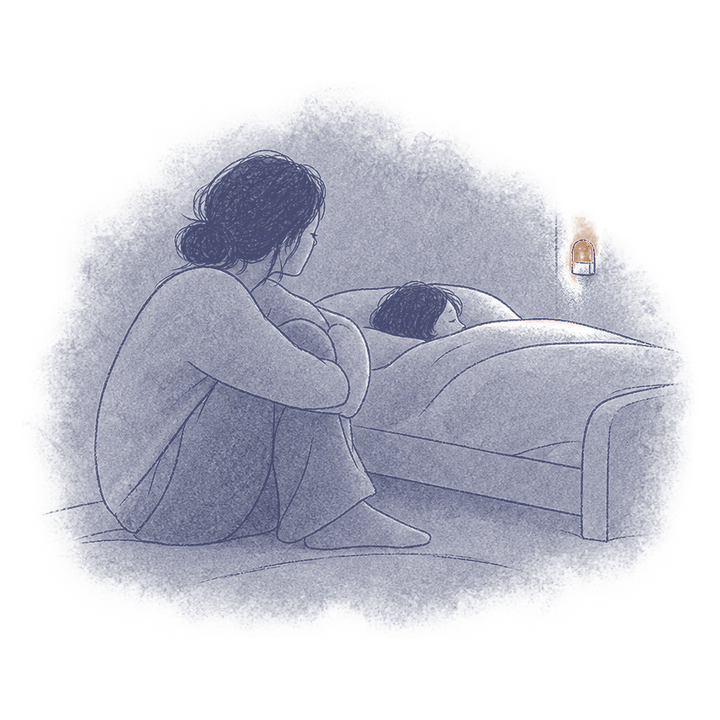
If you're reading this not long after, the house has probably gone still again, with your child asleep down the hall and your own heart still going hard. Or it may be the morning, and the child who frightened you so badly has woken bright and ordinary, with no idea that anything happened, while you feel as though you were up half the night. Either way, you probably want to know two things: whether something is wrong, and what to do if it happens again. Both have clear answers.
What can I do when it happens?
Most parents do the same things the first time. They pick the child up, say their name again and again, switch on the light, perhaps give a small shake to bring them round, and find that the screaming goes on, or grows. You haven't made it happen by doing any of that, and it helps to know why it went that way: trying to console, hold or wake a child in a night terror can add to the panic, make the episode longer or more intense, and make some children push back harder23.
Next time, you could stay near and let it run its course: sit or kneel close by, keep your own voice low and slow, and say very little. If a brother or sister shares the room and wakes to the noise, a few words to help them back to sleep are fine while you stay near the one in the episode. The advice from the NHS is to wait for it to pass, without trying to wake them, and to leave them free to move unless they could hurt themselves or someone else3. Most terrors cause no injury, though a child who runs can hit furniture or walls2, so it helps to clear the floor around the bed and, if they're up and moving, to stand between them and anything hard or the top of the stairs.
Most episodes last a few minutes; the NHS puts it at up to about fifteen, and some go on longer23, and even a short one can feel like an hour from the edge of the bed. Then it simply stops, and the child is soon back in deep sleep2. There's usually only one in a night2, so once they're asleep again, you can go back to bed as well.
Enjoy the honey-heavy dew of slumber. Thou hast no figures nor no fantasies Which busy care draws in the brains of men. Therefore thou sleep’st so sound.
How can I tell a night terror from a nightmare?
A few things you can see for yourself usually tell you which it was. The first is the clock, because night terrors come within one to three hours of falling asleep, almost always in the first half of the night23. It's the scream that has you running down the hall not long after you've sat down for the evening. Nightmares come later, in the middle or last part of the night23.
The second is whether your child knows you, and whether your comfort reaches them. A child in a terror looks terrified, heart racing and skin damp with sweat, and stares past you with a glassy look, hard to wake or console23. A child waking from a nightmare wakes easily and completely, and is fully alert2. The third comes in the morning: after a nightmare they remember the dream23, and after a terror they remember nothing at all23.
Some toddlers have something in between, which doctors call a confusional arousal: the child sits up confused, cries, moans or whimpers and may be impossible to settle, but without the screaming, fear, sweating or running of a terror, and again with no memory of it2. It is another partial waking out of deep sleep24, so it comes in the same early part of the night, and it makes sense to handle it the same way. If your child wakes from bad dreams they can tell you about, there's more on why nightmares happen and how to help.
One night from falling asleep to morning, in thirds. Deep sleep fills the shaded first third and dreaming sleep the last2. A terror comes near the end of that first stretch of deep sleep, almost always in the first half2, while nightmares belong to the dreaming hours later on23. The ten-hour night is an example, within what’s advised for children of 3 to 125, and real nights are less tidy.
Worked out from the figures in the studies cited
See this as a table
| Part of the night | From | To | What fills it |
|---|---|---|---|
| First third | Falling asleep | 3 hours 20 minutes after falling asleep | Mostly deep sleep |
| Middle third | 3 hours 20 minutes after falling asleep | 6 hours 40 minutes after falling asleep | Both, cycle by cycle |
| Last third | 6 hours 40 minutes after falling asleep | Morning (10 hours) | Mostly dreaming sleep |
| What | Usually comes | Almost always before |
|---|---|---|
| A night terror, out of deep sleep | 1 hour after falling asleep to 3 hours after falling asleep | Halfway through the night (5 hours) |
| A nightmare, out of dreaming sleep | A third of the way through (3 hours 20 minutes) to morning (10 hours) | Not given |
Why doesn't my child seem to know I'm there?
A night terror is a sudden, partial waking out of deep sleep24, the slow, heavy deep sleep that fills the first third of the night, before dreaming sleep takes over in the last third2. Something starts to wake the child, and they only get partway there.
Researchers think the brain is divided during these moments. Brain recordings, mostly from adults, suggest that the areas that drive movement and emotion are running much as they do awake, while the frontal and parietal areas, which awareness depends on, stay in deep sleep67. If children's brains do the same, as seems likely, it explains what you saw: a body awake enough to scream and run, alongside the part of the mind that would recognize your face, hear your voice and remember any of it, still fast asleep. That's also why your comfort can't reach them: it's aimed at the part of your child that would know your face and hear your voice.
The same picture fits the morning. There usually isn't a vivid dream behind a terror, and if a child is woken at the end, what they recall is fragmentary, sometimes only a sense of threat28. Nobody can know fully what a child feels in those minutes, but they aren't awake in the usual sense and won't remember it afterward, so most of the fear that lasts past the night is yours.
A closer look What do the brain recordings show?
The clearest picture comes from one unusual recording. A 20-year-old man with epilepsy had electrodes placed inside his brain to plan his treatment, and while they were in place he had a confusional arousal, the milder relative of a night terror. The recording showed the movement areas switching to wake-like activity while the frontal and parietal areas stayed in deep sleep7.
A review by European sleep researchers brings together brain-wave and imaging studies of adults with these disorders, and finds the same pattern of a brain partly awake and partly asleep6. Nobody has recorded a young child's brain this way during a night terror, so applying the picture to children rests on the episodes looking so alike and coming from the same deep sleep. It's how researchers think it works, and the best explanation there is for why a child can scream and run and remember nothing.
Is this common, and will they grow out of it?
How many other children do this? In Québec, researchers followed 1,940 children born in the late 1990s and asked their mothers every year about their sleep. At 18 months, the peak age, 34.4% of the children had had night terrors1, which makes them common: about one toddler in three.
From that peak the numbers fall away, dropping sharply through childhood910, and most children have grown out of them by adolescence, so that they're uncommon after puberty23.
Perhaps someone in your family sleepwalked as a child, or still does. That matters, because a parent's history of sleepwalking makes terrors in the child more likely13, and part of the tendency is passed down through genes10. The two are close relatives, and up to a third of children with early terrors go on to sleepwalk later in childhood1. There's more on that in why people sleepwalk.
A closer look Why do some sources give much smaller numbers?
The big Québec numbers and the small clinical ones are counting different things. The Québec researchers asked mothers every year and counted any episode a mother noticed1, even a single one, in toddlers close to the peak age. A twin study in the same province, of 390 pairs, found 36.9% of toddlers with terrors at 18 months and 19.7% by 30 months10. The same twins showed why family history matters: genes explained about 42 to 44% of the differences between toddlers in who had terrors10. A third study, which followed 1,353 Québec children, saw terrors drop sharply through childhood9.
A clinical review spreads its count across every age from 1 to 12 instead, and puts terrors in 1 to 6.5% of children, most often around ages 5 to 72; the NHS says they're most common between 3 and 83. As the review itself says, estimates vary with how terrors are defined and counted2. Read together, the two kinds of count tell you that a single episode in a toddler is common, and that terrors which keep coming through the school years are much less so.
It’s often said
Something must have frightened them, or something's wrong at home.
Why it can feel that way
A terrified face reads as fear, and fear seems to need a cause, so you go back over the day looking for it: the film, the argument, the worry they mentioned at bath time. Popular advice, including the NHS, lists a fright, a scary film or stress among the causes3.
What’s going on underneath
Researchers don't agree on how much feelings matter in children. Clinical reviewers say psychological factors are uncommon in children with night terrors, though common in adults2. One large Québec study found terrors unrelated to adversity in the family, though linked with higher anxiety scores9, and nobody knows yet whether the anxiety comes first, or the disturbed nights, or something behind both. What the evidence supports more firmly is anything that deepens or breaks up a child's sleep, and none of that is a judgement on your home.
What makes a night terror more likely?
If you've been through a few, you may already have noticed that the bad nights follow a missed nap, a late party or a fever. The research agrees: terrors come more often when a child is ill with a fever, overtired or short of sleep, in a noisy room or with a full bladder238. Anything that keeps breaking up sleep through the night can do it too, including conditions such as sleep apnea and restless legs238.
How much can one short night matter? Researchers in Montréal tested it in ten adults who sleepwalk, playing them a sound during deep sleep. On a normal night it set off an episode in three of them11. When the same people came back after twenty-five hours without sleep, the sound set one off in all ten11, while in ten people who didn't sleepwalk it set off nothing at all11. Sleepwalking and terrors are close enough relatives that it's a fair guess a tired child is primed in the same way.
If your child snores most nights, or you've seen them seem to pause in their breathing, that's worth knowing about too. At a sleep clinic at Stanford, doctors looked back at children brought in for frequent terrors and found that more than half had breathing problems in their sleep, and in every child who had their tonsils or adenoids taken out to treat it, the episodes stopped12. These were children with frequent episodes, seen at a specialist clinic, and the study had no proper comparison group. Even so, it makes snoring a lead worth taking to a doctor, and there's more on it under Do I have sleep apnea?.
For most children, the most useful thing is plenty of regular sleep, which means ten to thirteen hours in every 24, naps included, for children aged 3 to 5, and nine to twelve hours for ages 6 to 125. No trial has tested extra sleep against terrors directly, so this rests on what's known about sleep loss setting them off. If you want to see a pattern, a few lines on the calendar over two weeks, noting naps, late nights and the terrors themselves, can help you spot what comes before the bad nights23. There's help with bedtimes in how to help your child sleep.
Can I stop them before they start?
If the terrors come often and at much the same time each night, there's one tactic that has been studied, called scheduled waking: you rouse your child a little before the usual time, so the deep sleep is broken up before a terror can start. The NHS describes it as something that may stop them3.
It rests on a handful of small studies, and the children in them who were treated with scheduled waking alone all got better4. Only one of them was a trial in children with a group to compare against. One group of children had scheduled waking, and in the other the families were given only an explanation of night terrors and some reassurance. Both groups got better, and in that one small trial the difference between them wasn't significant4. So it may help, and it may be that time and a better understanding of what's happening do much of the work.
On that evidence, it's a reasonable thing to try for two weeks. It is a nightly task for a parent who is already tired, though, and it briefly breaks your child's sleep, so it's worth stopping if the nights get worse or your child becomes harder to settle.
A closer look How much research is there on scheduled waking?
A 2023 systematic review gathered every report it could find on scheduled waking for night terrors or sleepwalking, and found nine, two of them randomized trials and the rest case reports, case series and small studies, mostly without a comparison group4. The reports cover terrors and sleepwalking together, and most were about children. Across them, every child treated with scheduled waking alone improved, twenty-two fully and one partly4. Without a comparison group, though, nobody can tell how many of those children would have improved on their own, because most children outgrow terrors23.
What do I say to them in the morning?
You don't need to say much at all. Your child won't remember the night23, so there's no need to ask them about it or make it a topic at breakfast. There's little to gain from telling them how frightening they looked, either. A matter-of-fact morning, with the day going on as usual, is often the most reassuring thing for you both. Most children need nothing more than that; medicines are kept for the rare child whose episodes are frequent and disruptive, which is a decision for a doctor28.
Childhood terrors are often hardest on the family, through broken sleep and a great deal of parental worry2. It's often the parent who is wrung out the next morning while the child eats cereal and chatters about the day, and it's okay to treat yourself as the one who had the hard night. If you're facing the day on too little sleep, there's help in how to get through the day after a bad night.
What if I'm the adult who has them?
Perhaps you've woken partway through one yourself, sitting up or halfway across the room, with your heart pounding and a single picture still in your mind. Researchers in Paris heard much the same from adults sent to their clinic with severe sleepwalking or terrors. Seven in ten of them recalled at least one dreamlike image, almost always a single scene and usually with a sense of dread13, and what they saw matched what they had done13. Most of them sleepwalked and their episodes were severe, so their memories may not match every adult's.
Then there's everyone else: a partner who was frightened beside you, or a shared room on holiday that's become something to dread. Your situation differs from a child's in a few ways, too. Terrors are rarer in adults than in children614, and ones that begin at puberty or later may continue into adulthood2, so you may have had them on and off since your teens. Your feelings count for more, too: psychological factors play a part more often in adults than in children2.
It may help to think back over the days before your last bad night. Was it a stressful week, or a day of strong emotion, even a happy one, or one short on sleep15? Those are what adults at a French sleep clinic most often named, in a study of people who sleepwalk, many of whom also had terrors. Terrors also turn up more often in people who have sleep apnea or drink alcohol at bedtime14, so a nightcap or heavy snoring belongs on that list.
That list is also where help starts: protecting your sleep, cutting back on alcohol before bed, getting snoring checked for apnea, and making the bedroom safe68. The bedroom matters because some adults are hurt in an episode badly enough to need medical care, and some injure the people around them615, so you could clear the floor, fit a window lock and keep anything sharp away from the bed. No one has run placebo-controlled drug trials68, so medicine, if it's used at all, is a doctor's call.
A closer look How common are night terrors in adults, and what goes with them?
In a UK telephone survey of 4,972 people aged 15 and over, 2.2% reported night terrors14, and the authors thought the true figure was likely higher. In the same survey, terrors were about four times as common in people with sleep apnea or who drank alcohol at bedtime, and about five times as common in those with a sense of choking at night14. A survey like this shows what tends to go together, but it can't say what causes what.
A clinic in Montpellier studied 100 adults who sleepwalked, nearly two-thirds of whom also had terrors. About 60% named things that made their episodes more frequent or severe, mainly stress, strong happy emotions and lost sleep15. These were adults sent to a specialist, with episodes more severe than most, so their figures describe the harder end of what adults go through.
For most families, though, it goes the way it went the first time: a scream down the hall an hour or two after bedtime, a few long minutes spent close by in the dim light, and then a child asleep again, who comes down in the morning with no memory of it and a good appetite. As the years go on, nights like that grow fewer29, and the parent who sat on the edge of the bed with a racing heart can find their way back to sleep a little sooner each time.