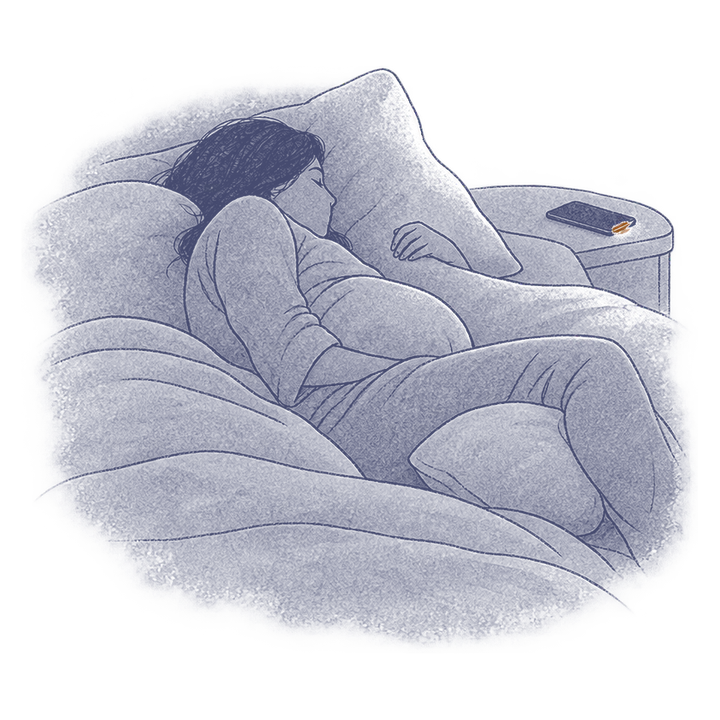
If you've come to on your back this minute with that jolt of fright, the NHS has a sentence for exactly this moment: if you wake up on your back there's no need to worry, as you can turn onto your side and go back to sleep2. Why so relaxed about the rest of the night? The research behind the side-sleeping advice is about the position you fall asleep in, from twenty-eight weeks on23. That's the position most people stay in longest3, so it's the one the studies asked about. The advice asks something of you at bedtime and nothing while you sleep. Your right side counts the same as your left3, which means you can face whichever way your hip will let you.
The other wakings have their reasons too. When a team surveyed more than two thousand pregnant women online, the commonest reason they gave for broken nights was needing to pee4, and what breaks yours up changes as the months go by.
When thou liest down, thou shalt not be afraid: yea, thou shalt lie down, and thy sleep shall be sweet.
Is it normal to sleep this badly when I'm pregnant?
It is, and it isn't only how it feels. A US team recorded women's sleep overnight in a lab early in their pregnancy, then brought the same women back late on. On the later nights they slept less and woke more, with less deep and REM sleep6. So if you feel you're resting less than you used to, that's what the recordings found in women like you.
What shifts over the months is which things do the waking. Early on it's mostly tiredness and sickness. Late on it's size, pressure and a baby with a timetable of their own.
Why am I so tired in the first months, and then awake at 2am?
In the first twelve weeks, hormonal changes can make you tired, sick and emotional, and the tiredness itself won't harm you or the baby2. So you may find yourself asleep on the sofa soon after dinner and then lying awake in the small hours with your stomach turning, while the rest of the house sleeps on.
Pregnancy sickness can come at any time of the day or night, and it usually clears by sixteen to twenty weeks without putting the baby at extra risk7. What tends to help is something plain, like dry toast or a plain biscuit, small and frequent snacks high in carbohydrate and low in fat such as crackers, with sips of drink little and often7. A few crackers and a glass of water by the bed are one way of keeping that within reach when you wake queasy at 2am, so you needn't pad to the kitchen and stand in the light of the fridge. Foods with ginger in them can help too, though it's worth checking with a pharmacist before taking ginger as a supplement7.
Why do the middle months feel easier?
Many women find a pause somewhere in the middle, once sickness usually eases by sixteen to twenty weeks7 and before the late discomforts arrive. The insomnia numbers fit that shape: insomnia stays about level through the first two trimesters and climbs in the third8. Nobody has measured the lull itself, though. It's pieced together from those two findings, and an average across thousands of women can't tell you how your own months will run.
Two pooled analyses of pregnant women answering questionnaires, one row each, so read each row's shape rather than setting one against the other: insomnia symptoms stay level through the first two trimesters and climb in the third8, while restless legs build steadily to the third and mostly go after the birth9. The light marks where the climb comes.
From the studies’ own measurements
See this as a table
| What was counted | First trimester | Second trimester | Third trimester | After the birth |
|---|---|---|---|---|
| Insomnia symptoms24 studies, 15,564 women | 25.3% | 27.2% | 39.7% | Not reported |
| Restless legs27 studies, 51,717 women | 8% | 16% | 22% | 4% |
What wakes me in the last months, and what helps?
In the last months, turning over can mean waking right up to shift a pillow and the bump together, and just as you get comfortable, a small heel may press up under your ribs. As the bump grows, lying down gets harder to make comfortable2, and specialists count stretching ligaments, tightenings of the womb and the baby's movements among the things that break sleep up10.
The bladder is back too, because the growing bump means needing the bathroom a lot2. Drinking less just before bed is one of the steps sleep specialists suggest for nighttime peeing10, though nobody has tested it on its own.
Heartburn has its own reasons for choosing the night. It grows more common from twelve weeks on, because hormones relax the valve at the top of the stomach and the growing baby presses against it5. Then you lie down, and acid can come back up5. So the evening is where you can head it off. Smaller meals more often, with nothing in the three hours before bed, can help5, and so can sitting up for a while after you eat5. In bed, there's the extra pillow and the left side5. If it still wakes you, a pharmacist can suggest an antacid or alginate if you tell them you're pregnant, since some antacids aren't suitable5. If you take iron or folic acid, it's worth leaving two hours between that and an antacid5.
When a calf seizes in the night, it pulls you awake in a moment. Researchers who reviewed the trials found that no supplement has yet been shown to help, magnesium included11, so if you're tempted to buy one for cramps, it's one to ask your midwife about first. Once the cramp lets go, getting comfortable on your side again is the whole job, and the pillows you set up for that2 are still there.
If your nose is stuffed up at night in these months, or you feel a little short of breath lying flat, part of the reason is that pregnancy hormones and extra fluid can swell the lining of the nose and airway, and late on the lungs hold less air at rest, especially lying on your back10.
Why won't my legs keep still at night?
That creeping, fizzing need to move your legs just as you lie still is restless legs. It turns up in about one in five pregnant women, building toward the third trimester and mostly going after the birth9.
The international guideline for restless legs in pregnancy starts with reassurance, exercise and avoiding what makes the legs worse, and it sets out a reason for iron12. Specialists suggest iron when a blood test of your iron stores, called ferritin, comes back low, with more tests to follow10. So iron is something to start after that test, on your midwife's or doctor's word. If those first steps aren't enough, they can weigh up other treatments with you. It's worth raising even if it seems minor. Many pregnant women with restless legs have symptoms bad enough to harm their sleep, and some studies have linked it with high blood pressure in pregnancy1012. Why do my legs feel restless at night? has more on it outside pregnancy.
What does the research really say about sleeping on my back?
You've probably been told to sleep on your side. From twenty-eight weeks, what the advice asks of you is the side you're on as you go to sleep23. Where did it come from? Researchers talked with women late in pregnancy, some who had lost their baby and some whose pregnancies were going on, and asked each how she had gone to sleep in the weeks before. When they pooled five of those studies, going to sleep on the back was linked to 2.6 times the odds of stillbirth from twenty-eight weeks, compared with going to sleep on the left side3. Going to sleep on the right side was no riskier than the left3, so in these data the two sides come out the same.
Nobody has tested this in a trial. The link comes from women recalling their sleep after the event3. The researchers think the reason is that lying on your back late in pregnancy lets the womb press on the large vein and artery behind it, reducing blood flow to the baby3, though that's a proposed explanation, and no one has shown it's the cause. Even so, the NHS advises going to sleep on your side from twenty-eight weeks2. For a finding like this, and an ask this small, going to sleep on either side from then on seems well worth it.
If you're earlier in pregnancy, the side-sleeping advice begins at twenty-eight weeks2, so until then the way you fall asleep isn't something you need to watch. A US study of first-time mothers agrees. The women described how they went to sleep before anyone knew how their pregnancy would end, and going to sleep on the back or the right side up to thirty weeks wasn't linked to stillbirth, a small baby or high blood pressure13. Its stillbirths were few, and it couldn't speak to the last two months13.
It’s often said
You have to stay on your left side all night, or it could hurt the baby.
Why it can feel that way
It's how the advice often reaches people, passed on quickly by friends and forums, and it grows from a real finding, so lying rigid on the left can feel like the one thing you can do to keep your baby safe.
A closer look How were the sleep-position studies done?
The pooled analysis gathered five case–control studies from New Zealand, Australia, the UK and an international online study, covering 851 late stillbirths and 2,257 ongoing pregnancies3. Each compared women who had a stillbirth at or after twenty-eight weeks with women whose pregnancies were going on at the same stage, and asked both groups how they had gone to sleep in the last two weeks. Few went to sleep on their backs: about three in every hundred women whose babies were born alive, and about eight in every hundred of those whose babies were stillborn3. From this the authors estimated that about six in every hundred late stillbirths might be prevented if everyone went to sleep on their side from twenty-eight weeks3.
Because women described their position after the event, the memory of a stillbirth may color what they recall, which the authors acknowledge3, and they had no randomized trials or forward-looking studies of the last weeks to include. Earlier single studies had disagreed about the right side. Taken together, they found it no different from the left3, as far as these data can say, which for you means the hip that's less sore gets to choose.
Is snoring in pregnancy something to mention?
Snoring often starts or grows in pregnancy, reaching up to a third of women by the third trimester10, and the swelling of the nose and airway that comes with pregnancy10 is part of why.
Breathing problems in sleep become more common through pregnancy, and observational studies have linked them with high blood pressure and diabetes in pregnancy14. If your snoring is heavy, and especially if your partner or anyone else in the room hears you pause in your breathing or gasp, or you wake yourself with a gasp, that's worth telling your midwife or doctor. Snoring on its own can't show whether your breathing is being disturbed in sleep14, and they can help you find out. Whether treatment changes how pregnancies go isn't yet known14. Do I have sleep apnea? explains what a test involves.
What can I do when my mind won't stop?
The thoughts that come at 3am in pregnancy are about real things, the birth, money, whether the baby is well, and at that hour each one looks bigger than it will over breakfast. Strange dreams and nightmares about the baby, labor and birth are normal in pregnancy, and talking them over with a partner or midwife, along with relaxation and breathing, can help with the anxiety2. What can I do when worry keeps me awake? has some ways to try.
If the bad nights have turned into insomnia that's gone on for weeks, there's a treatment without drugs that has been tested in pregnant women, and specialists in sleep and pregnancy put approaches like it first10. In one US trial, pregnant women with insomnia had either CBT for insomnia or another therapy built on imagery, and nearly two in three of those who had CBT reached remission, a little more than with the comparison, and they got there sooner15. Why only a little more? The comparison was a real therapy too, and the women who had it improved as well, so CBT was measured against something that helped. A second trial set a digital version against usual care, and twice as many women reached remission with it16. With two trials pointing the same way, CBT seems well worth asking about if your insomnia has lasted weeks. In the first trial, the women who had CBT got there in a median of about a month15, and you could start by raising it with your midwife, or with What is CBT for insomnia, and what would it ask of me?
A closer look What did the two CBT trials in pregnancy find?
In the first trial, run at three US sites, 179 women between eighteen and thirty-two weeks pregnant had either CBT for insomnia or a comparison therapy; insomnia scores fell from 15.4 to 8.0 with CBT, against 15.9 to 11.2, and 64 percent reached remission against 52 percent, getting there in a median of thirty-one days against forty-eight15. The comparison was an active therapy built on imagery, and women with major psychiatric conditions, depression among them, weren't included.
In the second, 208 women up to twenty-eight weeks pregnant did six weekly sessions of a digital program, each about twenty minutes, and 44 percent reached remission against 22 percent with usual care, with less depression and anxiety too, though they didn't sleep longer16. The whole trial ran remotely, and most of the women in it were white, college-educated and well off, so it says less about women whose lives look different from theirs.
Is it okay to nap or lie down in the day?
It is, and most pregnant women do: in one large survey, seventy-eight in every hundred napped4. The NHS advises resting as much as you can in early pregnancy, and sitting with your feet up in the day2. It does suggest skipping afternoon or evening naps if they make it harder to fall asleep at bedtime2, so it's worth noticing whether a late nap does that to you, and keeping the ones that don't. People may tell you to get your sleep now, before the baby comes. When you are already trying every night, that can sound like a reproach, so it may help to think of any rest you find as being for the day you're in.
Can I take something to help me sleep?
Maybe you've been eyeing the box of sleep aids in the drawer, or a bottle of melatonin, and wondering whether you may. Some people reach for a drink instead10, and that one has a plain answer: in pregnancy it's safest not to drink at all5. For the rest, the research is thin, and pregnant women and specialists alike tend to prefer starting without drugs10.
If the box says diphenhydramine, it's a sleep-aid antihistamine. Many women take it in pregnancy, though few studies confirm it's safe10, and some reports link taking it in the first trimester with birth differences10. That's why it's one to ask your midwife or doctor about before you take it. An antihistamine your doctor prescribes for sickness is a different matter: that's a separate, supervised use710.
Melatonin has had little research in pregnancy, and nobody yet knows whether it helps insomnia there1017. What researchers have seen, mostly in animals, suggests it crosses the placenta, which raises a theoretical concern for the baby's developing body clock1017. With that still open, it's worth a word with your midwife or doctor first. Valerian and chamomile sound harmless, yet little is known about whether they're safe in pregnancy, and herbs can interact with medicines1819, so they belong in that conversation too, especially if you take anything else.
Specialists treat prescription sleeping pills as a decision for you and your doctor to make together10. For zolpidem, one large study found more babies born small or early, though no more birth differences10, and a newborn can have withdrawal from many drugs taken late in pregnancy10. Still, specialists say some medicines may be justified when treatment without drugs hasn't worked10, because an untreated condition can be riskier for you and the baby than a medicine is10. If you already take a prescribed medicine for sleep or mood, please don't stop it suddenly without talking to your doctor first, as stopping without advice isn't recommended1020.
The sleeplessness itself is something you can bring to your midwife as a problem in its own right, and the CBT from the section above is still there to try.
If you're lying beside her, what's typical and how can you help?
From your side of the bed, it can seem as though she barely sleeps at all. She gets up in the dark, comes back, and turns over slowly with the bump, a pillow at a time. What you're watching is the bladder, the heartburn and the sheer size from the sections above, each taking its turn. You could take over the evening tasks so dinner comes earlier and she can sit up afterward. You could help build the wall of pillows at bedtime, and when she wakes from a strange dream, talk it through together2.
You may also see something before she does. Partners and family may be the first to notice signs of depression, and can help by encouraging a talk with a health professional20. And if you hear her snoring heavily with pauses or gasps, you could tell her, so she can mention it to her midwife.
What the research says
- Poor sleep is very common in pregnancy, and some loss of sleep quality is expected. Well established
- Restless legs affect about one in five pregnant women, peak in the third trimester and usually ease after the birth. Well established
- From twenty-eight weeks, going to sleep on the back is linked to more late stillbirths, and the right side is no different from the left. Good evidence
- Up to thirty weeks, a forward-looking study found no link between going-to-sleep position and stillbirth, though it had few stillbirths and couldn't speak to the last weeks. Good evidence
- CBT for insomnia, in person or digital, improved insomnia in pregnant women in two trials. Good evidence
- In a review of eight small trials, it was unclear whether any treatment for leg cramps in pregnancy works, magnesium included. Early evidence
- The middle months may be easier for many women, though this is pieced together from sickness easing and insomnia staying level, and hasn't been measured directly. Early evidence
- Whether melatonin, sleep-aid antihistamines, valerian or chamomile are safe in pregnancy hasn't been well studied. Not well studied yet
The late-pregnancy position evidence comes from case–control studies, with no trials behind it.
Questions people ask
Is it okay to sleep propped up?
Will my being so tired harm the baby?
The NHS says the tiredness itself won't harm you or the baby2. It is still hard on you, and How do I get through the day after a bad night? has some thoughts on the day itself.
Will the restless legs go away?
For most women they do. Restless legs fall from 22 percent in the third trimester to 4 percent after the birth9.
So when you lie down again tonight, you could pick whichever side your hip prefers, with the pillows where you want them. That's the whole of what the position research asks. If you wake later on your back, you can turn onto your side and go back to sleep.