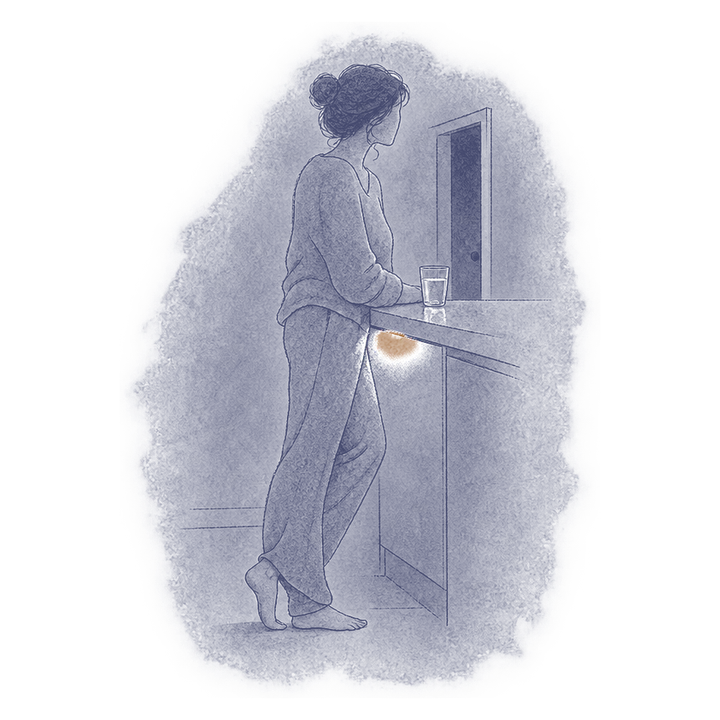
Your legs won't keep still, however you lie. You get up and they ease. You lie back down and it all starts over. It's hard to put into words. It isn't quite pain and it isn't a cramp, so people reach for all sorts of descriptions: a fizzing under the skin, an itch somewhere too deep to scratch, a stretch that stretching never finishes. In a survey of more than fifteen thousand adults in the US and Europe, about seven in a hundred had felt it in the past year, and nearly three in a hundred at least twice a week with real distress34.
Doctors call it restless legs syndrome, and four things mark it out15: an urge to move the legs, sometimes the arms too, that comes on or grows when you're still, eases while you move and is worst in the evening or at night. The feeling that comes with the urge is often described as creeping, itching or pulling, or as an ache or a tingle23.
Lying still and willing it away is the one thing that tends not to work, because stillness is what brings it on and moving is what brings relief1.
How do I know it's restless legs and not something else?
There's no blood test or scan that shows restless legs, and no need for a night in a sleep lab to find it13. A doctor recognizes it from what you describe, so your own account of your evenings is the most useful thing you can bring. They'll also want to rule out a few things that can feel similar, among them nerve damage in the feet, a restlessness some medicines bring on, discomfort from lying awkwardly, sore joints and nighttime cramps178.
A cramp is the easiest of these to tell apart once you've had both. A nighttime leg cramp is a sudden, painful tightening of the calf, the back of the thigh or the foot, with a muscle that goes hard, and it lasts seconds to minutes, usually ten at most9. What restless legs brings instead is the urge to move, which eases while you're moving and returns each time you're still again1.
If you've mentioned it to a doctor before and come away with talk of nerves or circulation, or with nothing at all, you'll recognize what that same survey found. Among the people whose symptoms were frequent and troubling, eighty-one percent had raised them with their doctor. Of those, only about six percent had been told it was restless legs45. Those conversations took place in the early 2000s, and recognition may be better now.
Why does it wait until I lie down at night?
It keeps time, rising and ebbing on much the same schedule night after night. If you were once told it was nerves, that steadiness says something, because a rhythm this regular points to something happening in the body. On a usual sleep schedule, symptoms tend to climb through the evening, peak between about 11pm and 4am, and fall to their lowest from about 9am to 2pm2. So the sofa after dinner, a late film in the cinema, a long drive home and the first hours in bed all meet it near its height, while the same legs can sit through a morning meeting without complaint.
That rhythm seems to come from the body clock itself, more than from tiredness. In a small laboratory study, seven people with restless legs and seven without stayed awake for twenty-eight hours in unchanging conditions. The leg discomfort still rose and fell on its daily rhythm10. They'd gone twenty-eight hours without sleep, and their legs were still keeping time. The researchers also saw a rise in melatonin, the hormone of the body's night, come just before the symptoms climbed10. They read that as a sign of the clock at work, though nobody has shown that melatonin causes the symptoms. Reports from shift workers and long-haul flyers describe the symptoms shifting later after flying west and earlier after flying east2, as you'd expect of something set by an inner clock.
One leading idea ties the clock to iron. In this model, low iron in the brain upsets the signaling of dopamine, one of the brain's messengers. Dopamine naturally dips in the evening and night, so the signal may fall below a threshold then and set off the urge2. It's still a hypothesis, and researchers agree that the cause is only partly understood, with genes mattering alongside iron and other brain chemicals still to be fitted into the picture15.
A closer look How might low brain iron set off symptoms in the evening?
The model most researchers point to runs in a few steps, and much of it comes from spinal-fluid samples, post-mortem brains and mice kept short of iron2.
First, brain scans and ultrasound, along with those spinal-fluid and post-mortem studies, have found less iron in parts of the brain in people with restless legs, including the substantia nigra12, a region that helps control movement. Second, in this model, the iron shortage leads to too much dopamine being released, and the receptors that receive it turn themselves down in response2. Third, dopamine has its own daily rhythm, and in the blood it peaks around 8am and is lowest around 3am2, though blood levels aren't the same as levels in the brain. So in the evening, as dopamine falls, the turned-down receptors are left with a signal too weak to keep the legs still, and the urge begins.
This account fits the clock and the iron findings well, though it remains a model, and other brain chemicals, among them glutamate, adenosine and the body's own opioids, are still being fitted into it15.
It’s often said
It's a circulation problem.
Why it can feel that way
The feeling is in the legs, it eases when you walk and it gets worse after long stretches of sitting, so blood flow seems the obvious place to look, and some studies have found changes in the small blood vessels and low oxygen in the legs of people with restless legs2.
Why would iron matter if my blood tests were fine?
You may already have had bloods taken and been told they were fine. The brain can be short of iron while the blood looks normal12. Iron in the blood doesn't reliably show iron in the brain, and some people whose blood iron tests were normal still improve with iron treatment12. So “your bloods were fine” can be true by the usual measure and still leave the question open.
The test that matters is ferritin, the measure of the body's iron store, and guidelines recommend checking it for everyone with troublesome restless legs, along with transferrin saturation1. If you've had it checked before, your result was most likely read against a typical lab range, and those ranges call ferritin normal from a much lower level11 than the one used for restless legs. Where restless legs is concerned, guidelines suggest iron treatment when ferritin is 75 nanograms per milliliter or below112, and that's the number to compare your own result with. The line is expert consensus that trials haven't tested, and a 2026 review draws it at 1003, so a result a little above 75, or a low transferrin saturation, is still worth talking over with your doctor. A woman told her ferritin of 20 was normal could still be far below the line for restless legs, and only the number itself will show her that.
Each dot is where a typical lab range starts calling ferritin normal11, for women and for men, and labs vary a little. The dotted lines are where guidelines for restless legs suggest iron treatment112, and where a 2026 review draws it3. A result in the lit stretch is normal by the lab’s range and still under the line that matters here. Both lines are expert consensus that trials haven't yet tested.
Worked out from the figures in the studies cited
See this as a table
| Who | Called normal on a typical lab range | Called normal, still under the guideline line |
|---|---|---|
| Women, labs vary a little | 13 ng/mL | 13 to 75 ng/mL |
| Men | 30 ng/mL | 30 to 75 ng/mL |
| Line | At |
|---|---|
| Guidelines for restless legs | 75 ng/mL |
| A 2026 review | 100 ng/mL |
If your ferritin is low, iron can be given in two ways. Iron by drip has a strong guideline recommendation for restless legs, while tablets have a weaker one and often cause constipation1. Please have the test before taking iron on your own, because iron can be harmful in excess, and iron tablets are especially dangerous if a child gets hold of them11113.
Could something I take be making it worse?
It could, and this is one of the most useful things to check. The evening drink, the afternoon coffee and a prescription you've taken for years can all play a part. When guidelines set out treatment, they begin with what feeds it: alcohol, caffeine, antihistamines, many antidepressants and untreated sleep apnea, along with medicines that block dopamine, such as antipsychotics114. Some anti-nausea drugs block dopamine too, so they belong on that list. Going short on sleep tends to make it worse as well2, which is hard to escape when your legs are the reason you're short of it.
Of these, the antihistamine may be the one already waiting in the bathroom cabinet. Diphenhydramine is one of the medicines linked to restless legs, and it's the sleep ingredient in many over-the-counter sleep aids and PM painkillers36. So the pill taken at 2am to get through can add to the very thing keeping you up. There's little research yet on how often that happens, and Are sleeping pills safe to take? looks at the wider question.
Perhaps it began, or grew worse, soon after you started a new antidepressant. In one study of people newly starting one, about one in eleven developed restless legs or found it worse, usually within the first few days15. The rate was highest with mirtazapine, at about twenty-eight in a hundred15. If you think a prescribed medicine is part of it, please talk to whoever prescribed it before stopping, since there may be an alternative, and some medicines cause problems if they're stopped suddenly3.
For caffeine, How long does caffeine stay in your system? can help you see how far into the evening an afternoon cup reaches, and Does alcohol help you sleep? covers what a drink does to the night.
Why do my legs jerk once I'm finally asleep?
If you share a bed, the other person may know what your legs do after dark better than you do: the kicks that wake them, or the covers you find tangled in the morning with no memory of having moved. Restless legs often comes with periodic limb movements once you're asleep, brief jerks or flexes of the legs that come again and again, mostly early in the night1. They're often what a bed partner feels as kicking. If you're that partner, the one who has been kicked awake or watched someone pace the hallway at midnight, it can help to describe what you've seen at the doctor's, as a picture of the night from the one person who was awake for it.
What helps on the nights it comes?
When you're out in the hallway again, the walking is doing real work, since relief while you move is part of how doctors recognize restless legs1. Getting up to do something on your feet is the most direct use of that.
Maybe you've tried more than walking: a cold pack, a vibrating pad, a hot bath before bed. Researchers have tested a few of these in trials, though the trials are few and not of high quality16. In them, exercise and leg compression devices may ease it. Vibration pads and cold therapy didn't lower its severity, though they did help some measures of sleep16. That review didn't include massage or a warm bath, so there's little or no trial evidence on them either way, and if one of them eases your legs at midnight, it's yours to keep.
It’s often said
Magnesium will sort it out.
Why it can feel that way
It's suggested almost everywhere, and it's often recommended for leg cramps17, which are easy to confuse with restless legs, so advice meant for one gets passed on to the other.
What’s going on underneath
A systematic review found only one randomized trial of magnesium for restless legs, and it showed no clear benefit17, though it may have been too small to tell, so whether magnesium helps isn't known yet.
What can a doctor offer?
If you're already taking a medicine for restless legs, you may have noticed the evenings starting earlier than they used to. The legs might start up on the sofa after dinner now, or the feeling might have crept into your arms. That change has a name, augmentation: symptoms start earlier in the day, come on faster when you sit, or spread to the arms or elsewhere13. It comes with the dopamine drugs that were for years a usual first choice, pramipexole, ropinirole, rotigotine and levodopa1.
One clinic went back through its records to see how often it happened. About seven in a hundred people a year on pramipexole developed it, and the rate stayed at much the same level year after year18. So a medicine can work well for a long time and then slowly start making the evenings longer.
That's why the American Academy of Sleep Medicine now advises against dopamine drugs as standard treatment1. They tend to work well at first. Over time they can make the condition itself worse, and they can cause impulse-control problems too1. Treatment now usually begins with the iron tests and a look at what you take. If you need a medicine, the first choice is the gabapentin family, whose main side effects are sleepiness and dizziness13. For the hardest cases, a doctor can offer a low-dose opioid, which brings risks of misuse, dependence and slowed breathing, or a wearable device that stimulates a nerve below the knee1.
If you're on a dopamine drug and your evenings have been creeping earlier, it's something to raise with your doctor, since there are other treatments to move to. Please don't stop it abruptly, because symptoms can rebound badly, and the usual plan is to add another treatment and then taper off slowly with your doctor1.
A closer look How well do the newer medicines work, and who is still on the old ones?
In the trials, people with restless legs took either a medicine from the gabapentin family (gabapentin, gabapentin enacarbil or pregabalin) or a placebo, a dummy pill. About seventy percent of those on the medicine came out much or very much better, against about forty percent on the placebo13. So plenty of people improve on a dummy pill, and the medicine adds a good deal more.
The move away from dopamine drugs is recent. If you've been on pramipexole or ropinirole for years, the change may simply not have reached you yet: in 2017 and 2018 more than half of US patients on medicine for restless legs were still on a dopamine drug, often at a high dose1.
If I'm pregnant, will it go away after the birth?
It usually eases after the birth. About one in five pregnant women gets restless legs. It climbs as pregnancy goes on, most of all in the third trimester, then drops to about four in a hundred after the birth19. So far fewer women have it once the baby is here. If the evenings of late pregnancy have you pacing, there's a good chance yours will ease too.
Guidelines for pregnancy start with reassurance, exercise, avoiding what makes it worse and iron where it's needed. They keep medicines for severe cases and choose them with the pregnancy in mind120. Please talk to your midwife or doctor before taking anything for it, including a sleep aid from the pharmacy shelf. Why is it so hard to sleep while pregnant? covers the rest of pregnancy's nights.
What the research says
- Restless legs is defined by an urge to move that comes at rest, eases with movement and is worst in the evening or at night, and it's diagnosed from your description, without a scan or sleep study. Well established
- Symptoms tend to peak in the late evening and first half of the night and are lowest from mid-morning to early afternoon. Good evidence
- People with restless legs tend to have less iron in parts of the brain, and blood tests don't reliably show it. Good evidence
- Early work, much of it in spinal fluid, post-mortem brains and mice, suggests low brain iron may upset dopamine in the evening; this is a hypothesis. Early evidence
- For restless legs, guidelines suggest iron treatment when ferritin is 75 ng/mL or below, with iron by drip considered up to 100; these lines are expert consensus that trials haven't tested. Good evidence
- Iron by drip helps people with suitable iron levels, and the gabapentin family is the first choice of medicine. Well established
- Dopamine drugs can make restless legs worse over time, and current guidance advises against them as standard treatment. Well established
- Sedating antihistamines and many antidepressants may bring it on or make it worse, on evidence that is mostly case reports and one small study. Early evidence
- Whether magnesium helps isn't known: the one trial found no clear benefit. Not well studied yet
Researchers don't yet agree on the exact ferritin line, with the guideline using 75 ng/mL and a 2026 review using 100, and on how much more common it is in women. There's little or no trial evidence on massage or a warm bath.
Questions people ask
My mother had this. Does it run in families?
It does. Roughly half of people with restless legs have a parent, brother or sister, or child who has it too, and at least 164 gene variants have been linked to it1, so if you remember your mother up at night walking the landing, it may well have been the same thing.
Who gets it most?
Does it mean I'll get Parkinson's?
Restless legs doesn't appear to raise the risk of Parkinson's disease, and the dopamine changes involve different pathways in the brain8, though the evidence behind that is limited, so it's a reasonable question to put to your doctor if it worries you.
It's wrecked my sleep for months. Is that insomnia now?
About ninety percent of people with restless legs have trouble falling or staying asleep13, so the sleeplessness often follows from the legs, and treating them comes first. If the nights stay hard even once the legs are better, Do I have insomnia? and What is CBT for insomnia, and what would it ask of me? take up that side of it.
Where do I start?
If your legs are still going as you read this, the walking is the right thing for tonight, and the bed will still be there when they ease. Tomorrow, you could ask for one number, your ferritin, and set it against 75, whatever the lab's range calls normal. That's the line guidelines draw1 for legs like yours.
And the night shall be filled with music, And the cares, that infest the day, Shall fold their tents, like the Arabs, And as silently steal away.