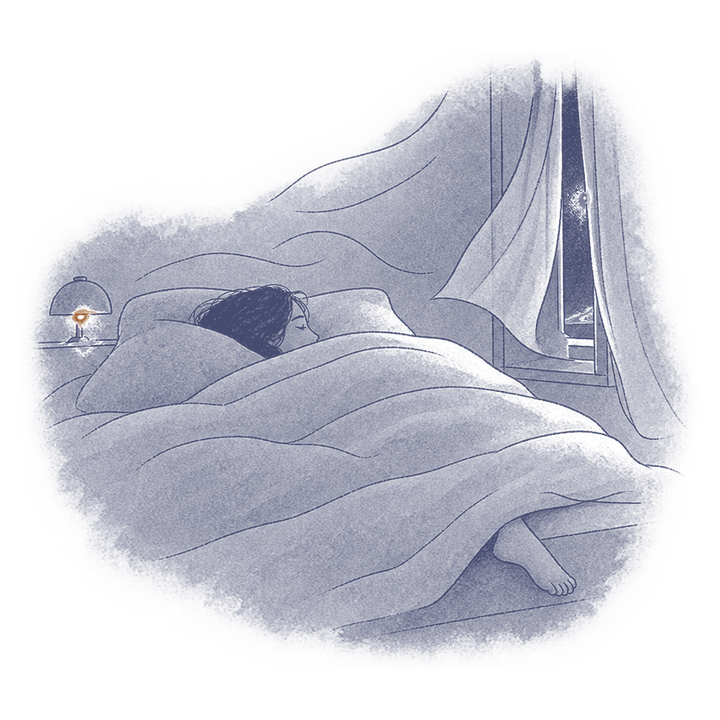
Some nights the trouble seems to be the room itself. You're awake in the small hours and too warm, with the covers half off, and a light you hardly noticed by day catches the edge of your eye. It's easy to lie there sure that something about the place is keeping you up.
Sleep is something your body already knows how to do, and the room's whole job is to stop interrupting it. As night comes on, your core temperature starts to fall, and sleep comes most easily while it's falling1. To help it along, the body opens up the blood flow to the skin of your hands and feet and lets heat go there1, out into the air under the covers. If you're lying awake and too warm right now, that's the part you can help with before reading on.
Why does a cool room matter so much?
The warmth leaving through your hands and feet is the body bringing its core temperature down, so falling asleep is partly a matter of cooling. When researchers warmed people's feet to open those vessels further, they fell asleep faster1. If your feet are cold in bed, that cooling has a harder time getting going, and socks or a hot-water bottle may help on the same idea: warming the feet until their vessels open and the heat can leave.
What your skin feels through the night is mostly the small pocket of air between you and the covers. In people sleeping normally, that pocket stays warm and fairly steady1 more or less whatever the room is doing, as the figure below shows. It's the covers that set what your skin feels, so the duvet, the sheets and what you wear count for as much as the thermostat.
In lab studies where people slept under ordinary covers, too warm a night disturbed sleep more than a cool one, and the trouble came mostly in the early hours. Those are the hours of a hot night when you lie restless, awake more than you'd like, with less1 deep sleep and REM sleep than a cooler night would bring. In one of the studies the sleepers still hadn't adapted after five days1 of heat. A cool room is the easier of the two to live with, since you can pull up a layer when you need one.
Both rows are drawn on one scale in degrees Fahrenheit. The long line is the span of bedroom temperatures across which small lab studies with ordinary bedding and nightwear found sleep barely changed1; the short one is the air next to the skin under the covers in people sleeping normally, from earlier Japanese bed-climate studies1. The two come from different studies, so read them for their shape: the covers, more than the thermostat, set what your skin feels.
Worked out from the figures in the studies cited
See this as a table
| Who or what | Range | Note |
|---|---|---|
| The bedroom | 55 to 73 degrees Fahrenheit | Sleep barely changed, with bedding (13 to 23°C) |
| The air under the covers | 90 to 93 degrees Fahrenheit | During normal sleep (32 to 34°C) |
It’s often said
There's one ideal temperature a bedroom needs to be
Why it can feel that way
If you've noticed you sleep better when the room's cooler, a single number looks like the obvious next step: something to set the thermostat to and stop thinking about.
What’s going on underneath
Small lab studies found that with ordinary bedding and nightwear, sleep barely changed in rooms anywhere from 55°F to 73°F (13°C to 23°C)1, because the covers keep that pocket of air steady. So the best room for you depends on your bedding, your nightwear and your own body. If the duvet gets too hot or too cold, it's usually easier to change than the room. The one number worth keeping is a floor for winter: the same researchers suggest keeping the bedroom above 50°F (10°C)1, since a cold room can still affect the heart during sleep.
What if it's hot and there's no air conditioning?
In a heatwave without air conditioning, being told to keep the room cool can sound almost like a taunt. The walls give off the day's warmth long after dark and the sheet clings to your back. Humid heat is the hardest kind. When sweat can't evaporate, the body can't shed its heat1, and people lie awake longer.
One survey of US adults gathered 765,000 responses and matched them to local nighttime temperatures. Each 1.8°F (1°C) of unusually warm night meant about three extra nights of poor sleep a month for every hundred people4. That was sleep as people reported it, and the effect was strongest in summer, in people over 65 and in people on lower incomes4. The researchers wondered whether air conditioning, and who can afford it, explains the income gap. That was their guess, and they didn't measure it.
So what about a fan? Reviewers went looking for trials of fans in heatwaves and found none. None of the research they read looked at sleep5, either. The case for a fan rests on what it does at your skin: it moves air across it and helps the sweat dry, so the heat has somewhere to go. A single sheet can stand in for the duvet. If you have cooling of any kind but can only run it for part of the night, the researchers suggest the first few hours of sleep1 are when it matters most. If you wake later damp with sweat, drying off and changing into dry clothes1 can keep you from waking chilled before dawn, so it helps to leave something dry within reach.
Older people's sleep seems to be more sensitive to heat. In small studies of older men, even mild warmth added time awake1, and in one it also doubled how much they sweated overnight1, so a glass of water by the bed is worth having on hot nights.
None of this applies to babies, whose rooms and bedding follow their own safety guidance, which you'll find in how to keep a newborn safe.
How dark does the room need to be?
The light you notice at night is often small: a streetlight in the gap between the curtains, or the red glow of a standby light across the room. Most of the ways to shut it out cost very little. An eye mask does the job, and so does something pinned over the gap or a scrap of tape over the light. Blackout blinds do the same for the whole window.
What you're after is a room dark enough that light doesn't wake you or keep you stirring. In a study of older adults in their sixties to eighties, those whose wrist sensors picked up any light in the darkest hours of the night spent more time awake after first falling asleep2. It's a link, and it doesn't show that the light was the cause.
If you're curious about light's wider effects on the body and its clock, how light affects sleep goes further into it.
Why does a door slam wake me when the traffic doesn't?
All night the sleeping brain keeps half an ear open. What wakes us is less the overall level of sound than the number of separate noises3: a door, a motorbike, a voice on the stairs. In sleep-lab recordings, each ten-decibel rise in the peak sound of a passing plane, car or train raised the odds of waking by about a third3, whichever it was.
We do get used to a street, but how far does that go? Years on, the sleeping brain still reacts to the noise, and the heart and nervous system get used to it even less3 than the brain does. So the person who says they no longer hear the trucks may be right about waking and still be stirred by them.
If it's the street or the house that wakes you, earplugs are the most direct answer. In one small trial, researchers had healthy volunteers spend a night in a sleep lab with recorded intensive-care noise and light playing. Those given earplugs and an eye mask woke less often and fell asleep faster6. When others looked at real patients in intensive care, most of the studies that measured sleep directly found no benefit7. None of the research read here tested them in an ordinary bedroom at home, but earplugs cost little and the reasoning behind them is plain, so they're worth a few nights' try anyway.
White noise rests on the idea of masking those changes under a steady sound. Some people find a fan's hum or a rain recording helps them drop off. The studies point both ways: in some, steady noise helped sleep, and in others it disturbed it8. There's also an open question about its effects on hearing. If a sound helps you, there's no reason to give it up, though it's worth keeping the volume modest.
Which things sold for the bedroom are worth it?
A fair question to ask of any of them is what it stops interrupting, and the cheap things answer it most clearly. Earplugs stop the changing sounds that rouse you, a mask or blackout blinds stop the light, and a fan helps heat leave your skin. Each costs little and has plain reasoning behind it.
If a cooling mattress is in your basket, it has a real answer too, and the size of it is useful to know. When people slept on a heat-absorbing mattress in a sleep lab, they gained about seven and a half minutes of deep sleep over a seven-and-a-half-hour night9. People responded very differently, so the average may tell you little about your own nights. One of the researchers works for a mattress maker, too.
For mattresses in general, the answer comes down to comfort. Reviews favor medium-firm1011, but the studies disagree, and each judges firmness its own way. The best guide is what feels comfortable to you over a few weeks. A scent or a pillow spray is harder to place. Some studies found people slept better with scents, but the gains showed mostly in the weaker studies and in aroma massage12, which tells you little about a spray on the pillow by itself.
What the research says
- In lab studies with covers, heat disturbs sleep more than cold, adding time awake and cutting deep and REM sleep. Good evidence
- The number and character of separate noises predict disturbed sleep better than the average level, and people don't fully get used to them. Good evidence
- Earplugs and eye masks reduced awakenings in a small lab trial; in intensive care the evidence is low. Early evidence
- A heat-absorbing mattress added about seven and a half minutes of deep sleep a night in one lab study of seventy-two people. Early evidence
- Reviews favor medium-firm mattresses, but studies disagree and it isn't clear that any one type is best. Still debated
- Whether white noise helps is unclear: some studies found it helped sleep and others that it disturbed it. Still debated
- Studies of aromatherapy disagree, and the benefit shows mostly in weaker designs and in massage. Still debated
- No trials have tested fans for health in heatwaves, and the case for one in bed rests on how sweat evaporates. Not well studied yet
Almost all of this comes from labs, hospitals and survey data, and very little from ordinary bedrooms, so your own nights over a few weeks are a good guide alongside it.
What if we share a bed and want different things?
Then you're two bodies with two sets of needs under one blanket, and often one of you runs hot while the other's cold. The studies found two things that are both true to life. In the few studies that measured it, people moved more and slept somewhat differently13 with a partner in the bed. Yet most said they slept better together, and women in one study said a partner made them feel more secure13.
A small first step is two duvets on the one bed, each of a weight that suits the person under it. The one who runs hot can sleep under something thin while the other stays wrapped up. Sometimes what one of you brings to the bed is snoring. For the one lying awake beside it, that's a sound that keeps changing, so it seems fair to expect it to disturb sleep the way separate noises tend to3. Earplugs or a steady sound, as in the part on noise, are an untested but cheap thing to try. Where a couple's sleep problems are getting in each other's way, researchers suggest that splitting the bed or using a second room may help them cope13, and that sleeping apart needn't strain the relationship. Nobody has put that to a direct test, so it stays a choice for the two of you, made around how each of you sleeps.
What if I sleep by day, or can't change the room?
If you sleep after a night shift, you're sleeping against daylight, deliveries and the school run. On top of the body clock, noise and the obligations of daytime life interrupt that sleep14. In a small study of thirty permanent night workers, the body clocks of those who slept in a darker bedroom by day adjusted further to nights14. It's an association, but it makes darkening the room a sensible, low-cost place to start. You could try foil on the glass, a heavy curtain pinned over the existing one, an eye mask and earplugs against the street, and none of them means changing the window. None of these has been studied in day sleepers themselves. Timing your sleep and light around shifts has its own page, how to sleep well on night shifts.
If you rent on a busy road, share a room or live in a small flat that stays hot from the day, the things that travel with you do the most good: earplugs and an eye mask, a lighter layer on the bed, a window opened for the first hours of sleep, and dry clothes within reach for a sweaty waking. An open window lets the street in along with the cool, and earplugs are how you can have both. A fan's hum is a steady sound too, the kind some people find helps them sleep, as in the part on noise.
What if I sleep badly in any room?
If the poor nights follow you from room to room, the room probably isn't the cause, and a better one is unlikely to set it right. For insomnia that has gone on for months, the sleep doctors' guideline advises against counting on a better room and good habits, what's often called sleep hygiene, as the treatment on their own15. What it firmly recommends is CBT for insomnia. One part of that, stimulus control, keeps the bed for sleep alone, so that over time lying down comes to mean sleep again. Do I have insomnia? and what CBT for insomnia would ask of you take that further.
A room can't fix loud snoring with pauses in breathing or gasping in the night, or sleepiness in the day despite enough time in bed. These are the signs a doctor looks at16 for sleep apnea. If you or someone beside you notices them, they're worth taking to a doctor. If you're the one lying awake beside the snoring, whether to worry about a partner's snoring looks at it from your side of the bed.
For everyone else, the list is short and mostly cheap: a layer you can throw off, a window or a fan, something to make the room dark, and earplugs if the street or the house keeps waking you. It helps to make the changes before bed and then let the room be for the night. You may remember sleeping best in a borrowed bed, a hotel room on holiday or a friend's sofa after a long day. In each of them you felt safe, and nothing needed seeing to.
I will both lay me down in peace, and sleep: for thou, LORD, only makest me dwell in safety.
A closer look How does heat leave the body as I fall asleep?
Your core temperature follows a daily curve, falling through the night and rising through the day1, and sleep comes most easily on the way down. To bring it down, the body widens the blood vessels in the skin of the hands and feet. Warm blood from the core runs out to the edges and gives up its heat there.
Under the covers, that heat doesn't pass straight into the room. It warms the pocket of air between your skin and the bedding. The covers keep that pocket steady, a small climate of its own, so a cold room and a mild one can feel much the same when you're well tucked in. Humidity is what upsets the arrangement. Some of the heat leaves as sweat dries, and in damp air sweat can't evaporate, so the body can't shed its heat1. Most of these studies were small and in young, healthy adults, so they describe how the system works more than they set a rule for any one bedroom.