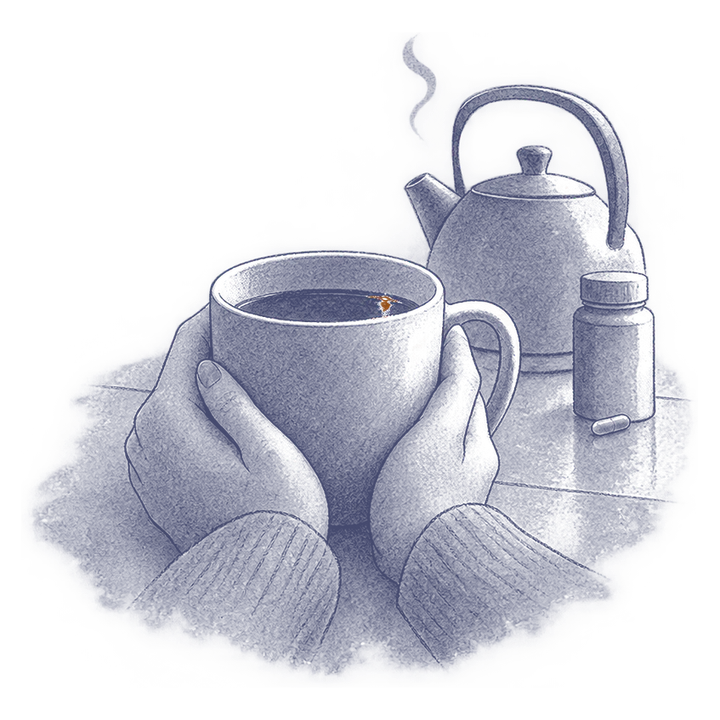

By the time you're reading about valerian or chamomile, you've probably tried the obvious things already: less coffee, the phone put away earlier, a bath before bed. Perhaps you bought a bottle of valerian or a magnesium powder, and the first few nights went better before the lift seemed to fade. Perhaps it's the chamomile you make every evening, and you've started to wonder whether it's doing anything. Either way, you'd like to know whether what you reach for is helping, and whether it's safe alongside whatever else you take.
In one trial, adults who signed up online with anxiety or insomnia took valerian at bedtime or a dummy pill for twenty-eight days. At the end, 89 percent of those on valerian said their sleep had improved, and so had 86 percent of those on the dummy pill5. Other valerian trials found wider gaps, so this one trial can't speak for the herb in general. When researchers gathered trials of prescription sleeping pills, they found the same pattern there too, with much of the improvement on the drug coming on the dummy pill as well2.
Those better nights are real, and they showed on overnight sleep recordings2 as well as in how people felt. People with insomnia who took a dummy pill they believed in said they slept better than people given nothing at all6, so it isn't only time passing. Part of it is a bad patch mending, as bad patches tend to. Much of the rest seems to come from the people themselves, from expecting to sleep better, the small act of taking something and the attention of being in a study2. That part is yours to keep, with or without a capsule in your hand. So the question to ask of any remedy is how much it adds on top.
Each bar is the whole improvement a trial found on the remedy. The shaded part is how much of it the group given a dummy pill reported too, and the firm end is what the remedy added on top. Each trial used its own measure, so read the proportions rather than the lengths. The trials were in adults recruited online with anxiety or insomnia5, adults with insomnia in Norway7, and adults in Germany whose anxiety came with restlessness and poor sleep, in a trial funded by the capsule's maker8.
From the studies’ own measurements
See this as a table
| Trial | What was measured | On the dummy pill | On the remedy |
|---|---|---|---|
| Valerian, 600 mg at bedtime | Said their sleep had improved, after 28 days | 86% | 89% |
| Valerian, 3,600 mg nightly | Met the study’s mark for better sleep, after two weeks | 21.2% | 28.7% |
| Lavender oil capsule, 80 mg a day | Fall in anxiety score, over ten weeks | 9.3 points | 12 points |
A closer look How large is the dummy-pill effect in sleep trials?
When researchers gathered the placebo groups from thirty-two trials of prescription sleeping pills, 3,969 adults in all, they found that about two-thirds of the improvement seen on the drug also appeared on the dummy pill2. It showed on overnight recordings as well as in people's own ratings of their nights. Those trials tested sleeping pills, so they can't say what a cup of tea or a capsule does on its own, but they do show where a good part of a better night comes from.
A second review asked whether a dummy pill does more than time alone. It compared people with insomnia who took a placebo they believed was real with people given nothing, and those on the placebo reported falling asleep faster, sleeping longer and sleeping better6. The time it took them to fall asleep, measured by instruments, stayed the same, so the clearest gain was in how well they felt they had slept.
Does valerian work?
If you're awake now with the bottle beside you, wondering about another capsule, it's unlikely to add much to what the first one did. Valerian may make you drowsy, though that isn't proven3, so please keep it away from alcohol, a sleeping pill or any other sedative tonight.
The clearest reason to think more won't help comes from a large trial in Norway. There, 405 adults with insomnia took valerian or a dummy pill every night for two weeks, and the dose was 3,600 milligrams, far larger than the usual one. By the end, 28.7 percent on valerian and 21.2 percent on the dummy pill7 had met the study's mark for better sleep, a gap too small to be sure it wasn't chance.
That trial and one other led the American Academy of Sleep Medicine to suggest that doctors not use valerian7 for trouble falling or staying asleep. Three other reviews went back over the trials and found no evidence that it treats insomnia91011, at most a possible lift in how people rate their sleep.
Not everyone reads the trials the same way. An earlier team pooled six trials and found people on valerian 80 percent more likely to report better sleep5. Then they doubted their own number. They spotted signs that small negative studies had gone unpublished5, and the trials that recorded sleep in a laboratory showed no consistent change. A later team, more hopeful about the herb, blames extracts of uneven quality12 and thinks the whole dried root might work more reliably. They offer that as a hypothesis, still to be tested12.
So what to make of it? On one side are a guideline and three reviews. On the other are a pooled figure its own authors doubted and an idea that's still a hypothesis. On that balance, valerian as it's sold now probably adds little to your sleep, though the argument isn't over.
For most adults, a few weeks of valerian is within what's been tested. People have taken 300 to 600 milligrams a day for up to six weeks3 without apparent harm, and in trials it left them no groggier the next morning than the dummy pill did5. Nobody knows yet how it fares over years, so months of nightly capsules go past the testing. Some people get headache, an upset stomach, mental dullness, excitability or vivid dreams3.
If you've taken it nightly for a long time, stopping suddenly can bring some people anxiety, irritability, heart disturbances and sleeplessness3, so easing off gradually may suit you better than stopping at once. Liver injury has been reported only very rarely, most often when valerian was taken alongside other herbs3.
Is my cup of chamomile doing anything?
Chamomile has been tested far less than its place in so many evenings would suggest. Only one placebo-controlled trial has looked at people with long-term insomnia. Thirty-four adults who had slept poorly for at least six months took chamomile capsules or a dummy pill for twenty-eight days, and their sleep diaries showed no clear difference113. It was a small pilot, too small to rule out a modest effect, and it tested capsules rather than tea. In a wider mix of studies, mostly in people without insomnia, chamomile was linked with somewhat better self-rated sleep1415. The results varied widely from one study to the next, and it didn't lengthen sleep.
What the tea gives you may come mostly from the few warm minutes themselves, a cup held in both hands while the day winds down. The studies so far don't separate the cup from the herb1415, but the dummy-pill research26 suggests minutes like those can do a good share of the work.
If the chamomile shares a cupboard with other medicines, a few things matter. In the amounts you'd drink as tea, it's likely safe1. Allergic reactions are uncommon, though some can be serious, and you're more likely to have one if you're allergic to ragweed, chrysanthemums, marigolds or daisies1. Researchers suspect it may add to the effect of sedatives1, though nobody has shown it does. It might also make birth control pills less effective1.
If you take warfarin or another blood thinner, please tell whoever prescribes it before making chamomile a nightly habit. Chamomile tea has been linked with a higher risk of bleeding14 alongside warfarin, mostly in case reports.
And the night shall be filled with music, And the cares, that infest the day, Shall fold their tents, like the Arabs, And as silently steal away.
Does lavender help, as a capsule or as a scent?
You may have met lavender as a spray for the pillow, or as a capsule on the pharmacy shelf. Researchers have studied the two separately, and what they found for one doesn't tell you about the other. As a scent, it's unclear whether it improves sleep1617. One review of thirty-four studies of breathing in essential oils, lavender most of all, found that sleep improved. The reviewers rated those studies at high risk of bias, though, including in whether people could tell what they were smelling. That makes it hard to tell the oil from the expectation. If you like the smell on your pillow, the US government's complementary-medicine center rates it possibly safe, listing headache and coughing as side effects16.
The evidence for the capsule comes from one lavender oil, Silexan, taken at 80 milligrams a day. German researchers gave it to adults whose anxiety came with restlessness and poor sleep, and it eased their symptoms more than a dummy pill over ten weeks8, though the dummy pill helped a good deal too. When researchers looked at how it improved sleep, almost all of what it added ran through eased anxiety18 rather than sedation. So it may help mainly when worry is what keeps you awake.
Its maker paid for both trials. And a capsule labeled lavender on the shelf may not be the same preparation. Taken by mouth, lavender can cause diarrhea, headache, nausea or burping16, though in its trial side effects came about as often on the dummy pill8. Lavender might add to the effect of sedative drugs or herbs16. That's unproven, but please keep it away from alcohol and sleeping pills all the same.
What about magnesium?
If you've been stirring a magnesium powder into a drink at night, you've probably met the names on the tub: glycinate, threonate, citrate and the rest. None of the trials so far tested glycinate, threonate or the other forms common on shelves19, so no one can yet say whether one works better than another. The few trials there are gave plain tablets to older adults, and those taking magnesium fell asleep about seventeen minutes sooner19 than those on a dummy pill, without sleeping longer overall. The trials were small and the certainty is low. One of them left out people who already got plenty of magnesium, so any benefit may belong mostly to people who run low, and it says nothing about younger adults.
UK health advice says 400 milligrams a day or less from supplements is unlikely to cause harm20, with diarrhea more likely above that.
Magnesium rarely builds up to dangerous levels in the blood, and when it does, it's mostly in people whose kidneys have failed21. So if you have kidney disease, please check with a pharmacist or doctor before taking it. It's worth mentioning any other medicines you take as well, since supplements in general can interact with them22.
A closer look Who was in the magnesium trials, and how much did they take?
A review found only three small trials, 151 people in all19, aged roughly 51 to 80. The seventeen minutes comes from pooling only two of them, and the reviewers rated the trials at moderate to high risk of bias, with certainty low to very low.
The trials used magnesium oxide or citrate tablets giving 320 to 729 milligrams a day19 of magnesium itself, split into two or three doses. Two of them gave more than the UK's 400-milligram line for supplements, and in the highest-dose trial everyone had soft stools.
Is what's in the bottle what was studied?
It’s often said
If it's natural, it can't do much harm.
Why it can feel that way
A root or a flower steeped in hot water feels closer to food than to a pill. Sleeping pills come with stories of people who couldn't stop taking them, and this seems a different thing altogether.
What’s going on underneath
If you've opened a bottle of valerian, you'll know the smell, something like old socks. It comes from compounds in the root breaking down. In one comparison, a tincture kept two months at room temperature held less than five percent of them12. The valerenic acids that makers use to standardize products hadn't changed12. Whether the lost compounds matter for sleep isn't known, but it means a standardized label can miss what changes inside the bottle.
The label can tell you less than you might expect. In the US, herbs and magnesium count as dietary supplements. The FDA doesn't approve them before they go on sale23, so nobody there checked your bottle before it reached the shelf. The maker answers for what's inside, and the agency mostly steps in after problems appear. A label has to give the amount of each ingredient, except those inside a proprietary blend23. That's how a sleep blend can list five herbs without saying how much of each it holds. And since no law limits how much of an ingredient a serving can contain23, each name could stand for a lot or a little. Those are the US rules; other countries treat some herbal products differently.
Then there's the dose. The trials that earlier team reviewed gave people 225 to 1,215 milligrams of valerian a day5. When researchers checked thirteen common US products, the labels recommended anywhere from 75 to 3,0005. That survey is old, and today's shelves may differ. Still, the dose on the bottle you're holding may be far from what those trials tested.
Hidden drugs are a separate question. Between 2007 and 2016 the FDA found 776 supplements with undeclared drug ingredients24. That counts only the products it caught, and most were sold for sex, weight loss or muscle building. Nothing so far shows hidden drugs are common in sleep herbs. A trial of one extract tells you about that extract, and the bottle in your hand may hold something rather different.
What the research says
- In sleep trials, people on a dummy pill improve a lot too, on sleep recordings as well as in how they feel. Good evidence
- A sleep guideline suggests doctors not use valerian for insomnia, as trials found little or no benefit, and newer reviews agree. Well established
- Valerian seems safe for most adults over a few weeks; long-term safety is unknown. Good evidence
- Chamomile showed no clear benefit in the one small trial in long-term insomnia, and may slightly improve self-rated sleep in people without it. Early evidence
- Chamomile is likely safe in tea amounts; its link with bleeding on warfarin comes mostly from case reports. Good evidence
- Lavender scent may help sleep in early studies, but they were rated at high risk of bias, so whether it does is still unclear. Early evidence
- In small trials funded by its maker, one lavender oil capsule eased anxiety with poor sleep, seemingly through the anxiety. Early evidence
- Magnesium may help older adults fall asleep a little sooner; nothing shows it helps everyone. Early evidence
- US supplements aren't approved before sale, and blends needn't say how much of each herb they hold. Well established
Most of these trials were small and short, and many tested a single extract, so they say little about whatever product happens to be on the shelf. Researchers still disagree about whether better-made valerian extracts, or the whole root, would do more.
What if my nights have been poor for months?
-
If it's been a few weeks of poor nights
A run of bad nights often eases as its cause does, and a cup of tea at the same point each evening is a sound way to look after them in the meantime. If you'd like to try a remedy as well, what matters most is what it mustn't be mixed with. There's more on the hour before bed in how to wind down when you're tired but wired.
-
If it's been going on for months
When poor nights have gone on for months, the American College of Physicians strongly recommends CBT for insomnia25, or CBT-I, as the first treatment for all adults. You could raise it with a pharmacist or doctor, and there's more on what CBT for insomnia would ask of you.
So what's worth keeping?
If you came here with a bottle in your hand, much of what made your better nights was already yours. You expected rest, and you set the evening aside for it. A capsule adds little to that, so what matters most about it is what it might meet among the other things you take. The same goes for a pillow spray or a scoop of magnesium powder.
You could try a remedy for a few weeks, keeping it away from alcohol, sleeping pills and the medicines above. You could leave the bottle on the shelf. Or, if your nights have been poor for months, you could put the money towards CBT for insomnia. Whichever you choose, the kettle will still cool on the counter. The evening you set aside for rest was doing its share all along.