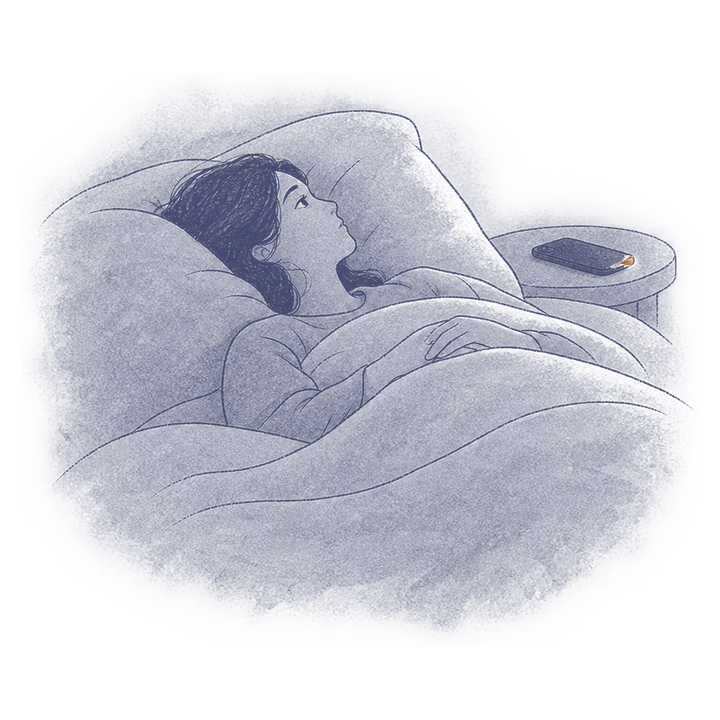
It’s been a while since you turned the light out, long enough that it no longer feels like a few minutes. You’ve tried your back and both sides, and pulled the covers up and pushed them off again. Somewhere along the way the sum began, the hours left before morning counted and then counted again, a little smaller each time. Once or twice you’ve felt yourself going, loose and heavy, and then come back up as if someone had said your name. It matters because tomorrow is waiting on the other side of tonight, and you’d like to meet it rested.
Is something wrong with me?
Most likely nothing is, because how long sleep takes to come differs a great deal from one person to the next, and from one night to the next for the same person. When older adults kept sleep diaries at home for two weeks, the wait swung widely from night to night, even in those without insomnia3. A slow night like this one is well within that range.
If this is the third or fourth night and you’ve begun to dread the next, it may help to know how runs like this tend to go. Researchers followed 1,248 good sleepers in the US, all aged 35 and over, through a year of daily sleep diaries. Twenty-seven in a hundred had a spell of short-term insomnia along the way. Most of those spells passed, and of everyone followed, fewer than two in a hundred went on to long-term insomnia4.
Wanting it badly doesn’t help, because no amount of wanting can switch sleep on12. Sleep researchers think that turning your attention on it and trying to steer it directly can keep it away, and can make a bad patch worse and help it linger12. One way to picture it is that sleep comes when the brain stops standing guard. Lying here willing it, waiting for the moment and checking how it’s going are all ways of standing guard. That may be why the nights you want it most can be the ones it keeps its distance. It may be what happened when you came back up earlier: you were drifting, almost there, until the small thought that you were nearly asleep became the very thing that brought you back.
Why does trying harder keep me awake?
Lying here, you may be working hard without moving at all. You’re willing sleep to come and listening to the house tick and creak around you. Trying feels like the right thing to do, since it’s how most things in a day get done.
In 1996 a group of researchers set out to see what trying does to sleep. They asked good sleepers to lie down and fall asleep while music played, some as fast as they could and some whenever they happened to. For some of them the music was a run of rousing John Philip Sousa marches, and for others it was relaxing. With the marches playing, the people trying hardest took longer to drop off, and when the music was relaxing, trying worked slightly in their favor7. So effort seems to backfire most when the mind is already busy. If tomorrow’s list is still running in your head tonight, it may be doing what the marches did in the lab.
One leading model of how sleeplessness keeps going, written about people with insomnia, describes what that effort turns into in the dark. Worry about sleep sets off arousal, and with it a watchful scanning of the body and the room for signs that sleep isn’t coming8. That watching makes the problem seem bigger, and can end up making sleep worse8.
The clock is where the watching is easiest to see. In two experiments at home, good and poor sleepers asked to watch a clock while trying to sleep worried more and took longer to fall asleep5, and people with insomnia also overestimated how long they’d lain awake5. The only thing that differed between the groups was whether they watched the clock. So knowing the time, and the sum of hours it starts, look like the part that does the harm, and that’s reason enough to try turning the clock round. Each experiment lasted a single night, so they can’t tell us what turning the clock away does over weeks.
A flock of sheep that leisurely pass by, One after one; the sound of rain, and bees Murmuring; the fall of rivers, winds and seas, Smooth fields, white sheets of water, and pure sky; I’ve thought of all by turns; and still I lie Sleepless;
A closer look What does it look like when the brain keeps watch?
On a first night in an unfamiliar sleep lab, healthy young adults slept less deeply in one half of the brain, which reacted more to odd sounds, and the bigger that imbalance, the longer they took to fall asleep9. That study was about a strange room, and nobody in it was trying any harder, so it’s only an analogy. Still, it shows what a brain that hasn’t quite stood down can look like.
The second clock experiment had a careful comparison. Thirty-eight people with insomnia watched either a real clock or a display that looked like a digital clock but showed random digits, so everyone had their eyes open and something to look at510. Only the real clock made people overestimate how long they’d lain awake, and those watching it woke more often in the first hour after dropping off10.
Have I really been awake all this time?
You may well have been awake for much of it, and nobody can tell you otherwise from outside. Still, the edge of sleep is harder to judge than it seems, for everyone. Sleep doesn’t arrive all at once. It begins in relaxed drowsiness and slides down through the lightest sleep, often into the first minutes of the stage below it11. So in your own first hour there may have been no click to notice, only a gradual slope down.
In a small lab study from 1982, twelve young adults were woken soon after the first sign of sleep showed on their brain recordings. Their hearing had already dulled within a minute, yet they only said they’d been asleep half the time once they were two to four minutes past that first sign12. The first few minutes of light sleep can feel much like lying awake.
Think back over your own last hour. If you did drop off for a while, you’d have nothing to show for it, since the moment you fall asleep is the point where memory stops, and the minutes just before it are hazy10. All of it happened in the dark, with nothing to tell the time by10. So why would a worried wait feel longer than a calm one? Harvey and Tang, the researchers who drew this work together in a review, offer an explanation: time feels longer the more the mind is doing in it, so worrying while you wait may stretch the wait as you feel it10. On their account, an hour filled with sums and listening would feel longer than an empty one.
For people whose trouble has gone on a long while, the gap between felt and measured can grow wide. Many people with insomnia overestimate how long they take to fall asleep compared with recordings, though not all of them, and their trouble sleeping is still real10. The edge of sleep is hard to see from the inside. That’s one more reason to stop keeping watch for it.
Counted in minutes from the first sign of sleep on the brain recording, in twelve healthy young adults in a sleep lab. In the gap between the two bars, the body has already begun to stand down while most people woken then would still say they were awake, so falling asleep is a blurred stretch of a few minutes12.
From the studies’ own measurements
See this as a table
| What | From | To |
|---|---|---|
| Hearing already dulled | 0 minutes | 1 minute |
| Half the time, they said they’d slept | 2 minutes | 4 minutes |
| At | What |
|---|---|
| 0 minutes | First sign of sleep |
A closer look How do researchers know when someone has fallen asleep?
In a sleep lab, researchers watch the brain’s rhythm on a recording called the EEG, and they mark the first sign of sleep where that rhythm changes. In the 1982 study, twelve young adults spent five nights in the lab and were woken five times a night, anywhere from one to 140 minutes into sleep12. Each time they were asked whether they’d been asleep, and their answers, gathered night after night, show how much the first minutes of light sleep can feel like lying awake.
People with insomnia are even more likely to answer “awake”. In a small study of fourteen people with insomnia and eight good sleepers, mean age 58, those with insomnia, woken five minutes into light sleep, were more likely to say they’d been awake, and the more they did this in the lab, the more they underestimated their sleep at home13. This isn’t a general trouble with time, since people with insomnia judge time as well as anyone else10.
The widest gap comes from an older lab comparison of fifty-six people with insomnia and ten good sleepers10. Those with insomnia overestimated how long they took to fall asleep by about twenty-nine minutes on average, while the good sleepers were accurate to within a minute10. The gap shrank when sleep was counted from the first fifteen minutes of steady sleep10, so part of what looks like misjudging is a question of where exactly sleep is said to begin.
What if it keeps happening, night after night?
A run of nights like this is harder than any one of them. By the third or fourth, it’s easy to start dreading bedtime before the evening is out, and to wonder whether this is simply how your nights are now. What fits depends on how long it has been going on.
-
If it’s an odd night, or a few
A long wait on some nights is part of how sleep goes, and it doesn’t call for a new list of bedtime rules. If the morning is on your mind, How do I get through the day after a bad night? is there for it. Tonight you could turn the clock away and rest. If the night stays hard all the same, getting up for a while is the other choice, and neither way counts as getting it wrong.
-
If it’s been most nights for weeks or months
Doctors call it insomnia when trouble getting to sleep comes with effects on your days, even though you have the time and a fit place to sleep1415. It counts as short-term at first, and as chronic once it has happened at least three times a week for at least three months1415. Do I have insomnia? goes through it slowly.
For long-term insomnia, sleep specialists strongly recommend cognitive behavioral therapy for insomnia, and advise against sleep hygiene on its own16. So if lists of bedtime rules haven’t helped, that isn’t a failing of yours. What is CBT for insomnia, and what would it ask of me? sets out what CBT-I involves, and how it differs from sleep hygiene.
A closer look What is paradoxical intention, and does it work?
Paradoxical intention turns the night’s goal around: you give up the goal of sleeping and aim to stay awake instead17. Across ten trials in people with insomnia, it brought large improvements against no treatment and moderate ones against other treatments, though the trials were weak enough that the reviewers called for better studies17.
One small trial gives a fair picture of what it can and can’t do. Thirty-four people who struggled to fall asleep kept diaries for a week and then spent two weeks with or without paradoxical intention, wearing a wrist monitor throughout18. Those using it felt less effort and less worry about sleep, and their diaries showed a trend toward falling asleep sooner, though the monitor showed no clear difference18.
A wider review of mental strategies for falling asleep, from imagery and hypnosis to paradoxical intention and distraction, found effects that were beneficial, negligible or even harmful, depending on the study19, so it’s one option to try and see how it goes for you. In one experimental night, people with insomnia who filled their minds with an engaging imagined scene fell asleep sooner than those given no instructions, while a general instruction to distract themselves didn’t help20, and How do I stop my mind racing at night? goes into that further.
What the research says
- Sleep happens by itself and can’t be willed; trying to control it directly is thought to keep sleeplessness going. Good evidence
- In one older experiment with good sleepers, trying to fall asleep fast took longer while rousing music played, and helped slightly with relaxing music. Early evidence
- In small single-night experiments, watching a clock while trying to sleep led to more worry and a longer time to fall asleep. Early evidence
- Falling asleep happens gradually, from relaxed drowsiness into light sleep. Good evidence
- In a small, old lab study, the first minutes of light sleep often felt like being awake. Early evidence
- Many people with insomnia overestimate how long they take to fall asleep, and their trouble sleeping is still real. Good evidence
- In a year-long diary study of good sleepers aged 35 and over, most spells of bad nights passed, and very few of the people followed went on to long-term insomnia. Good evidence
- Paradoxical intention lowered effort and worry about sleep in small trials, with mixed evidence on measured time to fall asleep. Early evidence
- CBT for insomnia is the recommended treatment for long-term insomnia, and sleep hygiene on its own isn’t. Well established
Most of the studies on effort and the clock are small experiments over single nights, and the large gaps between felt and measured sleep come from people with insomnia. How long falling asleep takes varies too much between people and nights for one number to fit everyone.
What about the rest of tonight?
The clock can face the wall. You can lie here and rest, or get up for a while if the bed starts to chafe. When sleep comes, it will come as it does for everyone, down a gradual slope11 that you won’t feel yourself start down, with no single moment on it to catch.